
Dinosaurs
Tyrannosaurus
Tyrannosaurus Rex
Classification and scientific name: Tyrannosaurus rex
Sources checked:
Reading Tyrannosaurus’s huge jaws and bipedal movement from fossils
Tyrannosaurus rex was a tyrannosaurid theropod living in North America near the end of the Late Cretaceous. Known through bones and teeth from Canada and the United States, it lived at a different time from Jurassic Allosaurus.
Origins and distribution
Late Cretaceous, North America
- Tyrannosaurus rex
- An extinct animal studied through fossils
- Distinguish reconstruction from evidence
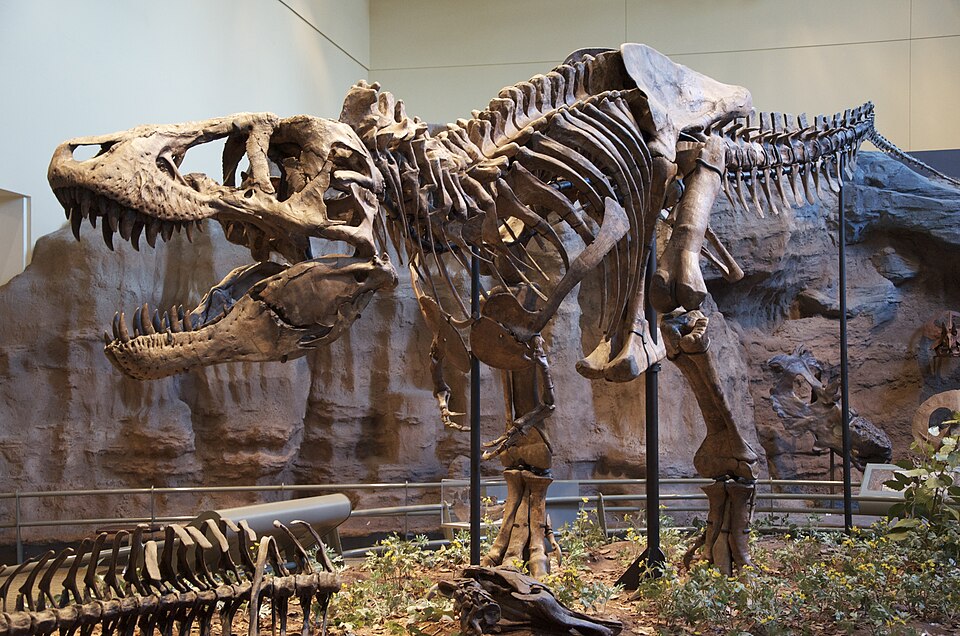
Fossil or skeletal specimen
Tyrannosaurus fossil and skeletal exhibition material. The exhibit may include replicas or reconstructed parts; this is not a photograph of a living animal.
Source: ScottRobertAnselmo · Original material · CC BY-SA 3.0
1. Classification, discovery and geological context
Tyrannosaurus rex was a tyrannosaurid theropod living in North America near the end of the Late Cretaceous. Known through bones and teeth from Canada and the United States, it lived at a different time from Jurassic Allosaurus. Skeletons discovered by Barnum Brown of the American Museum of Natural History played an important role in establishing its name and reconstructing the body. North America’s coastlines then differed from today’s, so modern place names identify discovery locations.
2. Appearance and identification
A large head, deep sturdy jaws, thick teeth, weight-bearing hind legs and a long tail are major features. The forelimbs are small relative to the body, with two principal fingers on each hand. In mounted skeletons, observe how the tail extends behind to balance the body. Size varies with growth stage and specimen; reconstructed muscle and body mass are not directly measured values. Although skin impressions are known, color over the whole body and covering on every region have not been established.
3. Evidence for ecological interpretations
Bones bearing tooth marks and fossilized dung provide evidence that it ate other animals. Such material is used to study both hunting and scavenging; do not insist that food was always obtained in only one way. Bite marks on bones of the same species indicate contact between individuals but do not directly record its reasons. Smell and vision are studied through internal skull structures and comparisons with living animals. Movie scenes of coordinated pack pursuit must be distinguished from observed facts.
4. Limits of the fossil record and reconstructions
Sedimentary layers yielding fossils and associated plants and animals provide clues to the past environment. At a mounted skeleton, distinguishing original fossils, replica parts and additions for missing portions helps explain the research process. No photograph of a living Tyrannosaurus exists; visual material on this page should also be read as a specimen or scientific reconstruction. Calls, skin color and everyday temperament cannot all be recovered from bones alone. Do not describe an extinct animal’s life as pet-husbandry requirements.
Evidence and references
- Natural History Museum — tyrannosaurus
Discovery locations, geological period, skeleton and dietary interpretations for this genus
- American Museum of Natural History — Tyrannosaurus rex
Discovery history, jaws, skeleton and exhibited specimens