
Birds
Oriental Magpie
Oriental Magpie
Classification and scientific name: Pica serica
Sources checked:
An East Asian magpie recognized by black-and-white plumage and a long tail
Meet the familiar magpie within the species limits of Pica serica. Explore its long tail, feathers that appear different with the light, ground-foraging behavior and ways to observe without disturbing nests.
Origins and distribution
Open countryside and urban surroundings in East Asia, including the Korean Peninsula and China
- Crow family
- Long tail
- Black-and-white plumage
- Omnivore
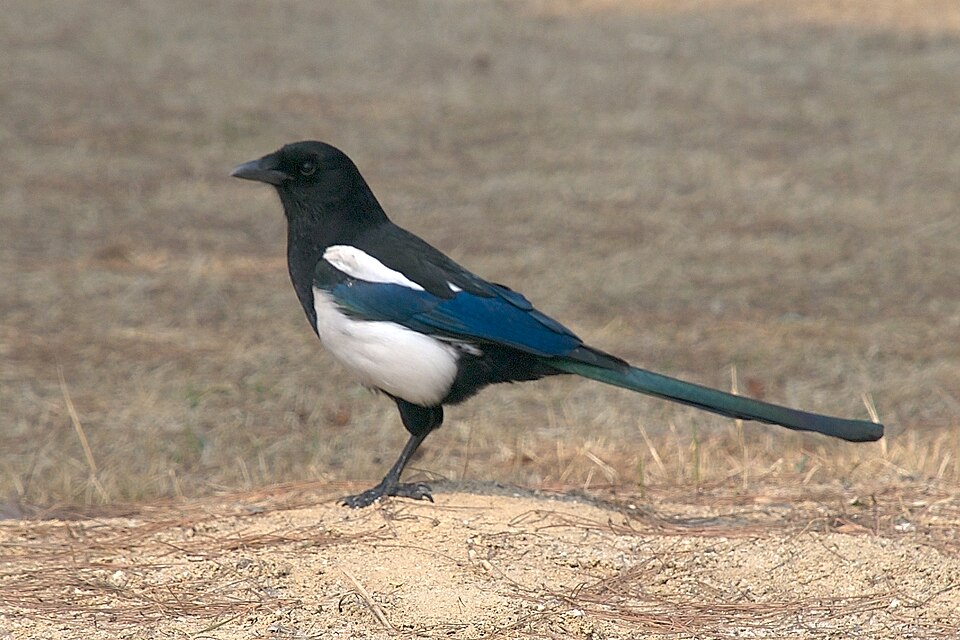
Reference photograph
An Oriental Magpie photographed in Daejeon, Korea. Reduced in size while preserving the original proportions.
Source: Yoo Chung — Korean magpie in Daejeon (side profile).jpg · Original material · CC BY-SA 2.5
1. Classification, origins and habitat
The Oriental Magpie is a bird in the order Passeriformes and family Corvidae. This profile treats the magpie distributed in East Asia, including the Korean Peninsula and China, as Pica serica, following the ITIS classification recognizing it as a valid species and information from the Hong Kong Bird Watching Society. Older references or other taxonomic systems may include it within a broader Pica pica. When scientific names differ, first check the publication date and species limits used. It inhabits places combining trees and open ground, such as farmland, villages and urban surroundings with green spaces. Being seen close to people does not imply that numbers are increasing everywhere or that adequate habitat exists in every region.
2. Appearance and identification
Important identification clues are the combination of black areas on the head and breast, white shoulders and belly, and a tail extending far behind the body. Dark wing and tail feathers can show blue or green iridescence depending on the direction of the light. A difference in a photograph's colors does not immediately indicate a different species. Male and female plumage is similar, and young birds may be less glossy overall, so brightness or darkness alone makes sex difficult to determine. When a photograph hides the tail, examine the black-and-white body areas together with the wing pattern. Do not group all black birds as crows or as the same kind of magpie.
3. Behavior and way of life
Oriental Magpies can be observed moving over the ground in search of food or perching in conspicuous places such as trees and wires. They are omnivorous and use several food resources, so one observed food item does not describe their entire diet. They may appear alone or in pairs, while outside the breeding season several individuals may gather around roosting sites. Group size and how often birds are seen vary by region and season. Repeated harsh calls do not always indicate an attack; the surrounding circumstances matter. Nest-building months or flock sizes reported from Hong Kong should not be applied directly to every magpie in Korea.
4. Observation, conservation and care
Even when a nest is nearby, do not part branches for a better view or linger beneath it. Use binoculars, and move back if a parent becomes alarmed or stops carrying food. Do not use recorded bird calls or food to create a desired scene. If you find a young bird on the ground, do not immediately take it away or feed it on your own; seek guidance from a local wildlife rescue organization if danger or injury is suspected. Keeping the surroundings tidy and preventing pets from chasing birds also helps. Even for a familiar urban bird, maintain enough distance to avoid disrupting its movements and breeding.
Evidence and references
- Hong Kong Bird Watching Society — Oriental Magpie
Distribution, plumage identification, foraging, breeding and communal roost observations for Pica serica. Hong Kong timing and figures are not generalized to Korea.
- Integrated Taxonomic Information System (ITIS) — Pica serica
Scientific name as a valid species and classification in the order Passeriformes and family Corvidae.
- U.S. National Park Service — Wildlife Watching Guidelines
Keeping a distance, avoiding feeding, touching and luring, and observing from trails. U.S. park regulations and numerical guidance are not applied directly to Korea.