
Dinosaurs
Stegosaurus
Stegosaurus
Classification and scientific name: Stegosaurus
Sources checked:
A stegosaur whose back plates and tail spikes merit separate attention
Stegosaurus was a stegosaurian dinosaur of the Late Jurassic. A representative herbivore known from North America's Morrison Formation, it did not live at the same time as the latest-Cretaceous Tyrannosaurus.
Origins and distribution
Late Jurassic, North America and elsewhere
- Stegosaurus
- Extinct animal studied through fossils
- Distinguish reconstruction from evidence
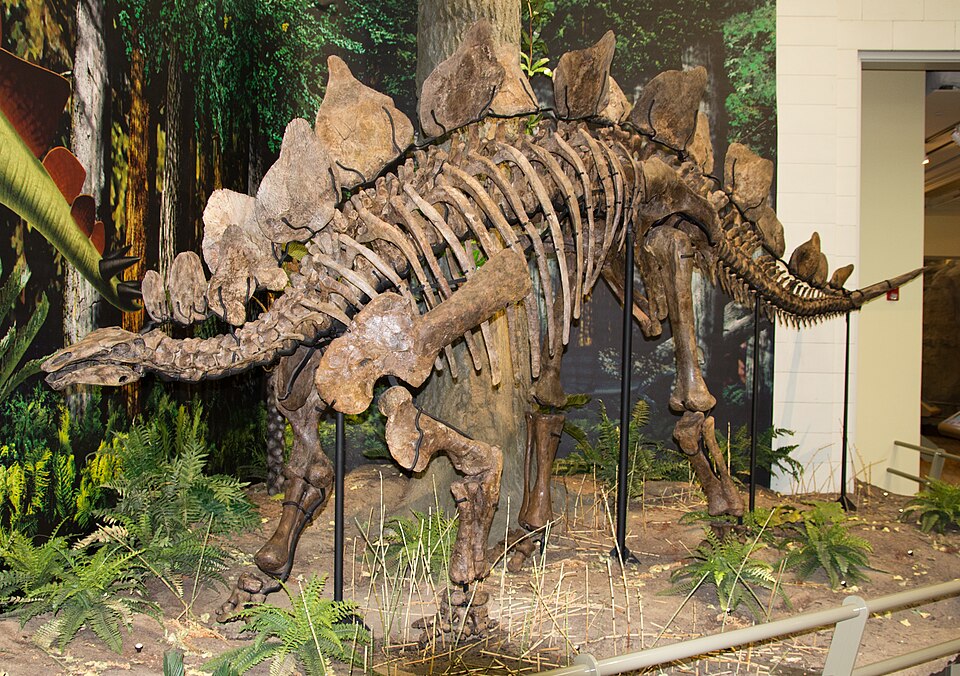
Fossil or skeletal specimen
Stegosaurus fossil or skeletal exhibit material. Displays may include replicated or supplemented parts; this is not a photograph of a living individual.
Source: Perry Quan from Oakville, Canada · Original material · CC BY-SA 2.0
1. Classification, discovery and geological context
Stegosaurus was a stegosaurian dinosaur of the Late Jurassic. A representative herbivore known from North America's Morrison Formation, it did not live at the same time as the latest-Cretaceous Tyrannosaurus. Early research sometimes reconstructed the back plates lying flat, but better-preserved fossils later changed interpretations. This discovery history shows the importance of the bones' original positions as well as their shapes. Different species and growth stages within the genus mean that not every specimen's plates have the same form.
2. Appearance and identification
Features include a small head, broad torso, hind legs longer than the forelegs, large plates in rows along the back and long spikes at the tail tip. The plates were bony structures in the skin, not bones directly attached to vertebrae, so they could scatter during fossilization. Observing plate arrangement separately from tail spikes reveals a more accurate structure than a general impression of a dinosaur with many spikes. A small skeletal head should not prompt a one-word judgment of intelligence or temperament. Body color and the covering outside the plates are reconstruction information absent from the skeletal exhibit.
3. Evidence for ecological interpretations
Teeth and jaws support an interpretation of a plant-eating animal. Tail spikes are studied in relation to defense, but not every spike movement or combat scene can be reconstructed. Several explanations have been proposed for the broad back plates, including display and temperature-related functions. Conspicuousness alone does not establish any single function as their sole purpose. Specific plant foods and browsing heights also require considering body structure alongside contemporary vegetation evidence.
4. Limits of the fossil record and reconstructions
The environment Stegosaurus inhabited is studied through plants, other animals, waterways and sediment traces in the same strata. Both genuine fossils and replica skeletons educate museum visitors, but checking the label's materials makes photographs easier to read accurately. An important observation is the combination of plates on the back, rather than a club, and long spikes at the tail tip. This page's image shows fossils or scientific reconstruction and is not presented as a photographic record of a living animal. Also consider older reconstructions as products of research in their own time.
Evidence and references
- Natural History Museum — Stegosaurus
The genus's discovery regions, geological time, skeleton and interpretations of diet
- Natural History Museum — A Stegosaurus brought to life
Well-preserved specimens and skeletal research