
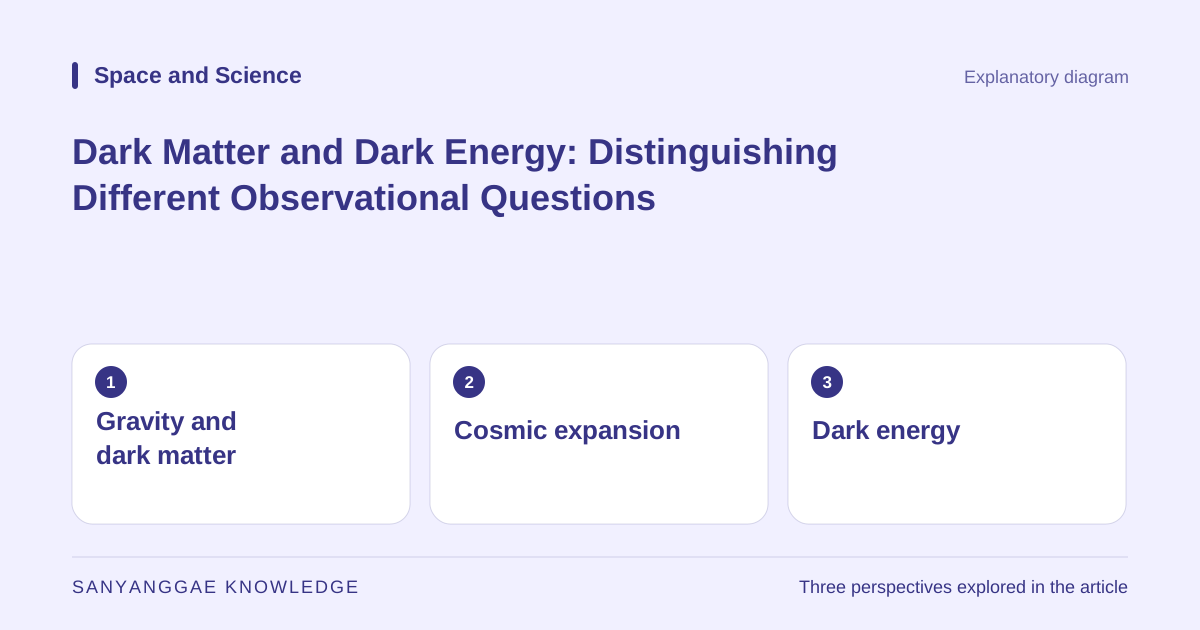
Dark matter and dark energy have similar names, but they do not mean different states of the same material. Dark matter concerns the problem of explaining observed gravitational effects, while dark energy concerns the problem of explaining the acceleration of cosmic expansion.
Writing down the scale of the observations first makes the two problems easier to understand. Asking how stars move within a galaxy and comparing the history of cosmic expansion through the distances of remote objects are not the same experiment. The former is connected with explaining a distribution of mass, while the latter concerns changes over time on large scales. The word “dark” does not describe the properties of an ordinary black-colored substance. It is better read as a name that helps distinguish what present observations allow us to infer from what we still do not know the identity of. Differences in the data and the questions, rather than similarities between the two names, are the starting point.
1. Observations used to infer unseen mass
Observations such as the motions of galaxies and gravitational lensing show cases in which luminous matter alone has difficulty explaining the gravitational effects. Dark matter models try to account for multiple observations together, but inferring gravitational effects and identifying the particles responsible are different stages.
2. Accelerating expansion and possible explanations
Dark energy is the name used in explaining accelerated expansion. Possibilities under investigation include a cosmological constant and components that change over time. Estimates of the proportions making up the universe come from observational data and cosmological models; they should not be read like the proportions of a fixed mixture in a laboratory.
3. Questions to ask when reading new results
Check which observations were analyzed, whether changing the model changes the result, and how large the statistical uncertainties are. Tension with an existing model or the proposal of a new candidate does not immediately mean the component’s identity has been discovered. What matters is whether the same explanation holds across several independent sets of data.
4. Bringing together gravitational data from different scales
Discussions of dark matter draw on more than the rotation of a single galaxy: they also involve galaxy clusters, gravitational lensing and large-scale structure. Connecting the distribution of luminous matter with gravitational effects requires consideration of distances, motions and observational errors together. The process is not to call anything unseen “dark matter,” but to find a model that consistently explains different observations.
Consider hypothetical data from a galaxy. If the speeds of stars or gas have been measured even beyond its visibly bright region, first calculate what distribution of mass explains that motion. Estimates may change if assumptions used to convert starlight into mass or the distribution of gas change. The fact that an area “looks dark in the photograph” cannot by itself determine the amount of dark matter. Darkness describes the brightness of a photograph; the question concerns a mass distribution revealed through gravity.
A gravitational-lensing map is not a chemical map obtained by directly photographing the components of matter. It is data used to infer a distribution of mass from how light from background objects has been deflected. Comparing it with the distribution of ordinary matter can provide important clues, but adding colors to the map does not produce a photograph of a particular dark particle. Make a habit of checking whether the colors in the legend represent observed light or calculated mass.
Hypotheses that describe gravity differently can also be compared with observations. Explaining one case well and explaining data from several scales together are different requirements. Whatever the theory, compare predictions and data under the same conditions rather than selecting a single favorable illustration to judge it. Acknowledging the observational puzzle must also be distinguished from saying that a particular particle has already been established as its solution.
5. Understanding expansion rate and accelerating expansion separately
Saying that the universe expands does not mean every everyday object grows at the same rate. Cosmology uses models connecting changes in distance with time on large scales. A simple illustration using the same arrows for the internal motions of gravitationally bound stars and galaxies mixes physics at different scales. Even when using a balloon analogy, explain only the changes in distances on its surface; do not assume the surrounding space is also equivalent to the actual universe.
Saying expansion is occurring and saying the change in expansion is an acceleration are different statements. This is similar to how knowing a car is moving forward does not tell us whether its speed is increasing or decreasing. In cosmology, light arriving from objects in the past is used to compare distances and the history of expansion. The actual analysis is more complicated than the everyday analogy and involves calibrating standard candles or other distance indicators, as well as cosmological assumptions.
Dark energy is connected with the problem of describing this large-scale accelerated expansion. The simplest explanation, a cosmological constant, can be studied separately from models in which properties change with time. When discussing whether new data agree exactly with a constant value or favor an explanation involving change, the statistical evidence and the way other data were combined also matter. A result in which the favored explanation has changed cannot immediately be recast as news that a substance has been isolated in a laboratory.
When reading numbers, check what whole the proportion refers to. Energy-component proportions estimated in a cosmological model and mass proportions in a particular part of our galaxy do not use the same denominator. Adding numbers taken from different tables may produce a meaningless result. Reading the data, assumptions and definitions together prevents us from mistaking a large number of digits for a small uncertainty.
6. Three examples for evaluating reports of new discoveries
The first example is a candidate particle signal in an underground experiment. To connect it with dark matter, researchers need to evaluate the apparatus’s background noise and known particle interactions, and check whether other experiments reproduce it. A process is needed to connect evidence from astronomical gravitational observations with a single event in a detector. A nondetection can also have scientific significance, depending on the ranges of mass and interactions it constrains.
The second example is a study that reanalyzes a galaxy. On hearing that it found a different mass distribution from earlier estimates, examine the observed object, distance assumptions and scope of the analysis. A revised result for one object does not invalidate every observation of the universe as a whole. Conversely, the fact that many observations support the same model does not justify ignoring errors in individual measurements. The key is to check the role each set of data plays in the explanation.
The third example is a report that the properties of dark energy might change. Examine which combination of data produced the result, how much the compared models differ in their numbers of free parameters, and whether subsequent data point in the same direction. In this process, saying we do not yet know does not make every explanation equally valid. Narrowing the range allowed by observations and testing new predictions continue even before the component’s identity is finally discovered.
To organize what you know about dark matter and dark energy, write down two questions rather than simply memorizing the names: “Which gravitational effects are difficult to explain with visible matter alone?” and “What explains the history of the universe’s expansion?” Recording the data and models beside each question clarifies which problem a new article addresses. It also helps avoid portraying the two unknown components as a single mysterious black substance.