
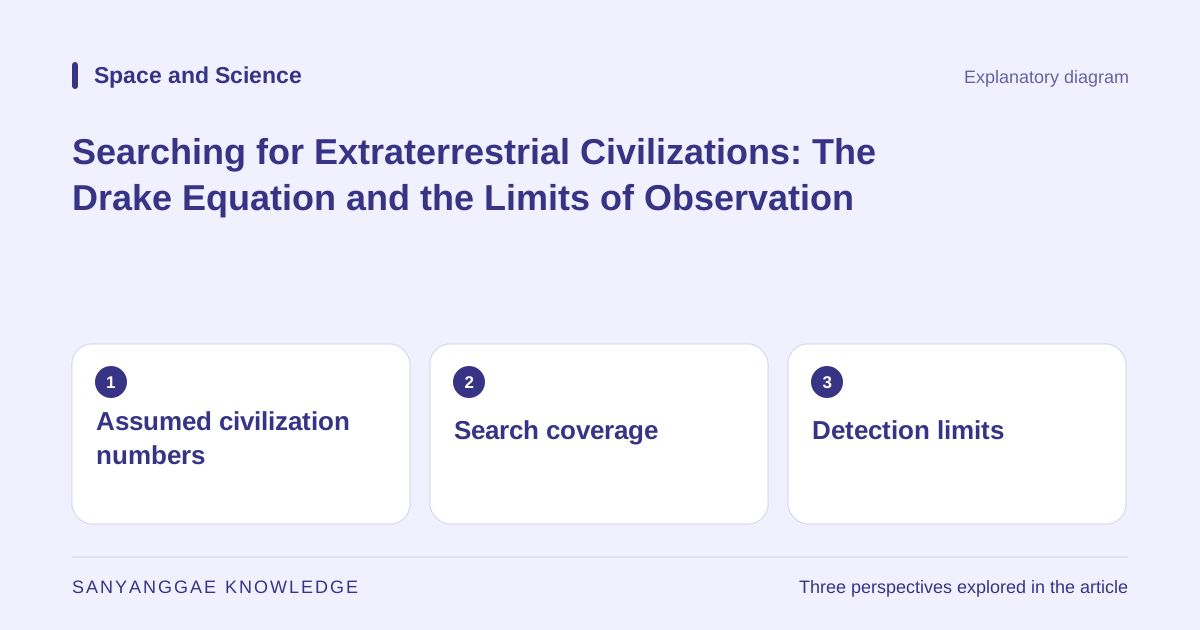
The question of why we have not yet found clear traces of extraterrestrial civilizations in a universe so large and old has prompted many hypotheses. But turning an absence of observations into the absence of civilizations altogether, without checking the space, time and frequencies searched or the detection limits, makes the conclusion too strong.
Observations that seek planets, missions that look for traces of microorganisms, and searches for artificial technological signals require different instruments and support conclusions of different scopes. Progress in one field does not immediately answer the questions of another. When reading discussions of extraterrestrial civilizations, first write down what kind of target is being sought and by what method. Both the large extent of unsearched territory and the lack of a confirmed signal so far matter. Treating imagined behavior by a civilization as an observed fact can make the meaning assigned to silence too strong.
1. The role of the Drake equation
The Drake equation encourages us to consider separate factors such as the formation of stars and planets, the emergence of life and intelligence, detectable technology, and its duration. The values of all the terms are not known, so inserting a single answer cannot be presented as establishing the number of extraterrestrial civilizations. It is useful as a framework for examining which variables strongly change the result.
2. Filters and energy scales are the language of hypotheses
The Great Filter is a hypothesis that there may be difficult stages along the path from life to a detectable civilization. It has not been established that humanity has already passed such a stage. The Kardashev scale likewise classifies civilizations by the scale of their energy use; it does not describe development stages actually observed in extraterrestrial societies.
3. Criteria for reading search results
Check which signals were sought, for how long, and whether the same candidate was observed repeatedly. Procedures are also needed to rule out terrestrial interference and natural phenomena. A difficult-to-explain signal or a new hypothesis can be an interesting subject of research, but judging it to be evidence of an extraterrestrial civilization requires further verification.
4. What to know before putting numbers into the equation
The Drake equation is a framework for considering the number of potentially communicating civilizations in our galaxy as a product of several factors. The rate at which stars form, the fraction with planets, the proportions where life and intelligence arise, and the existence and duration of detectable technology enter as different questions. Terms constrained by astronomical observations and terms unknown because we lack enough examples of life cannot be treated as equally certain.
Numerical examples are more useful for understanding sensitivity than for making predictions. If all other terms are kept unchanged and the assumed duration of a technological signal is multiplied by ten, the result of the product is also multiplied by ten. This is the mathematical effect of changing an assumption, not a discovery that the universe actually selected that duration. However precise the result may look, its digits do not guarantee factual accuracy if its inputs are guesses.
An environment in which life is possible must also be distinguished from one in which life has actually arisen. Observations suggesting that water and suitable energy might be present do not immediately yield a rate at which life begins. There are also several stages between the presence of microorganisms and the existence of a technological civilization detectable across great distances. Separating the terms of the equation is intended to make what we do not know visible without erasing these differences.
If two people give different results, first compare the terms to which they assign very different values. One may assume that civilizations emit signals for a long time and the other that they do so only briefly. Comparing only the conclusions “there are many aliens” and “there are almost none” misses the actual difference. Recording the evidence and possible range for each assumption turns a disagreement into questions that can be examined.
5. What the Great Filter and civilization scales do not tell us
The Great Filter is a hypothetical explanation in which there may be an extremely rare stage between life and a detectable civilization. It has not been established whether that stage is the emergence of life, complex life, or the persistence of a technological civilization. Accounts of whether humanity has already passed that stage or will encounter it in the future should also be read as conditional inferences. The impression of a quiet universe alone cannot determine humanity’s future.
Suppose, for example, that clear evidence of microorganisms were found on another planet. That would provide new data for questions about the emergence of life. But the question of whether technological civilizations survive for a long time could remain. A single hypothetical discovery does not settle every term. Distinguishing which stage has become less uncertain and which remains unchanged helps keep Great Filter discussions from becoming excessively optimistic or fearful.
The Kardashev scale classifies civilizations by the scale of energy available to them. It is not a historical chart of stages in extraterrestrial societies that have actually been observed. Energy consumption should not be equated with a society’s ethics, happiness or every aspect of its technology, either. Assuming access to greater amounts of energy does not automatically determine what signals a civilization emits or how it behaves.
Even when imagining enormous energy-using structures, ask what observable consequences they would have. If emission at a particular wavelength or changes in starlight are predicted, conditions for distinguishing them from natural phenomena can be specified. Conversely, an explanation that no observation could test may make an interesting story but is difficult to verify. The presence of testable predictions, rather than simply a large number of possibilities, determines the next step in research.
6. How to interpret a search that found nothing
When reading search results, check which direction in the sky was observed, at which wavelengths and for how long. A brief look at a particular radio frequency and prolonged observations across a broad range do not produce silence with the same meaning. It may also matter whether a signal is directed toward Earth, whether it is continuous, and whether it coincides with our observing time. A statement that something is “absent” needs to include the range actually examined.
Imagine a hypothetical search observing a few nearby stars in a particular band without finding an artificial signal. That result constrains signals detectable under those observing conditions. It cannot rule out all communications at other frequencies or around stars that were not observed. Nor does that make the result meaningless. Accumulating detection limits and search coverage can progressively narrow the range of allowed hypotheses.
When a candidate signal appears, first examine terrestrial interference, the properties of the instruments and known natural phenomena. Check whether it returns from the same direction, whether another facility can confirm it, and whether it changes in the way observers predicted. Concluding that a signal is artificial merely because it has no explanation yet skips steps in verification. Treating a candidate as interesting is different from announcing a confirmed extraterrestrial civilization.
What to keep from Fermi’s question is the scope of the question rather than a single answer. Write down life, intelligence, technological signals and search conditions as separate items. Checking which item gains data from a new report helps reduce sweeping conclusions about civilizations as a whole. We need to respect what observations actually allow without reducing the silence of the universe to a simple declaration of absence.