
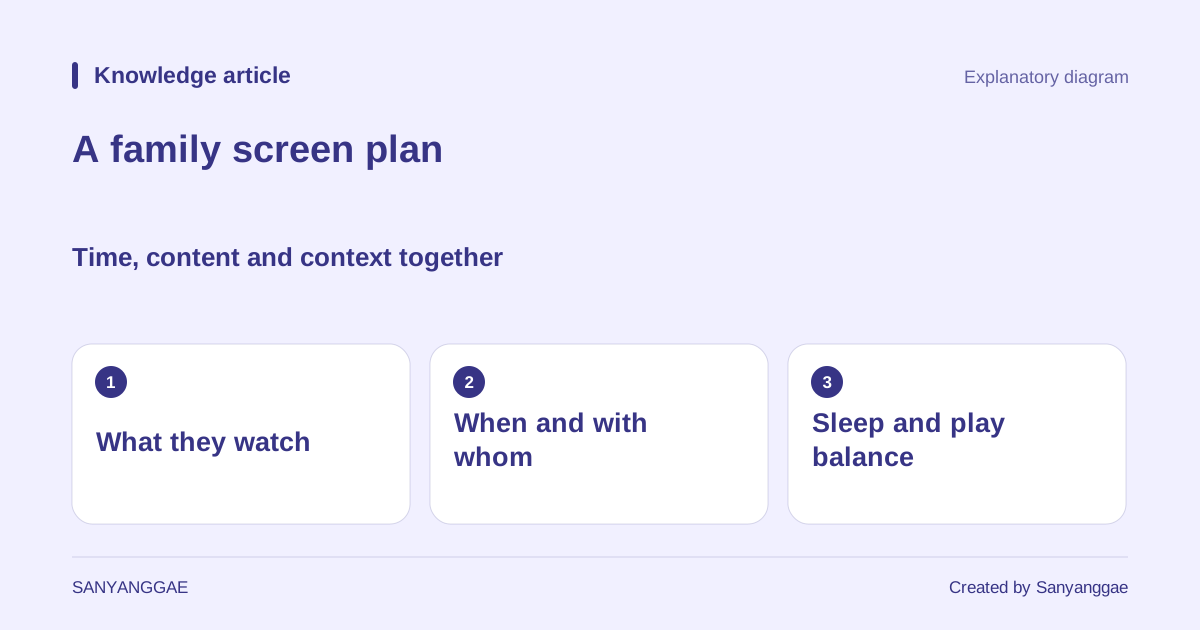
When considering a child’s screen use, content, companions and circumstances matter alongside duration. A short video call and ongoing autoplay before bedtime are not the same experience. Avoid using expressions such as “popcorn brain” as medical diagnoses or concluding that screen use alone establishes brain damage.
1. Look at the whole day first
Record whether screen use is displacing sleep, movement and conversation. Note whether it happens during meals, just before sleep or while caregivers need to do other tasks. WHO guidance for young children treats physical activity, sedentary behavior and sleep together, with recommendations that vary by age.
Being quiet while watching a screen and being sufficiently rested can be different assessments. Conversely, do not assume a day with screen use lacked all conversation and movement. Dividing the day into scenes to inspect actual life reveals adjustments more clearly than abstract guilt. Include the family’s reasons for using devices, such as childcare, work or travel. Acknowledging those needs makes it possible to identify sustainable agreements and required support together.
2. Make rules the family can keep
Choose observable agreements such as a charging location, device-break periods and autoplay settings. Review caregiver use too, starting with situations that need change. If every ending causes conflict, try advance notice of the ending signal and next activity in ways that fit your family.
The activity after stopping must be immediately accessible. If art supplies are on a high shelf and the caregiver is busy, saying “Now draw something” may not enable a transition. Set out materials beforehand or agree on a time to begin together. Allowing room to switch to an activity the child chooses can prevent the agreement from becoming only a one-way command. These are examples for household adjustment, not a promise that a particular conversational technique always eliminates conflict.
3. Criteria for choosing content together
Check age suitability, advertising and payment prompts, requests for personal information and the form of interaction. An educational label does not guarantee an actual learning effect. If concerns about daily life or health persist, seek advice using your records and revise the plan with current age-specific guidance.
4. Distinguish causation from association in use records
When reading research that finds difficulties alongside longer screen time, separate the observation that two things occurred together from the conclusion that screens caused those difficulties. A child already struggling to sleep may use a device more at night, or family circumstances may affect both sleep and device use. This does not mean disregarding research; it means checking methods and comparison conditions. One child’s screen log cannot establish damage or recovery in a particular brain area.
At home, look for situations you can actually change rather than creating a diagnosis. Separate weekdays from weekends and note why the device was turned on, what was viewed and what followed. Video calls, school assignments and solitary video watching are not identical uses. Even with similar total time, taking a device to bed and using it between other activities suggest different adjustments. Explain that the record aims to find habits the family can change together; turning it into a ledger of the child’s mistakes can create conflict and secret use.
For example, if the device was used only while a caregiver cooked dinner, acknowledge that need before choosing an alternative. Replacing it with an activity the child cannot do alone may simply increase caregiver burden. Conversely, if bedtime autoplay postpones stopping, playback settings and the charging location can be changed first. Clearly identifying the problem also determines what the family should check after trying the change.
5. Agreements to reduce stopping conflicts and checking content
Discuss when use will end and what will happen next before starting, rather than announcing the rule for the first time when switching off. “Just a little” can mean different things to different people, so choose an observable point such as the end of one video or an agreed family signal. However, on services that keep recommending videos, the end of one does not necessarily lead to a break; an adult needs to check settings. A child can still feel upset after an agreement, and that emotion itself does not prove the rule failed.
When choosing content, inspect not only what appears on screen but also mechanisms that keep use going. Examine how autoplay, endless lists, reward-driven logins and purchase prompts operate. Even with an educational label, check what the child actually does and whether it connects with conversation or play afterward. Privacy and advertising settings differ by service; read the instructions and apply available measures. An age label alone does not establish every risk or aspect of suitability.
If caregivers continually check notifications at meals, rules for the child alone may struggle to change family life. Set a shared device-resting place, and explain when urgent work or contact requires an exception. Rather than trying to hide all device use or control it perfectly, clarify the exceptions and the usual agreements. If several caregivers share care, use the same ending criteria so differing rules do not force renegotiation every time.
6. Applying guidance at home and deciding when to revise the plan
WHO guidance for children under five treats physical activity, time spent sitting and sleep together across the whole day. Its age ranges should not be transferred unchanged to school-age children. The AAP family media plan can be used as a tool for discussing sustainable family habits. Recommendations are a starting point for examining life, not a competitive scorecard. For children with medical needs or developmental conditions, the purpose of use and adjustments can be discussed separately with the relevant professional.
After trying a new agreement for roughly a week, check more than whether screen time decreased. Consider whether bedtime preparations were delayed less, mealtime conversation increased and caregivers could maintain the plan. This is an example of reviewing a household plan, not a claim that development changes within a certain period. If total time decreases but major conflict occurs every day, reconsider the ending method or alternative activity. When the plan was not followed, review what happened and adjust the next day’s demands realistically.
If concerns continue, summarize changes in sleep, mood, schoolwork and relationships for a consultation. Do not overlook other difficulties by assuming screens are the cause of everything. Conversation about which content the child enjoys is needed too. The core of a family plan is to understand the child’s interests while making space for multiple needs of health and everyday life.