
Infancy and toddlerhood are important developmental periods, but the third birthday is not a deadline after which the possibility of learning closes. Development begins before birth and continues throughout life. Claims that a particular learning material or app guarantees increased intelligence require separate evidence.
Trying to turn every moment of a day into an educational achievement can put adult plans ahead of a child’s interests. For example, looking together at a picture the child points to and responding may be the conversation of that moment, rather than finishing the entire book. Separating how much was taught from what experiences were exchanged reveals changes possible without expensive programs, as well as support the family needs.
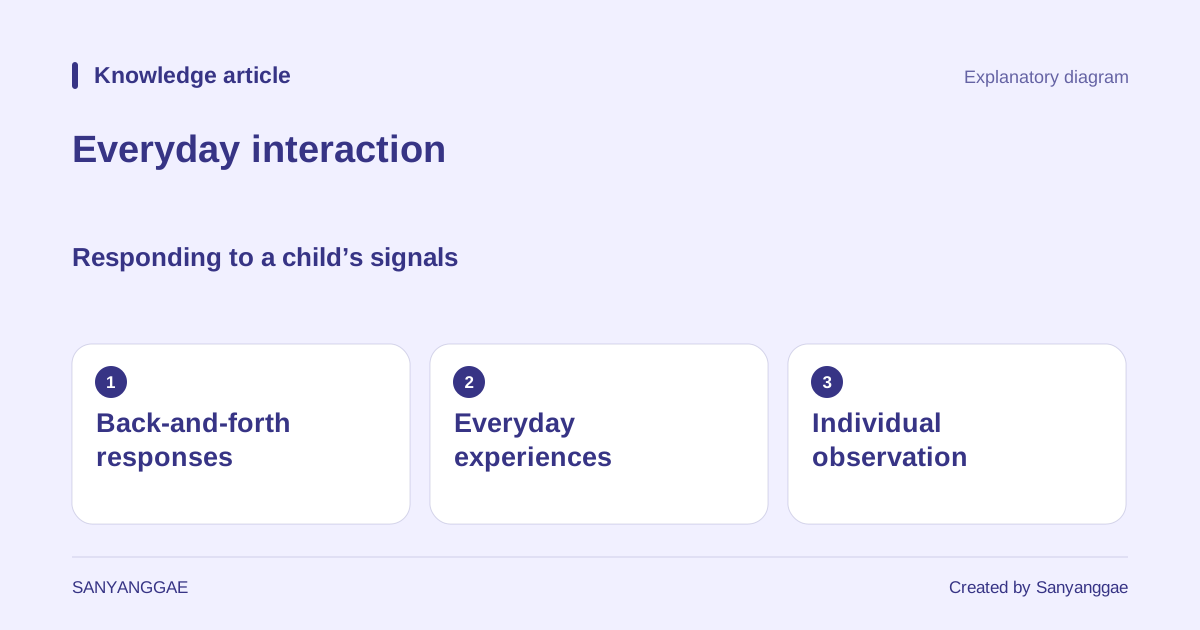
1. The signals a child sends first
Notice the child’s gaze, gestures and sounds, and respond with words or facial expressions to what interests them. If they point to a bird outside, look together and say something appropriate, such as “The bird is flying away.” Giving the child time to respond again, rather than asking questions continuously, is the beginning of conversation.
If an adult immediately moves to another question after speaking, the child may have less opportunity to participate. In the bird example, briefly observe whether the child moves a hand again, makes a sound or looks elsewhere. Instead of repeating the same words louder and louder when there is no response, check whether their interest has changed. There is no need for a rule that good interaction always requires eye contact. The goal is to share an experience in a way that is comfortable for the child; every moment need not be filmed or assessed. Talking naturally in the language the family usually uses is a sufficient starting point.
2. Experiences repeated in everyday life
Getting dressed, eating and looking at books can all offer opportunities for back-and-forth activity. Every daily task does not need to become an educational exercise. Try choosing brief interactions that your family can repeat, rather than a plan that keeps caregivers constantly tense. The importance of early experience is no basis for assigning all responsibility to an individual caregiver.
Choose repeated scenes from things already happening in daily life: looking for a towel after a bath, passing a cup at the table or a familiar page in a bedtime book. If the plan keeps slipping, reduce it to one easy scene instead of scheduling activities more strictly. Another caregiver may continue on days when someone is ill or busy. Converting relational experience into one adult’s output can merely increase family pressure. Flexibility to consider both the child’s condition and the family’s circumstances matters more than completing a fixed program.
3. Connecting observation with consultation
Developmental milestones are not a test for ranking children. If a change is worrying, note when it began and the situations in which it appears, and discuss it in a medical consultation. If a child loses a skill they previously had, or developmental concerns persist, consult a professional rather than simply increasing training.
Development has many aspects, including movement, communication and social participation. Doing one thing early does not establish overall advancement, nor does difficulty with one item imply delay in every area. Writing down questions beforehand helps make use of a short consultation. Ask, for example, “This behavior worries me; what assessment is needed?” or “What should I observe next?” and record the suggested next steps. An explanation that support is needed is not a declaration that a child’s future is fixed. It is better understood as a process of identifying present needs and receiving help.
4. Turning early-education advertising into everyday questions
Harvard’s explanation of brain development describes early experiences as a foundation for later learning while noting that new connections can form throughout life. That does not directly imply a need to start a particular workbook early. If an advertisement says “completed before age three,” check what is supposedly completed, which children were studied and what was measured. Scores for memorized words and the ability to use learning in an unfamiliar situation are also different outcomes.
Consider a family deciding whether to buy learning materials. First write down what the child currently enjoys: putting things in and taking them out, copying facial expressions or turning toward a sound can call for different experiences. Next consider whether safe containers or picture books already at home can help explore that interest together. Remember that an average change in a large study group does not guarantee an effect for your own child. An accessible environment and the caregiver’s available capacity determine how realistic a plan is more than the number of expensive objects.
5. Examples of conversation while dressing and walking
While preparing to go out, if a child holds up and looks at a sock, you might say “You found the sock,” then wait for the next action. If they offer a foot, help put it on; if their interest shifts to another object, notice that interest too. There is no need to ask for the correct color or number every time. A response is an opportunity to attend to the same thing, not a test question. A child who does not yet speak much can participate by reaching or leaning. Do not assume that no conversation is happening just because the response differs from an adult’s expectation.
On a walk, follow one object the child stops to examine rather than explaining the entire route. If they point to a leaf, watch it move together; if they want to touch it, check surrounding safety. End the explanation if the child turns away or becomes tired. A caregiver’s need to deal with a phone call or housework at some point does not invalidate the whole day’s interaction. Sharing scenes the child enjoyed among caregivers lets the next person continue a familiar experience. These are examples for adapting at home, not a training chart requiring a set number of repetitions.
6. Development records as a way to find the next support, not comparisons
Instead of judgments such as “slow,” record the observation date, situation, what the child did and the help provided. If response to their name is concerning, for example, note background noise, whether they were absorbed in another activity and whether the speaker was close. These records cannot themselves distinguish hearing or developmental issues, but they give the consultant concrete scenes to ask about. If behavior differs between childcare and home, examine differences in environment and demands rather than deciding one account is wrong.
CDC milestones describe behaviors many children perform at certain ages; they do not replace standardized developmental screening. Observe whether a behavior appears in everyday life instead of practicing to achieve one successful performance. If a previous skill disappears or worries continue, speak with healthcare professionals without waiting for the next birthday or the end of a workbook. A consultation can also include what the child does well, favorite people and changes in sleep and eating. Acting on the importance of early development means accessing needed relationships and support now, rather than proving achievement early.