
1. Separate changes in the star from changes in the light reaching your eyes
Watch a bright star on a clear night and you may see its light tremble or brighten and dim. At times its color seems to change rapidly. These brief, irregular changes should not be interpreted as the star repeatedly switching its light off and on. The final journey of the star's light through Earth's atmosphere to your eyes can change. As NASA StarChild explains, the starlight an observer receives follows slightly different paths depending on the state of the air. The different impression made by the same star near overhead and near the horizon is a clue that we need to consider the observing path as well as the celestial object.
Distinguish the amount of light from the star's apparent position. If light is concentrated or spread out differently as it crosses the atmosphere, the brightness reaching your eyes can fluctuate. Changes in the light's direction can also make the position of a tiny point, or its image in a telescope, appear to wobble. Variable stars really do change in brightness, so the atmosphere should not explain every change in starlight either. The key point is that a momentary shimmer seen with the unaided eye cannot establish a physical change in the star. Recording the timing and recurrence of changes, the equipment and the observing conditions helps separate what was observed from guesses about its cause.
2. Temperature and refractive-index differences in moving air
Air is transparent, but it is not empty space that leaves the direction of light entirely unaffected. Its refractive index changes with factors including temperature and density. Light passing through uneven layers of air can have its path and wavefront distorted. As warm and cool air mix and this distribution changes over time, the star's image becomes unstable too. The focusing and spreading described in optics education resources help explain changes in brightness. Rather than imagining wind pushing light like a physical object, picture the properties of the medium changing from place to place and over time. Wind strength alone cannot determine how much a star twinkles.
A distant scene shimmering above a hot road can remind us that the state of the air affects images. However, heat shimmer above a road and twinkling in the night sky are not experiments with identical conditions. The distance to the light source, the distribution of air layers and the apparent size of the image differ. In telescope observations too, clear skies and a sharp image are different things. Light being weakened by clouds or dust and a tiny image shaking and spreading because of the atmosphere may be related, but they are not the same measurement. A note saying there were few clouds cannot by itself establish that the star images were steady that night.
3. A planet appears as a small disk with an area
Stars look like points, but this is not because their actual sizes are small. Apart from the Sun, they are so distant that our eyes have difficulty resolving their surfaces into disks. By contrast, nearby Solar System planets can be resolved as small disks through a telescope. What matters is not just an object's actual diameter, but the angle it occupies for an observer: its apparent size. The University of Wisconsin's astronomy explanation emphasizes that light from different parts of a planet's disk takes slightly different paths through the atmosphere. Brightness changes in one part do not always reinforce those in another in the same direction, so the combined change tends to be smaller than for a point source.
Explaining the difference between stars and planets solely as a difference between emitted and reflected light therefore misses the main point. Reflected light also crosses uneven air, while starlight observed outside the atmosphere differs from the rapid twinkling seen from the ground. Nor should we make a rule that planets never twinkle. At low altitudes or in unstable air, planets can also appear to wobble or twinkle. Use twinkling as one clue to identification, together with position, observing date and the object's relationship to the constellations. The lights of a moving aircraft or an out-of-focus image are also difficult to identify from an impression of brightness alone.
4. Why twinkling stands out near the horizon
Light from an object near the horizon generally travels farther through the atmosphere than light from an object overhead. NASA's explanation links this difference in path length to the more conspicuous twinkling of low stars. This does not mean twinkling increases by an identical proportion at every place and time. The distribution of the air actually crossed, the object's altitude and the observing location make a difference. In a direction close to a roof or heating outlet, locally rising warm air can also affect observations. Even when comparing the same star, record how its height in that night's sky changed, so that differences in viewing direction are not confused with the star's properties.
The impression of rapidly changing color is also difficult to separate from observing conditions. Air does not affect the propagation of every wavelength in exactly the same way, and these effects may become noticeable for low objects. However, color changes on a phone screen must not be read directly as changes in the temperature of a star's surface. Automatic exposure and focus, image processing and hand movement also influence the image. Before comparing photographic brightness on different nights, check whether the settings were the same. A long exposure combines rapid changes into one frame, so the fact that a point looks broadly spread in one photograph cannot be converted directly into a numerical measure of the twinkling seen by eye.
5. A simple night-sky observation that records conditions separately
You can begin at the same location before traveling or buying equipment. Choose a safe place with a clear view and note the date, time and viewing direction. Select a bright star whose position you know and a planet visible that night, then first check whether their heights are similar. If only one is low on the horizon, record that difference. Alternate brief looks with the unaided eye and describe in words whether brightness changes are rapid and irregular, and whether color or position also seems to change. This is not an instrument experiment measuring the atmosphere precisely, but an activity that helps avoid mistaking comparisons under different conditions for equivalent ones.
Beside the object's name, keep separate fields for approximate altitude, cloud cover, roofs and windows along the line of sight, and equipment used. If you add photographs, note whether exposure and focus were automatic. In the next observation, comparing location or time first is easier to interpret than changing several conditions at once. If you did not see a clear change, record that. There is no need to fill in strong twinkling to fit an expected conclusion. The activity's value lies in asking what stays the same and what changes across repeated observations, without inferring a particular star's condition or the following day's weather from a few records.
6. What space telescopes and adaptive optics can address
Space telescopes observing outside Earth's atmosphere avoid image distortions caused by passing through the atmosphere below. On the ground, adaptive optics measures wavefronts distorted by the atmosphere and adjusts the shape of a mirror to improve the image. The laser guide star described by ESO provides reference light for this process. A laser does not create a real star or change the intrinsic brightness of a distant one. Nor should an explanation of adaptive optics become a claim that it completely removes every kind of brightness fluctuation and the effects of clouds. Distinguishing what the equipment corrects from the observing conditions that remain is essential to understanding its role.
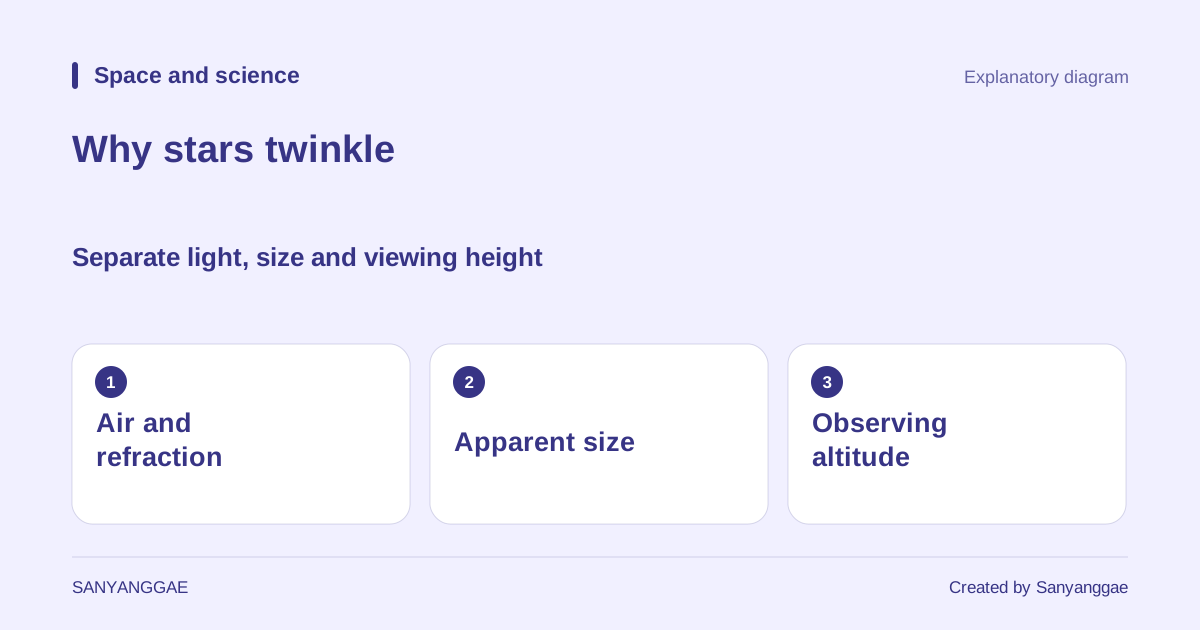
This article's main image is an explanatory diagram organizing three perspectives: changing light paths through the atmosphere, apparent angular size and altitude above the horizon. It is neither an observational photograph nor a measurement graph, and sizes and distances are not drawn to scale. When reading the diagram, avoid interpreting a point source as meaning that a star's actual size is small. When something twinkles in the night sky, ask in turn what you saw, which air layers and instruments you saw it through, and how much that record can explain. Separating changes in a star from changes in the observing process does not remove the beauty of the impression: it helps examine more specifically why it arose.