
Amphibians
Axolotl (Wooper Looper)
Axolotl
Classification and scientific name: Ambystoma mexicanum
Sources checked:
A Mexican aquatic salamander retaining external gills at maturity
The axolotl is a salamander associated with the aquatic environment of Xochimilco, Mexico. Wooper Looper is a widely used nickname, not a classification as a fish or a separate pet breed.
Origins and distribution
Xochimilco waterways, Mexico
- Ambystoma mexicanum
- Xochimilco waterways, Mexico
- Observe species-specific ecology
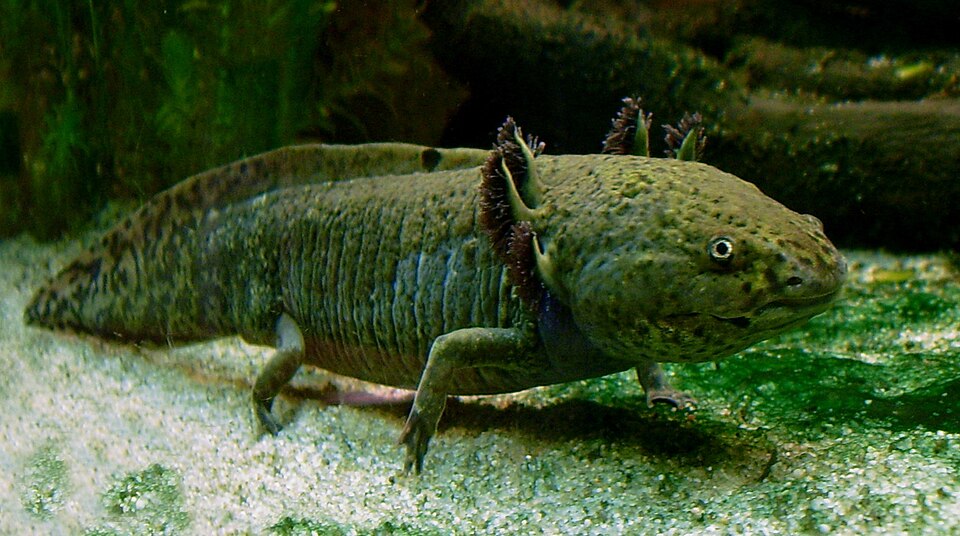
Reference photograph
Reference photograph of Axolotl (Wooper Looper). Compare the color and form of the individual shown with the identification notes in the text.
Source: LoKiLeCh · Original material · CC BY-SA 3.0
1. Classification, origins and habitat
The axolotl is a salamander associated with the aquatic environment of Xochimilco, Mexico. Wooper Looper is a widely used nickname, not a classification as a fish or a separate pet breed. Numerous animals bred in laboratories and captivity do not establish that wild populations are stable. Distinguish natural-habitat changes, introduced fish and water-quality problems.
2. Appearance and identification
Three pairs of external gills on either side of the head, four legs and a fin-like tail structure are characteristic. Pale skin and red gills common in captive photographs are not the universal appearance of wild individuals. The wild type has a dark brownish body and spots. The mouth’s outline should not be interpreted as a human smile or a happy expression. Retained external gills also do not mean that an individual is still an immature animal incapable of breeding.
3. Behavior and way of life
Maturing while retaining larval features makes this life history a prominent example in research on paedomorphosis. It feeds on small aquatic animals and shows suction-feeding movements. Regenerative ability is an important research subject, not proof that every wound and disease resolves perfectly without help. Do not transfer other salamanders’ land-going life histories to this species or present artificially induced metamorphosis as an ecological experience.
4. Observation, conservation and care
Understanding its original environment requires considering water conditions, shelters, aquatic vegetation and food relationships together. The popularity of white captive animals does not remove the need for wild conservation. This page explains natural history; it must not become advertising that keeping one water temperature makes the animal easy for anyone to keep. Distinguish color line and captive status in observation photographs, without mixing Xochimilco wild-habitat images and pet-aquarium scenes as the same record.
Evidence and references
- University of Michigan, Animal Diversity Web — Ambystoma mexicanum
Distribution, appearance, diet, reproduction and life history of this species
- American Museum of Natural History — Ambystoma mexicanum
Current scientific name, zoological synonyms, natural distribution and taxonomic research