
Amphibians
Korean Salamander
Korean Salamander
Classification and scientific name: Hynobius leechii
Sources checked:
Close species in Hynobius are not easily distinguished by appearance alone
The species covered here under the common name Korean salamander is Hynobius leechii. Its range includes the Korean Peninsula and northeastern China, so it should not be described as endemic only to the Republic of Korea.
Origins and distribution
Salamanders of the Korean Peninsula and northeastern China
- Hynobius leechii
- Salamanders of the Korean Peninsula and northeastern China
- Observe species-specific ecology
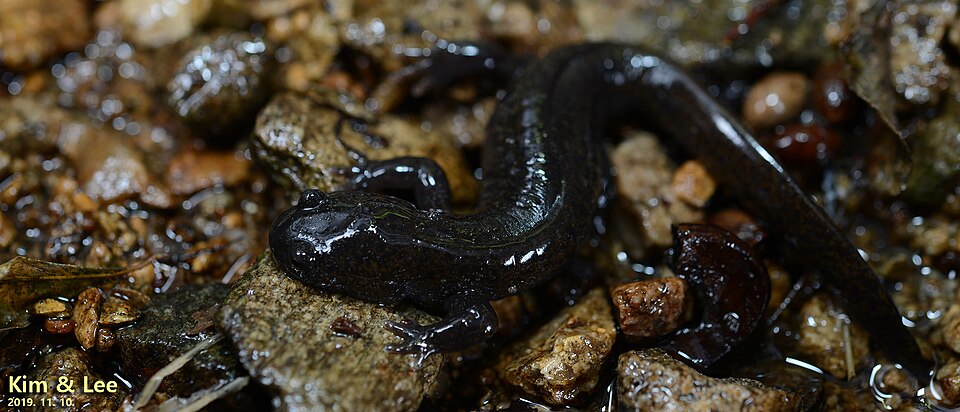
Reference photograph
Reference photograph of a Korean salamander. Examine this individual's color and form alongside the identification descriptions in the text.
Source: Kim, Hyun-tae · Original material · CC BY 4.0
1. Classification, origins and habitat
The species covered here under the common name Korean salamander is Hynobius leechii. Its range includes the Korean Peninsula and northeastern China, so it should not be described as endemic only to the Republic of Korea. Korea's Hynobius genus includes several similar-looking species, whose names and distribution ranges have been clarified through taxonomic research. One brown salamander photograph must not be used to explain every species in the genus as the same animal.
2. Appearance and identification
A long flattened tail, four legs, a rounded head and brown-toned skin are characteristic. Adults' smooth skin differs from a lizard's scales, and unlike frogs they retain a tail in adulthood. Eggs may be observed in sac-like structures rather than a single jelly-like mass. Close species can look similar, so genetic evidence and locality are sometimes considered together. Visible spot counts alone do not establish species or age.
3. Behavior and way of life
Adults use damp refuges such as forest leaf litter and spaces under stones, eating small invertebrates and other food. They move toward water for breeding, and aquatic larvae differ from terrestrial adults in breathing structures and body proportions. Salamander regeneration is studied, but this does not mean a lost part immediately returns perfectly under every condition. Damaging a body to observe regeneration is not ecological observation.
4. Observation, conservation and care
The forest used by adults and water where eggs and larvae develop are connected habitat. Instead of judging suitability from clear stream water alone, examine surrounding soil, leaf litter and seasonal waterways together. Turning over or moving stones to find hidden individuals may alter the microenvironment. Check distribution material from after species distinctions alongside photo provenance, and avoid describing every Korean salamander as the same endemic species.
Evidence and references
- National Institute of Biological Resources — Amphibian ecology: Hynobius
Hynobius species distinctions, eggs, form and habitat
- American Museum of Natural History — Hynobius leechii
Current scientific name, synonyms, natural distribution and taxonomic research