
Fish
Arowana
Arowana
Classification and scientific name: Osteoglossum bicirrhosum
Sources checked:
Silver arowanas seek food near the surface
Arowana names related but distinct South American and Asian lineages.
Origins and distribution
South American fresh waters, including the Amazon basin
- Fresh water
- Silver arowana
- Mouth barbels
- Male mouthbrooding
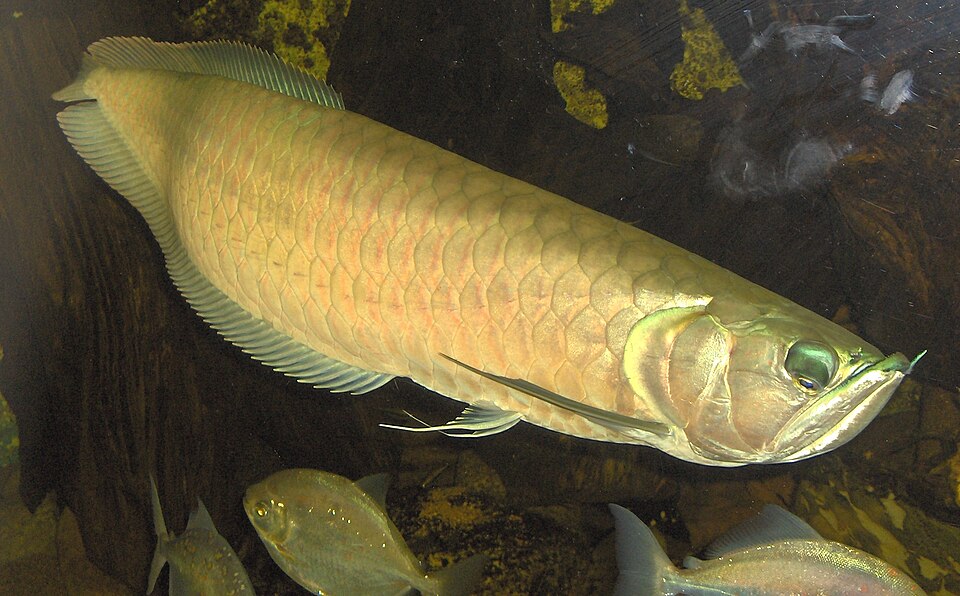
Reference photograph
Reference photograph of an arowana. Compare its colours and form with the identification details in the text.
Source: User:Qwertzy2 · Original material: Osteoglossum_bicirrhosum.JPG · CC BY-SA 3.0
1. Classification, origins and habitat
Arowana names related but distinct South American, Asian and other lineages. This page uses the silver arowana, Osteoglossum bicirrhosum, as its representative. It uses surface foods in South American fresh waters including the Amazon and is connected with flooding environments. Do not apply Asian arowana trade regulations or conservation status directly to this species. Slender young fish and large adults need distinction when considering keeping space. Although the long silvery outline may resemble a marine hairtail, this lineage lives in fresh water. Matching species and water environment begins an accurate introduction.
2. Appearance and identification
A long laterally compressed body, large scales, upturned mouth and pair of lower-jaw barbels are characteristic. Long dorsal and anal fins run along the rear body, supporting flexible movement. Young and adult proportions and tones can differ. Silver is representative, but light and water colour can make it look bluish or dark. Do not treat red captive Asian arowana colours as natural variation of this species. A small-tank photograph does not show adult growth or turning space; compare whole-body form with other barbel-bearing fishes too.
3. Behavior and way of life
Silver arowanas seek insects, fish and other animal foods near the surface. Leaping towards food just above water is known, but not every meal is always caught in the air. Male protection of eggs and young inside the mouth is characteristic. An open mouth alone may not distinguish predation from offspring care; check context. Vegetation and water-level changes affect food access and movement. Captive responses to human feeding should not become a claim of gentleness making combination with any other fish easy.
4. Observation, conservation and care
Management needs spacious safe conditions accounting for the adult's long body, movement and surface leaps. Check filtration, oxygen, environmental stability and food composition for the species. A small sale size does not establish lifelong suitability for a small tank. Regional management sources matter for wild capture and trade; releasing ornamental fish can endanger native organisms and the released animal. Captions should identify the silver arowana without mixing colours, ranges and protections of other arowanas. Connecting the surface-oriented mouth and barbels with feeding and reproduction helps understanding.
Evidence and references
- FishBase — Osteoglossum bicirrhosum
Species classification, distribution, habitat and form
- Animal Diversity Web — Osteoglossum bicirrhosum
Silver arowana appearance, surface feeding and male breeding behaviour