
Reptiles
Green anole
Green Anole
Classification and scientific name: Anolis carolinensis
Sources checked:
Reading green-to-brown colour changes together with dewlap signals
The green anole is a small North American lizard; changing colour does not place it in the chameleon lineage.
Origins and distribution
The southeastern United States and other parts of its range
- Anolis carolinensis
- Southeastern United States and other parts of its range
- Observing species-specific ecology
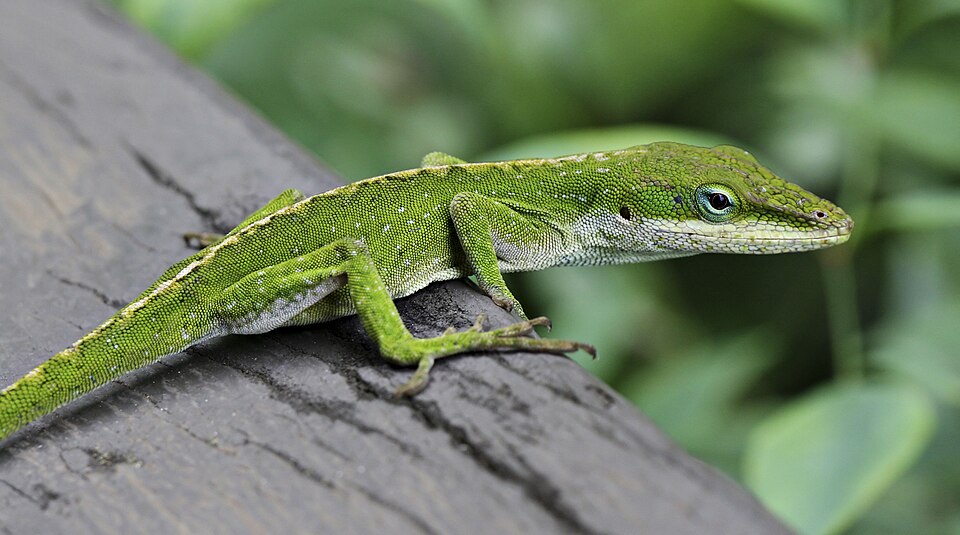
Reference photograph
Reference photograph of a green anole. Compare its colours and form with the identification details in the text.
Source: Paul Hirst (Phirst) · Original material: Anole_Lizard_Hilo_Hawaii_edit.jpg · CC BY-SA 2.5
Modification notice from the source: Edited by Fir0002
1. Classification, origins and habitat
The green anole is a small North American lizard. Colour changing does not place it in the same lineage as chameleons.
It can be encountered among shrubs, trees and fences in the southeastern United States. Introduced populations elsewhere mean that an observation site is not automatically a place of origin. Brown anoles at the same site may be a different species, so body colour alone does not establish that one animal simply changed colour.
2. Appearance and identification
Colour changes between green and brown, a long tail and throat dewlap are characteristic. The male's dewlap is reddish.
Consider the long slender tail, toe structures, pointed snout and dewlap together. A male's dewlap is conspicuous when expanded but less visible when folded. Temperature, light, physiology and social conditions affect colour, making a one-to-one reading of happy green versus sick brown inaccurate.
3. Behavior and way of life
Green anoles eat insects and other prey and signal with dewlap and head movements. One colour cannot establish health or emotion.
Dewlap extension and head movements occur in encounters and territorial behaviour. Anoles seek small insects and move among branches and stems. Quick movement and avoidance of people should not be explained only as curiosity or play. Recording heights and surfaces used improves understanding of tree-dwelling life.
4. Observation, conservation and care
Green anoles use tree and shrub branches. Light, temperature and surrounding stimuli affect colour and behaviour, so record observation conditions too.
They use three-dimensional connected shrubs and branches with varied sunshine and shade. A small body does not mean almost no room for movement. Observe at a distance without grabbing tails or provoking dewlaps to appear. Compare differently coloured photographed individuals through scientific names and observation conditions together.
Evidence and references
- Animal Diversity Web — University of Michigan — Anolis carolinensis
Classification, origin, appearance and ecology
- The Reptile Database — Anolis carolinensis
Scientific names, synonyms, distribution and related taxonomic research