
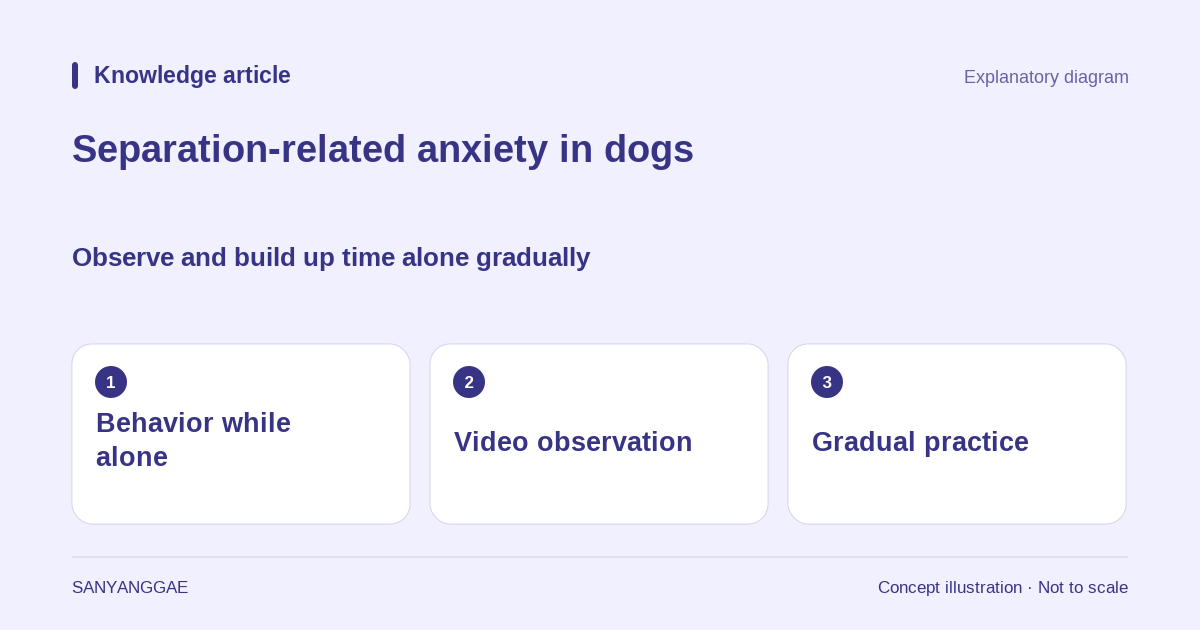
If a dog barks or damages things when you go out, you may wonder whether it is bored or has separation-related anxiety. The traces it leaves behind seldom reveal why it behaved that way. Scratching at the door can result from fear, a response to noise or distress at being confined. Video of what actually happens while the dog is alone, considered with its health and living conditions, helps build a plan based on its responses instead of simply leaving it alone longer.
1. Look at when and how your dog responds
Separation-related problems are behaviors associated with discomfort or distress when a dog is apart from its caregiver. Barking, howling, elimination, drooling, pacing and escape attempts may be clues. None alone establishes a diagnosis. Difficulty controlling elimination due to illness or reacting to stimuli outside a window are other possibilities. This is why comparing a dog's behavior when you are home and when you are away is useful.
See whether distress begins as soon as you leave, after a rest when a noise occurs or only when a particular person leaves. Interpreting a picture of a damaged item by the door as “revenge” can lead to punishment that makes anxiety worse. Scolding after you return cannot reduce the distress the dog felt while alone. Describing the timing, stimulus and actual behavior without judging the dog's character makes it easier for family members and professionals to discuss the same problem.
2. Use video to observe ordinary behavior
Set the camera in a safe location where it shows exits and resting areas, and capture the period before and after departure. Avoid leaving longer than normal or putting the dog in an unfamiliar and uncomfortable enclosure for observation. An angle that shows body tension, movement and resting posture is more useful than a view of just the face. Put cables and small parts out of reach to prevent chewing or swallowing.
Record when the first response occurs, any pacing or vocalization, whether the dog eats or rests, and any approaches to the door or window. Getting quiet and resting comfortably are different behaviors. Look for a stiff body and a fixed gaze at the door. At the same time, one bark cannot establish panic throughout the separation. Showing a professional key excerpts with a timeline may be more useful than sending only a long recording.
3. Adjust safety and real departures before practicing
Dogs that lunge at doors or windows or try to escape confinement can injure themselves. If a dog hurts itself or makes intense escape attempts, ask a veterinarian and a behavior professional for help before repeating exposure exercises at home. A carrier or crate can be an established resting place. It cannot automatically resolve separation anxiety. If confinement makes escape attempts more frantic, reconsider the choice of a safe space first.
A practice plan is hard to sustain if real absences outside practice repeatedly exceed what the dog can tolerate. Consider realistic help such as care by family or suitable daycare and watch how the dog responds in unfamiliar settings. Walks and sniffing can meet everyday needs. Exercising the dog to exhaustion offers no assurance that anxiety will resolve. Practice should go together with enough rest, a manageable routine and steps to reduce difficult situations where possible.
4. Practice time alone at a level the dog can manage
A gradual plan starts with conditions in which the dog remains comfortable and expands them in small steps. There is no fixed number of minutes that suits every dog. Some struggle with a door closing or their caregiver disappearing from sight briefly, while for others a different change comes first. If video repeatedly shows panting and pacing at a particular duration, that is not evidence of tolerating it and being ready for a longer absence.
Keep clear what you are practicing and avoid changing time away, door closure and departure actions all at once. Write down conditions that went easily and those that were hard before adjusting the next step. If the dog stiffens as soon as you stand by the front door, for example, ask a professional how to lower the intensity of that moment before practicing longer trips. Avoid leaving the dog to cry until it gives up or punishing its response.
5. The role of departure cues and food toys
Picking up keys or putting on shoes can signal an outing through past experience. Exercises to adjust the response to cues can help, but merely completing a certain number of repetitions will not solve the problem. Adjust intensity based on the dog's tension and recovery, and check video for evidence that the cue matters to this dog. Not all dogs are anxious at the sound of keys.
A food toy can give a dog an enjoyable activity. Refusing it may mean something other than disliking the taste. Check whether the dog rejects food while alone and eats it once you return, and whether it can chew and swallow safely. Solely distracting a severely anxious dog with treats can obscure the actual distress. A toy cannot justify leaving the dog alone for an intolerable duration. When using one, take size, material and previous supervised experience into account.
6. Professional help and what counts as progress
Seek veterinary assessment when anxiety is severe, health changes accompany it or daily management is insufficient to carry out the plan. Medication may be considered. Neither using medication alone nor always postponing it as a last resort suits every case. Ask about the individual treatment goals, behavior plan, adverse effects and follow-up. Choose someone who uses reward-based methods and recognizes the seriousness of the problem and the limits of their medical expertise.
Assess more than time away. Check whether the dog settles on its own, whether vocalization and pacing have decreased and how it recovers and eats after you get home. A change in schedule or a week of construction noise may make a previously achievable step difficult, so record the conditions. Treat a brief setback as a reason to return to a safe and manageable step without assigning blame. The goal is to reduce actual distress when the dog is alone and find a routine the caregiver can sustain. Quieter departures alone do not establish that the plan is working.