
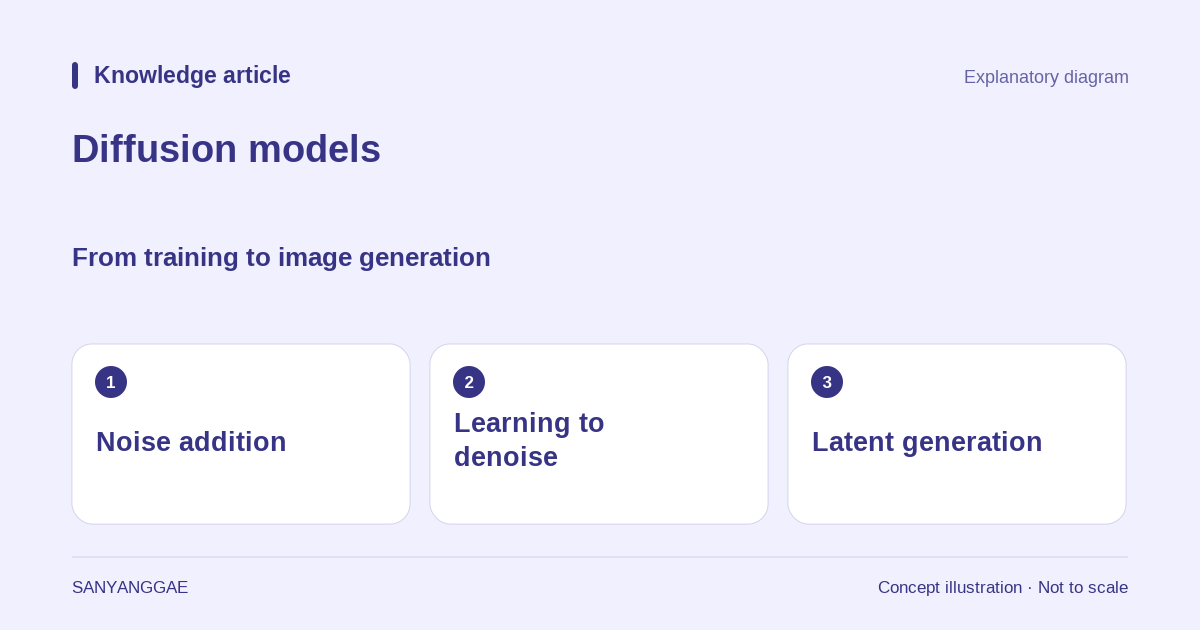
Diffusion models link data progressively to noise and learn to generate in the opposite direction. Statistical physics provides a useful analogy, but this is no physical experiment with real particles moving inside an image.
1. Training and generation are distinct processes
During training, inputs with varying noise levels teach the model to predict a direction for removing noise or a related quantity. Generation starts with noise and obtains a result after a series of updates. Saying that the model makes a blurry photo sharper at each step does not capture the full process.
2. Working in latent space
Latent diffusion runs the diffusion process in a compressed representation space before reconstructing an image. Consider both the reduction in computation and the limits of the compressed representation. The results in the original paper do not reveal the architecture of every later image or video model.
3. Conditioning and evaluation
Text or image conditioning influences the direction of generation. Stronger conditioning does not always improve accuracy. Compare results using the same settings and inputs, and check lettering, structure, bias and provenance requirements separately. An appealing output need not be a real photograph or verified material, so decide how to use and label generated images.
4. A simple model of adding noise
Imagine representing one pixel of a training image as a single number. Adding a small random component leaves some original information intact. Adding more weakens the connection to the original. Diffusion training can use inputs at different noise levels, plus information identifying those levels, to predict a direction for reconstruction or a related quantity. Actual models use high-dimensional data and a defined noise schedule, so one pixel cannot explain the entire implementation.
During training, the original is known. During generation there is no original of the new image you want to make. Generation repeatedly applies learned updates to a random state to produce something resembling the data. It is therefore inaccurate to call every generated result a restoration of a blurry photo that existed somewhere. Editing with an existing image as a condition differs from starting without any source image.
A diagram can show a blurry circle gradually coming into focus. Actual diffusion steps need not reveal recognizable outlines in an orderly sequence. Interpreting the dots in a diagram as real particles moving under physical laws misses the model's probabilistic definition. The link with statistical physics helps explain the mathematics and does not establish that a generated subject exists.
5. What it means to generate in latent space
Latent diffusion moves an image into a compressed representation, generates in that space and uses a decoder to return to image space. A compressed representation does not list the original pixels unchanged, so there are limits to what it can retain and reconstruct. At the same output size, details can differ depending on the latent space and decoder. Lower computational cost does not imply lossless reconstruction for every image.
Imagine making a fictional product illustration. The composition and materials may look natural while a small product name or button shape changes. Even an attractive output is hard to use as documentation if it differs from the actual product on sale. Separate the background you want generated from the product details that must be preserved exactly. Explain the influence of the model's compressed representation or training data only as far as public information and experiments support it.
Inspect letters and numbers directly. A convincing sign invites readers to infer what its text says, even if the actual letters are wrong. Decide whether advertising copy, values in a table or place names on a map should be left entirely to generation. An expressive model and an editing tool that preserves facts can serve different purposes. Define your output requirements first to make that choice easier.
6. Comparing conditions, seeds and settings
Text conditioning helps steer the output. A prompt that says “one blue box” does not guarantee the requested number and color. Check adherence to the condition, structural consistency and visual quality separately. Settings that strengthen conditioning can have different effects across models and implementations, so higher values do not guarantee better quality.
A shared seed helps comparison but does not guarantee identical results in all environments. Model version, sampling method and compute implementation can all affect the result. Record the model and key settings alongside the prompt and seed. Evaluate failure types across representative requirements, rather than judging overall quality from one lucky image.
An evaluation sheet for a fictional product image could include the number of boxes, logo preservation, button placement, the selected background and differences from the real product. Categorize natural-looking results that miss a condition separately. For real people and events, labeling and intended use matter. A generated image that looks like a photo cannot replace a record of the actual scene. Educational diagrams should also be identified separately from observations.
Provenance requirements for model training and distribution also inform decisions about how to use the output. An openly available model does not automatically clear every use or all input rights. Check the model terms and permitted uses of reference images. If using an external service, check where it processes the uploads. These issues are separate from the mathematics of denoising and matter in production.
To understand diffusion, distinguish the training objective for handling noise, iterative generation, compressed representations and conditioning. Use the same distinctions to evaluate which requirements an output satisfies. Natural textures are one dimension of quality. Accurate text and structure, and provenance labels suited to the use, are separate requirements. Decide these before judging whether an output fits the task.
Consider the conditions when increasing the step count. Even with the same model, the relationship between time and results depends on the sampler and settings. More steps alone do not remove structural errors or fix lettering. If the logo in the earlier example keeps changing, reconsider which elements you have entrusted to the model. Compare compute budgets against actual output needs and describe the speed and quality options within the range you have verified.