
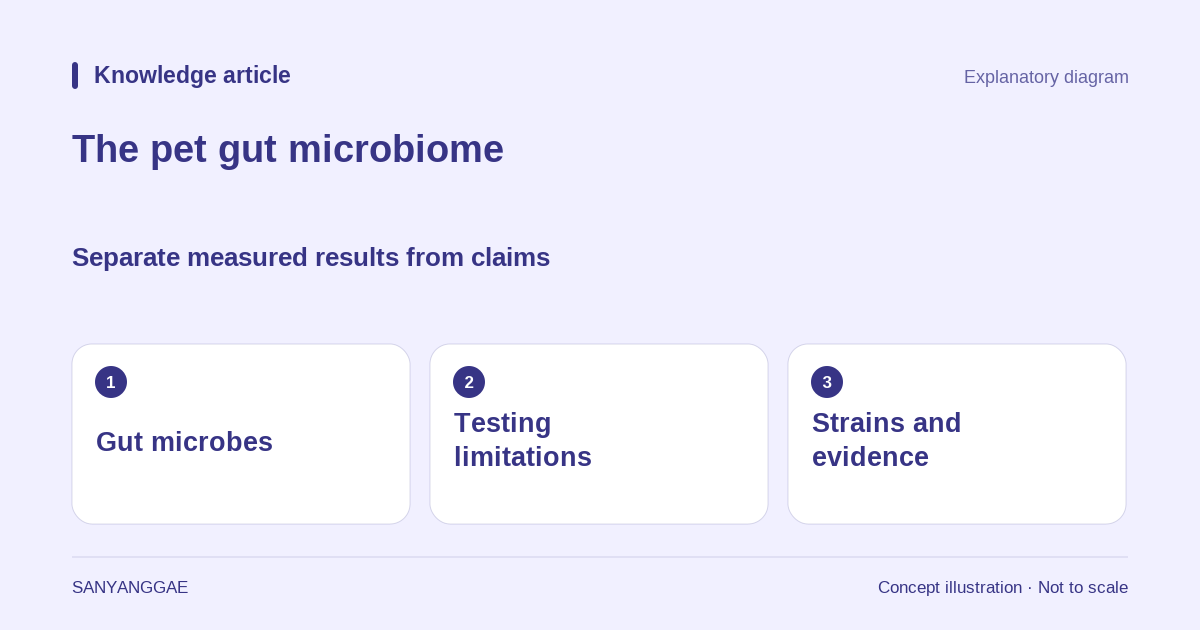
The pet gut microbiome is a complex ecosystem studied in relation to digestion, immunity and metabolism. Growing interest has brought more stool tests and probiotic products, but report colours and microbial counts are not automatically health scores. Explaining connections between gut and brain does not prove a particular product treats anxiety or behavioural problems. Separating what a test measures from the research supporting a product's claims helps reduce unnecessary comparisons and switching.
1. Gut microbes are not a simple list of good and bad organisms
Many microbes live together in the gut and interact with food and the host's condition. Some use components such as fibre to produce metabolites and participate in bile-acid metabolism and intestinal mucosal function. Finding an organism with a particular name does not always identify a disease cause. Location, amount, relationships with other microbes and the animal's health all matter. Claims that simply increasing one diversity measure always improves health are oversimplified.
Dysbiosis may result from inflammation or influence a disease process. Observing more of one organism in diarrhoea does not establish that eliminating it cures diarrhoea. Diet changes, medicines, age and living conditions also affect microbial composition. Trying to remove every red item on a report without examining causation may miss assessment of the actual disease. Symptoms and food and medicine histories are the starting point for interpretation.
2. Stool tests do not directly display the entire gut
Stool tests measure particular organisms, genetic material or other features in an excreted sample. Some quantify selected microbial groups, while others analyse broader genetic information. They do not directly observe every intestinal location and function, and different methods answer different questions. Different graphs from different companies therefore do not automatically establish a testing error or rapid health deterioration.
Ask how results would change current management, whether the test is validated in this species and condition, and what healthy controls and collection conditions were used. Collection, storage, recent antibiotics and diet changes affect interpretation too. Do not compare a sample kept at home for a long time without guidance with one collected following clinic instructions as though conditions were identical. A single report from an animal without symptoms should not by itself establish a diagnosis or trigger treatment.
3. Check strains and study populations in probiotic research
Probiotics involve live microorganisms used under suitable conditions with an expected health benefit. Evaluating effects requires the strain, product quality, use context and actual clinical outcomes as well as the organism's name. The broad category “lactic acid bacteria” or an identical total count does not make products equivalent. More organisms or more types do not guarantee a better result.
Check whether a study concerns dogs or cats, healthy animals or patients with a particular illness, and which improvement was measured. Slightly firmer stool and fewer disease recurrences are different outcomes, as are changed microbial composition and improved comfort. Do not directly transfer human or laboratory-animal findings into treatment claims for pet products. It is also worth checking whether the studied formulation matches the one being considered.
4. Separate prebiotic and gut–brain-axis claims
Prebiotics concern components used by microbes and differ from probiotics containing live organisms. Some products combine them, but a more complicated name does not mean a larger effect. Consider fibre and nutritional composition in the existing diet too; new ingredients may alter stool or intake. Starting several products together makes it difficult to identify what caused a change.
The gut and nervous system exchange signals through several routes, and microbial roles are being studied. However, a diagram of a possible biological pathway is not a diagnosis that one pet's anxiety comes from gut organisms. For behavioural-improvement advertising, check for controlled studies that actually assessed that behaviour. Separation-related anxiety and aggression require environmental, learning and health assessment. Adding a gut supplement must not replace behavioural care and safe everyday adjustments.
5. Define assessment criteria before trying a product
An animal with symptoms should first receive assessment of causes and necessary care. If a product has been discussed with the veterinarian, record the existing food, stool form and frequency, vomiting and appetite before starting. Note the product and start date; avoiding simultaneous changes to staple food and treats helps interpretation. Keep lighting and conditions comparable in photographs, and do not diagnose a cause from stool appearance alone. Ask for advice if discomfort increases rather than persisting on the assumption that continued use brings adaptation.
For example, if staple food changed and walking treats increased during the week a supplement began, improved stool cannot identify which change helped. Recording the accompanying conditions is more honest than claiming the product repaired the gut. Clarifying whether the goal is stable stool or weight recovery reduces the influence of broad advertising. Agree with the veterinarian on trial duration and stopping or reassessment criteria when a trial is appropriate.
6. Do not let test and supplement limitations obscure necessary care
Do not spend a long time switching gut-health products when there is blood in stool, repeated vomiting, weight loss or worsening general condition. Antibiotic effects on microbes do not mean stopping a necessary prescription independently, and a high dysbiosis index does not by itself mean antibiotics are needed. Discuss treatment goals and alternatives with the clinical team. Faecal microbiota transplantation is also a medical procedure requiring donor screening and consideration of infection risk, not a home activity.
A useful report explains the scope measured and uncertainty and supports interpretation alongside symptoms. A useful product description does not promise to solve all illnesses and behaviours at once. Rather than competing over numerical rankings, carers can watch whether eating, toileting and activity actually improve. Appreciating microbiome research while asking specific questions about diagnostic and management evidence supports choices relevant to the pet now.