
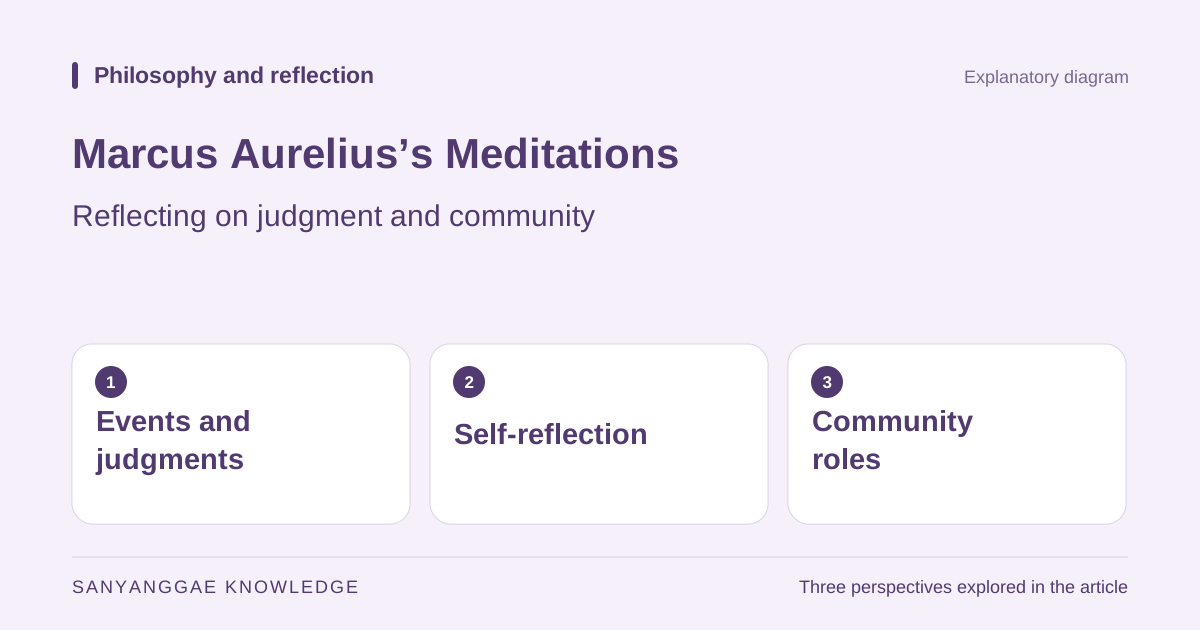
Meditations can be read as a record of reflections Marcus Aurelius wrote to himself. Reducing it to a formula for success that applies to everyone, or a training manual for eliminating emotions, misses the book’s ethical context.
1. Examine events and your judgments about them
If something is troubling you, try writing down the event that actually happened separately from the evaluation you added to it. This is a reading activity for applying the book to everyday life, rather than attributing a modern sentence absent from the original to the author as a famous quotation. Feeling an emotion should not itself be judged a moral failure.
2. Personal composure and responsibility to the community
Meditations repeatedly considers human beings as living alongside other people. This perspective needs to be distinguished from concentrating only on personal peace of mind while ignoring your responsibilities or the unjust treatment of others. You can also ask which actions are appropriate to the community and your relationships.
3. Read a note and leave a question of your own
After reading a short passage, record why you agree and the situations in which it would be difficult to apply. Wording may differ between translations, so check the book number and edition when quoting. It is useful to identify modern applications as suggestions by the commentator and to distinguish the original text from its interpretation.
4. Consider the context of writing addressed to oneself
Compared with a textbook that teaches a theory to readers step by step, the writing in Meditations often repeats and compresses ideas. Reading it as notes reminding the author of principles he already knew helps explain why the same themes recur. Before taking a short sentence out of context and turning it into a modern workplace tip, check what the surrounding passages warn against and what they say should be done. Repetition does not always imply the absence of an argument, nor does it make every sentence a universal command.
The beginning of Book II anticipates the difficult people the author will encounter during the day. Summarizing this as advice to “avoid people because they cannot be trusted” risks overlooking the ensuing context of shared reason and cooperation. Recognizing that others’ actions can be disagreeable is connected with the demand to live alongside them. Rather than following only the mood of one passage, ask what kind of action it prepares the reader to take.
A reader today does not bear the same responsibilities as an emperor. Applying the words of an era with different institutions and hierarchies without adjustment changes the scope of their application. Knowing the author’s social position makes it possible to consider both his statements about human beings generally and the self-examination of someone with particular powers. Learning from a historical figure does not mean agreeing with every institution of that era or every judgment the author made.
5. Read criticism at a meeting in two ways
The following is a hypothetical example of a modern application. Suppose a colleague says in a meeting, “This material lacks supporting evidence.” The statement and the content of the material can be recorded as events. “They are trying to make me look incompetent” is an interpretation of a motive. There is no need to assume in advance that the interpretation is wrong, but we can distinguish it from the facts currently established: it does not have the same level of supporting evidence.
The next question is which response would be appropriate, rather than how to eliminate the emotion. You might ask which parts lack evidence and check the material, or raise a specific concern if the manner of the criticism was unfair. You do not have to hide the fact that you feel uncomfortable or accept the colleague’s criticism unconditionally. This approach to reading connects the examination of judgment with actions needed in collaborative work.
This example must not be quoted as a direct prescription from Meditations. It is an interpretation that examines the original text’s themes of judgment, rational action and cooperation in a present-day situation. Another reader might place greater emphasis on power relations between colleagues or the rules of the meeting. Applying philosophy requires making the author’s concepts visible while acknowledging the new conditions of a modern example. Do not use the name of a classic as a guarantee that your own response was the correct one.
6. When composure and justice seem to conflict
If calmness becomes the only goal, avoiding uncomfortable problems can seem like a good choice. In Meditations, however, duties toward the community matter independently of personal feelings. If you see someone being unjustly excluded, remaining free of anger is not enough to establish that you have fulfilled your responsibility. You can consider what explanations, checks and requests for correction are possible within your role.
Whether to agree with the virtue-centered perspective of Stoic philosophy is also a question for the reader to examine. You can ask how it evaluates the moral significance of external conditions and whether it adequately accounts for harm and the effects of institutions. Reading a classic does not mean submitting to every proposition. Writing a counterexample or an unanswered question beside a sentence you agree with helps you follow the issues without reducing the work to a familiar collection of advice.
A reading notebook can separate the location in the original, your summary, an application and objections. For example, after reading a passage about cooperation in Book II, you could record the meeting example while also considering what institutional response would be needed if the other person repeatedly harassed someone. The book does not investigate the present facts for you, so grounds for judging a modern situation must be established separately.
The terms used in translation are also worth comparing. Words such as judgment, impression and nature have both everyday and philosophical uses. Rather than relying only on the tone of one translated sentence, check the conceptual context in notes or scholarly commentary. It is better not to use a saying circulated online under the author’s name as a direct quotation unless its precise book and section can be established. If you summarize an idea in your own words, make clear that it is a summary.
Read this way, Meditations becomes a partner in the continuing examination of judgment and action, rather than merely an instruction to become a person who is never unsettled. You can reflect both on how you interpreted an event and on what you did afterward. There is no reason to promise that reading will immediately change emotions or resolve health problems. Its practical value lies in examining your interpretation and asking more clearly about the responsibilities you hold within relationships.
You can also make use of the difference between reading alone and reading in conversation. If a private note makes an overly quick assumption about another person’s intentions, another reader can ask what supports it. Conversely, if emphasizing responsibility to the community has led you to overlook your own limitations, you can write down again where your role begins and ends. Such examination is closer to checking your own judgments than to borrowing the author’s authority to judge someone else in an argument. When keeping a record, note both the ways you changed your behavior and the points with which you still find it difficult to agree. You can identify what you learned and which questions remain without creating a new obligation to feel calm at all times after reading the book.