
Boston ivy
Boston ivy is a deciduous woody climber that attaches to walls and rocks with adhesive discs at its tendril tips. Observe both the seasonal change from green to red leaves and how it attaches to its support.
- Scientific name
- Parthenocissus tricuspidata (Siebold & Zucc.) Planch.
- Family
- Grape family · Vitaceae
- Other names
- Parthenocissus tricuspidata · Ampelopsis tricuspidata
- Reviewed
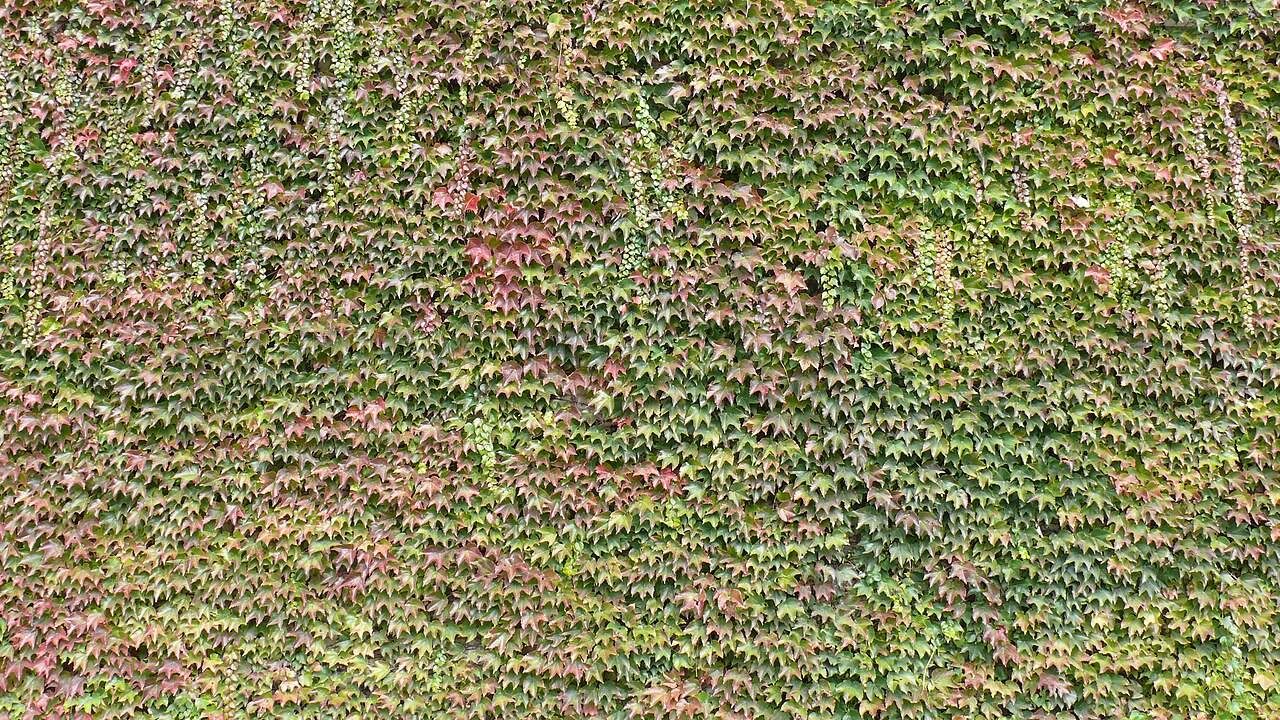
A wall covered in Boston ivy, showing changing leaf colors. Three-lobed leaves are visible, but this is not a close-up of the adhesive discs.
Parthenocissus tricuspidata002.jpg
Photo credit: Paweł Drozd on Wiki Drozdp
License: CC BY-SA 3.0
A reduced-size JPEG supplied by Wikimedia is used, with no additional cropping or color changes.
Names and classification
Parthenocissus tricuspidata belongs to Vitaceae and is native to East Asia, including Korea. Although called ivy in English, it is distinct from Hedera helix, which belongs to Araliaceae.
Observable features
Leaves often have three lobes, but their shapes vary, so not every leaf should be drawn with the same outline. Small adhesive discs at the tendril tips fasten to surfaces, and leaves turn red or purple in autumn.
Distribution and habitat
Its use of supports such as rocks and trees is also expressed in plantings on building walls. Seeing it covering a wall in another country does not establish that it is native there.
Ecology and life cycle
Small flowers are followed by dark blue fruits that can provide food for birds. Branches can cover large areas and climb other trees, so consider the fruits' role together with the vine's competition with other plants.
Cultivation and care
Provide drained ground and growing space, and manage branches spreading into gutters, wires or trees where they are unwanted. When selecting a planting site, consider attachment marks and removal damage on wood, painted surfaces or cracked walls.
Observation and use precautions
Fruit eaten by birds is not necessarily edible for people; do not use these fruits as food. Be aware of possible skin irritation when handling the vine, and avoid forcibly pulling stems firmly attached to a wall.