
Green foxtail
Green foxtail is a grass with narrow leaves and a dense inflorescence surrounded by bristles. Comparing this wild grass with rice and maize in the same family helps reveal the structure of spikelets and inflorescences.
- Scientific name
- Setaria viridis (L.) P.Beauv.
- Family
- Grass family · Poaceae
- Other names
- Setaria viridis
- Reviewed
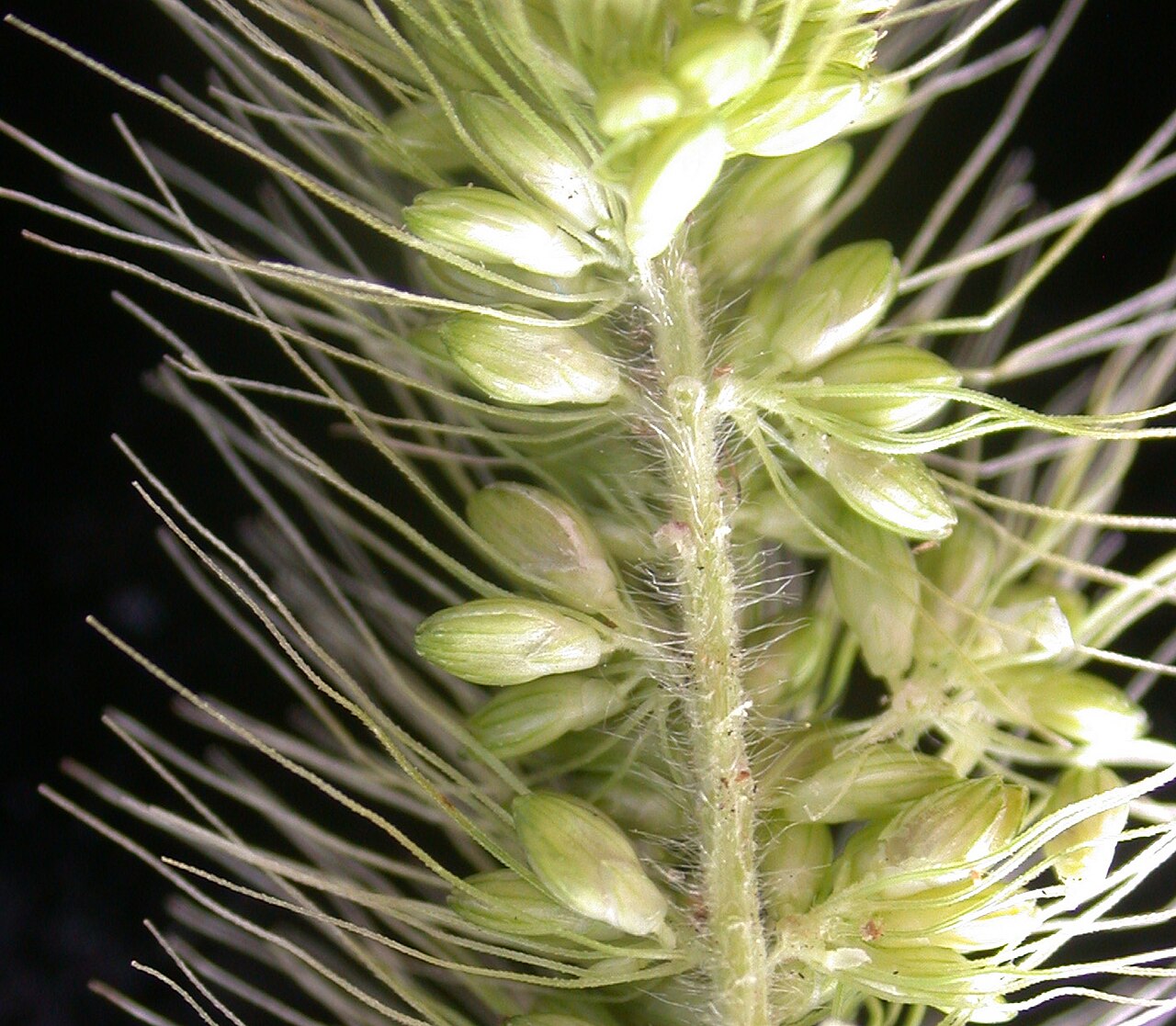
An enlarged part of the inflorescence shows spikelets and surrounding bristles. The whole plant, leaf sheaths and ligules are absent, so this photograph alone cannot separate every look-alike species.
Photo credit: Ayotte, Gilles, 1948-
References: http://cdm22018.contentdm.oclc.org/cdm/ref/collection/Botanique/id/13172
License: CC BY-SA 4.0
A reduced JPEG supplied by Wikimedia is used, with no additional cropping, format conversion or color changes.
Names and classification
The accepted name is Setaria viridis, in Poaceae. It shares a family with rice and maize but is a different species; this account does not cover every member of Setaria.
Observable features
Long leaves alternate along the stem, and spikelets form a dense, spike-like panicle. Examine the long bristles arising below the spikelets together with stems and leaves, rather than identifying the species by inflorescence color alone.
Distribution and habitat
Its native range extends through the Old World to central and southeastern Australia and includes Korea. It grows in disturbed soil such as fields and roadsides, in sun or partial shade.
Ecology and life cycle
It grows as an annual in many regions and reproduces by seed. Seeds fall from mature inflorescences, so new seedlings can appear after visible plants have been removed.
Cultivation and care
It is well suited to observing the inflorescences and leaves of existing plants rather than planting it to spread. Where unwanted in fields or pots, manage it before seeds ripen and avoid spreading soil and plant remains to other places.
Observation and use precautions
For similar foxtail grasses, compare leaf sheaths and ligules as well as inflorescences. Animal use of a grass does not mean it is safe food for people or pets.