
Amphibians
Caecilian
Caecilian
Classification and scientific name: Ichthyophis glutinosus
Sources checked:
Limbless amphibians: tentacles and underground life in a Sri Lankan representative
Caecilians are neither snakes, earthworms nor a salamander breed; this page uses Ichthyophis glutinosus as its example.
Origins and distribution
A representative species from Sri Lanka
- Ichthyophis glutinosus
- Sri Lankan representative species
- Observing species-specific ecology
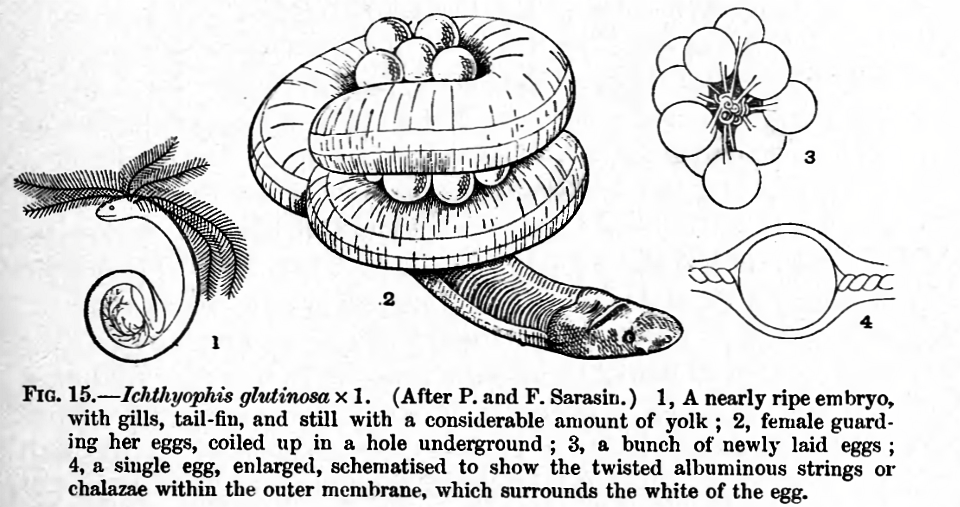
Illustration or historical material
Historical illustration showing a mother Ichthyophis glutinosus, eggs and developmental stages. This is not a photograph of a living animal; distinguish historical labels from current classification and reproductive explanations.
Source: Hans Gadow · Original material: CaecilianNHM.png · Public domain
1. Classification, origins and habitat
Caecilians are limbless amphibians, rather than snakes, earthworms or a breed of salamander. This page uses Ichthyophis glutinosus as its representative.
Caecilians form a major amphibian group distinct from frogs and salamanders; the Sri Lankan Ichthyophis glutinosus is the example here. Caecilians on different continents are not all one species or users of one breeding system. Check exact scientific names rather than substituting earthworm or snake photographs merely for a long limbless appearance.
2. Appearance and identification
An elongated, ringed-looking body, small eyes and sensory tentacles are characteristic.
Observe ring-like folds around the body, small eyes and sensory tentacles near the head. A pale lateral stripe helps describe this representative, rather than every caecilian. Skin folds resembling rings are not the same evolutionary structures as earthworm segments. Soil on an animal in a photograph can obscure fine details.
3. Behavior and way of life
Caecilians live in moist soil and use small invertebrates and other foods. Even without limbs, their skin and reproductive lineage differ from reptilian snakes.
They use small invertebrates in moist ground and explore with tentacles and chemical senses. Distinguish this species' egg and larval life from live-bearing and skin-feeding examples in other caecilians. Limbless amphibians do not all reproduce identically. Small eyes related to underground life do not mean an absence of senses.
4. Observation, conservation and care
Moist soil and water matter in the life cycle. Caecilians include many species, so do not merge every distribution and breeding system into this representative's account.
Moist soil, ground cover and water associated with the life cycle matter together. Excessive digging for observation damages microhabitats. Do not stretch bodies or inspect eyes and tentacles by hand. This page's visual material is a historical illustration of the Sri Lankan representative's mother, eggs and developmental stages. It should not be read as a live-animal photograph or proof of every current taxonomic and reproductive explanation; do not merge other caecilians' distinctive reproductive scenes into traits of this species.
Evidence and references
- Animal Diversity Web — University of Michigan — Ichthyophis glutinosus
Classification, origin, appearance and ecology
- American Museum of Natural History — Ichthyophis glutinosus
Current scientific names, synonyms, natural distribution and taxonomic research