
Birds
Barn swallow
Swallow
Classification and scientific name: Hirundo rustica
Sources checked:
Barn swallows connect aerial insects, mud nests and seasonal migration
Hirundo rustica is familiar for travelling between breeding and wintering grounds.
Origins and distribution
Northern Hemisphere breeding areas and lower-latitude wintering areas
- Barn swallow
- Aerial insects
- Mud nests
- Migration
Reference photograph
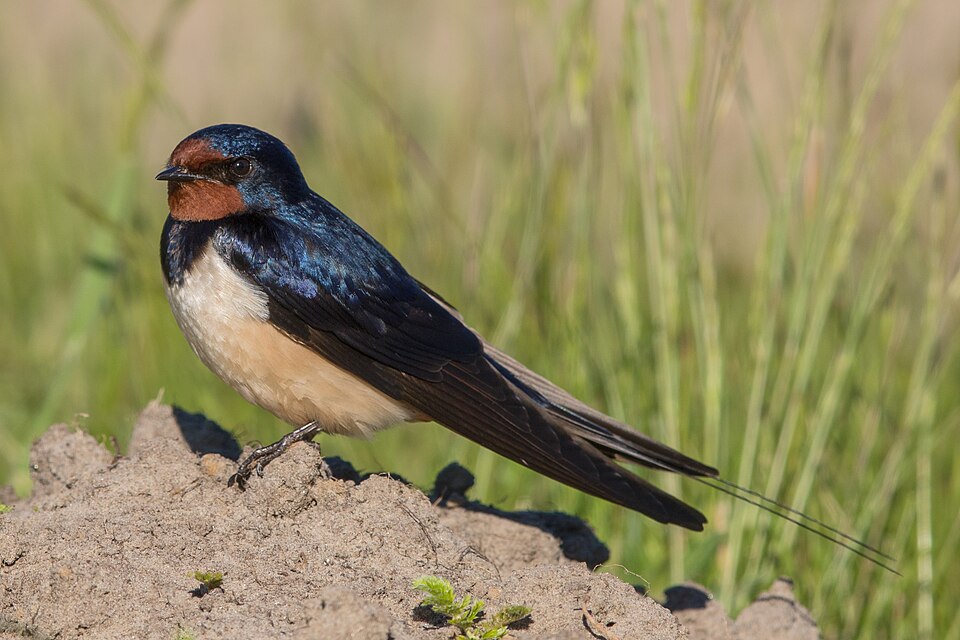
Reference photograph of a barn swallow. Compare the bird's colours and form with the identification details in the text.
Source: Andreas Trepte · Original material: Rauchschwalbe_Hirundo_rustica.jpg · CC BY-SA 2.5
1. Classification, origins and habitat
The barn swallow, Hirundo rustica, is familiar for travelling between breeding and wintering grounds. It breeds in many parts of the Northern Hemisphere, with migration routes and wintering areas differing among populations and regions. Some populations nest on human buildings, but buildings are not its only original habitat. It uses open places with airborne insects, water, mud and safe structures for attaching nests together. Other fast-flying birds, such as red-rumped swallows and swifts, differ in classification and nest form. Even saying that swallows return in spring requires a location and observation period; the calendar is not the same worldwide.
2. Appearance and identification
A deeply forked tail, pointed wings, dark blue-toned back and reddish face and throat are characteristic. Belly colour and band patterns can vary among regional populations and growth stages. Young birds can differ from adults in tail length and colour. The short bill and widely opening mouth relate to catching small insects in flight. A folded tail may show its fork less clearly in photographs, and light can make the back look black. Check the source's scientific name instead of treating white-rumped swallows or birds with different facial markings as simple colour variants of this species.
3. Behavior and way of life
Barn swallows catch insects in flight, skimming water or repeatedly circling open spaces. Nests are made of mud and plant material, and eaves and other building structures can provide breeding sites. Parents carry food to chicks and may gather with other birds to prepare for migration after breeding. Several birds perched on a wire show a moment of rest and gathering rather than necessarily the family composition of a nest. Rain and temperature affect insect flight, which can in turn change swallows' flying height and activity. A single bird behaviour should not be presented as a conclusive weather forecast.
4. Observation, conservation and care
If a nest is found in a place used by people, avoid removal during breeding and close photography, and consult local protection guidance. Droppings and bird safety can be considered together through measures such as supporting catch surfaces and appropriate distances. Pesticides, declining insects and changes to stopover sites are regional threats. Captions should specify species, growth stage and season, keeping swallow and swift lifespan and nesting information separate. Cultural stories about bringing good fortune should be presented separately from ecological facts. Seeing aerial food, mud nests and long migrations together reveals how a bird outside a building depends on a much wider environment.
Evidence and references
- Animal Diversity Web — Hirundo rustica
Classification, distribution, appearance, feeding and breeding behaviour
- Cornell Lab — Barn swallow
Barn swallow identification, flight, food, nesting and migration