
Fish
Ocean sunfish
Ocean Sunfish
Classification and scientific name: Mola mola
Sources checked:
A fish travelling into deep water with large fins and a seemingly truncated tail
The ocean sunfish is a bony fish that swims by moving the fins above and below its rounded body. Connecting its sideways resting at the surface with feeding in deep water reveals how its unusual body works.
Origins and distribution
Temperate and tropical seas worldwide
- Bony fish
- Clavus
- Vertical movement
- Gelatinous prey
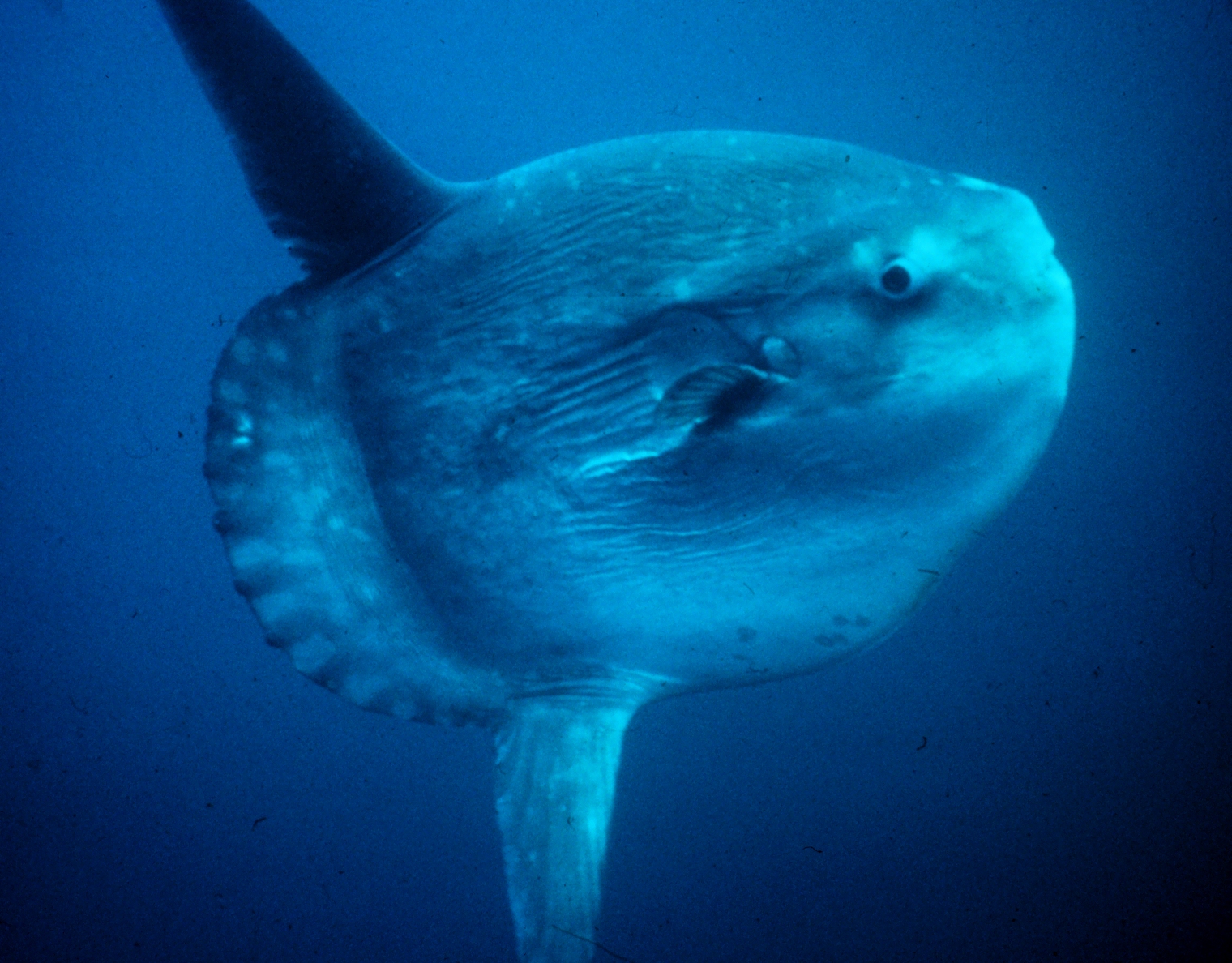
Reference photograph
Underwater photograph supplied by the U.S. NOAA as an ocean sunfish (Mola mola). The flattened body, long fins and scalloped clavus edge are visible; the original source does not specify whether the fish was captive.
Source: U.S. National Oceanic and Atmospheric Administration (NOAA) · Original material: Mola mola.jpg · Public domain (U.S. government / NOAA)
1. Classification, origins and habitat
The ocean sunfish is a marine fish in the family Molidae, order Tetraodontiformes; the species treated here is Mola mola. Taxonomically it belongs to the bony fishes and is related to puffers and filefishes, although its internal skeleton is mostly cartilage. The material of the skeleton alone does not make it a cartilaginous fish like a shark. A dorsal fin emerging at the surface can invite confusion with a shark, but the outline of the body and its rear structure reveal clear differences. Instead of considering parts missing against the familiar outline of other fishes, it is more accurate to examine the role of each part in this species.
It is observed in many temperate and tropical seas and lives primarily in the open ocean. Living offshore does not mean that it never approaches the coast. It may use coastal environments while feeding or having parasites removed by other fish. When interpreting distribution, distinguish a broad range on a world map from actual observation locations. A single photograph does not establish a breeding site, nor does the mapped range show that the species is equally common in waters where it has never been recorded.
Sunfishes include species other than Mola mola. They are distinguished by features such as the protruding head, rear body edge and skin, so treating all online photographs of huge sunfish as the same species produces errors. Records concerning the heaviest bony fishes particularly include Mola alexandrini. Copying those records as the average size of Mola mola loses both the species distinction and the exceptional nature of record individuals. The photograph on this page was identified by its source as Mola mola; the maximum record for the whole family is not given as the weight of this individual.
2. Appearance and identification
From the side, the sunfish looks large and rounded, with a short front-to-back body, while a frontal view reveals lateral flattening. Describing it only as thin can create confusion depending on the camera angle. The broad side and the narrow frontal cross-section are different views of the same animal. Its small mouth and eyes and short pectoral fins contrast with the large body, and the dorsal and anal fins extending far above and below it are especially conspicuous.
At the rear there is no narrow tail stalk or forked tail fin like those of a typical fish. Instead there is a rounded rim around the end of the body, the clavus. The apparently cut-off tail in photographs is the normal adult structure. The clavus of Mola mola has a wavy, scalloped margin that is also examined to distinguish related species. A blurry photograph of the edge alone, however, is insufficient for confident species identification. The viewing angle, growth stage, other identifying features and the source’s identification must also be checked.
Most swimming propulsion comes from the large upper and lower fins. Expecting only vigorous sideways movements of a conventional tail can cause the sunfish’s real movements to be missed. Video allows the dorsal and anal fin movements, direction of travel and steering by the clavus to be examined in sequence. Teeth fuse into plates resembling a beak, but a small mouth does not mean that the fish cannot feed. Photographs show body structure; video and observational records can supplement them with actual locomotion and food handling.
Young sunfishes also look different from adult photographs. Early stages are described as tiny rounded fish with spines around the body margins, changing to the familiar form as they grow. The Australian Museum explains that the features distinguishing adult species are absent in early stages, so identifying larvae requires research combining morphological observation and genetic analysis. A small spiny fish cannot therefore be excluded from the sunfish family merely because it lacks the adult shape. When comparing developmental photographs, first check whether they show material identified as the same species or examples of the family as a whole.
Thick tissue beneath the skin also helps support the sunfish’s large body in water. An anatomical study published by Davenport and colleagues in 2018 examined one individual measuring 67 cm in total length and weighing 17 kg. In that specimen the subcutaneous tissue was about 90% water, with collagen and elastic fibres interwoven like a network. This layer supplies buoyancy, supports the muscles moving the dorsal and anal fins, and provides pathways for tendons transmitting muscle force to the fins. An elastic membrane inside the body also separates the muscles of the upper and lower fins. The researchers interpreted the combination of these tissues and tendons as assisting muscle action during swimming. The rounded trunk is a combination of tissues producing movement in water, rather than simply a mass of weight.
3. Behavior and way of life
Sunfish are known to eat gelatinous animals such as jellyfish and salps. Saying that individuals of every age eat only jellyfish obscures the actual variety of their diet. Crustaceans and small fishes also occur in dietary accounts, with food use varying by growth stage and surroundings. The large body and small mouth should be considered together with the kinds of prey, rather than assuming the fish simply swallows food by chance. Its role in eating jellyfish also does not mean that it always keeps their numbers constant in a particular sea area.
Lying sideways near the surface is associated with the English name sunfish. This scene alone can suggest an animal that continuously drifts or readily loses its strength, yet tracking studies show active movements below the surface. A 2015 study by Nakamura and colleagues used animal-mounted cameras and sensors to record feeding on siphonophores at depth together with changes in body temperature. Fish were observed restoring body temperature in warm surface water after foraging in cold depths. These findings concern the individuals and conditions studied; they do not establish one cause for every surface behaviour.
Small fishes are also known to remove parasites from the body. Watching which body regions the surrounding fish approach, alongside the sunfish itself, makes these interactions easier to understand. The stationary sunfish and the small fish feeding around it form one situation. During reproduction, many tiny eggs are released into the water, but egg numbers do not equal the number of young surviving to adulthood. Early forms, species identification and wild growth still require research, so a short video or a captive record for one individual cannot explain the whole natural life cycle.
The 2015 tracking study described above took place in Funakoshi Bay, Iwate Prefecture, Japan, in July 2012 and July 2013. Researchers fitted recording devices to seven sunfish, 105–200 cm in total length, caught in set nets and released them; muscle-temperature sensors were also used on the three individuals studied in 2013. In this study, sunfish foraged mainly at depths of 100–200 m during the day, and their main prey, siphonophores, were frequently observed at 50–200 m where water temperatures were below 12°C. Recording camera footage of prey together with body movements, surrounding water temperature and muscle temperature enabled the researchers to connect feeding at depth with recovery of body temperature near the surface. Those depths and temperatures came from that summer study and do not define activity limits in every ocean or temperatures for keeping sunfish.
4. Observation, conservation and care
Conserving sunfish also requires examining bycatch, in which animals not targeted by fishing become caught in nets. A fisheries record of a sunfish catch differs from evidence that the species was deliberately targeted. Risks and outcomes vary with sea area, gear and study period, so one region’s bycatch proportion cannot be used as a fixed global ratio. Monterey Bay Aquarium’s information describes plastic bags entering the sea as a threat alongside bycatch. Swallowing objects resembling food can cause problems, linking proper disposal of waste on land to this offshore animal.
When encountering a sunfish from a boat or the shore, observe while leaving room for natural movement. Do not judge a sideways floating animal to be dying and touch it or herd it with a boat. Visible entanglement or injuries, however, need not be treated as normal behaviour. Recording the time, location, posture and presence of nearby boats or fishing gear provides more useful information than impressions alone. Where a decision about assistance is needed, reporting observations to the local marine-animal response organisation is more appropriate than hauling the animal out yourself.
Evidence and references
- Australian Museum — Ocean Sunfish, Mola mola
Classification, clavus and identification of similar species, habitat, and limits of life-history research
- Monterey Bay Aquarium — Ocean sunfish
Diet and growth stages, body structure, size records of other sunfish species, bycatch and plastics
- Nakamura, Goto & Sato (2015), Journal of Animal Ecology
Feeding at depth and recovery of body temperature near the surface observed with animal-mounted cameras and sensors
- Davenport et al. (2018), Journal of Anatomy — Locomotor structure of the ocean sunfish
Cartilage-rich internal skeleton, buoyancy of subcutaneous tissue, and fin-muscle and tendon structures documented by dissection of one individual
- Animal Diversity Web — Mola mola
Distribution, parasite-removal behaviour and reproduction. Maximum-size and conservation-status information from the 2011 account is not cited.