
Dog Breeds
Rottweiler
Rottweiler
Classification and scientific name: Canis lupus familiaris
Sources checked:
Black coloring with tan markings above the eyes and on muzzle, chest and legs, a broad head and strong body are characteristic
The Rottweiler is associated with dogs used for livestock movement, farm work and guarding around Rottweil in Germany. Black coloring with tan markings above the eyes and on muzzle, chest and legs, a broad head and strong body are characteristic.
Origins and distribution
Rottweil, Germany, and livestock-transport regions
- Rottweiler
- Rottweil, Germany, and livestock-transport regions
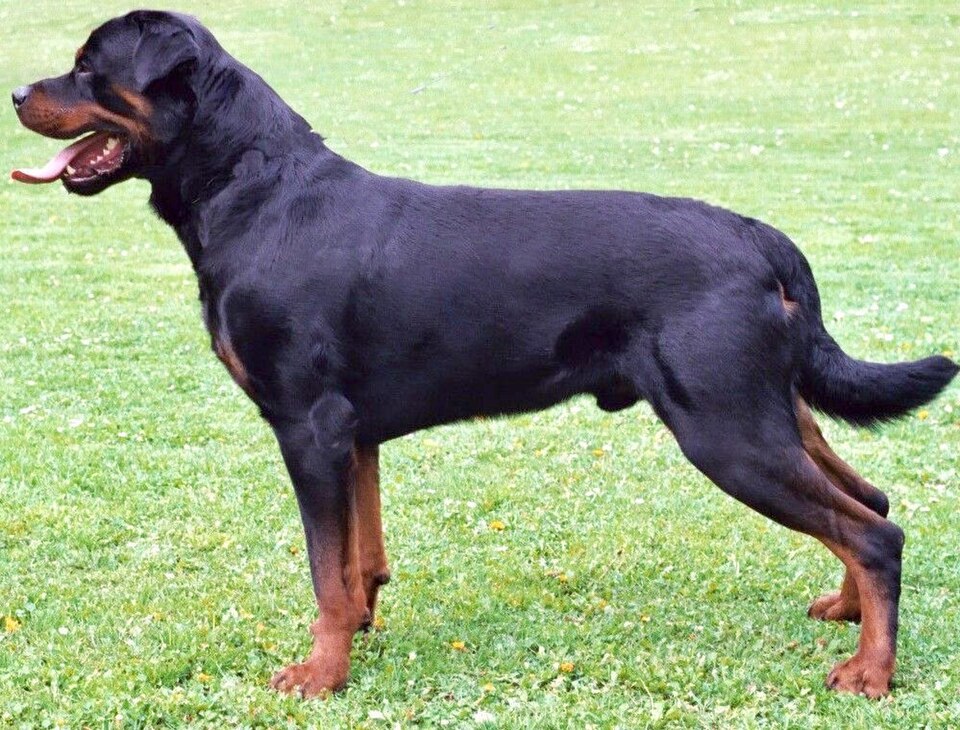
Reference photograph
Reference photograph of a Rottweiler. Examine this individual's color and form alongside the identification descriptions in the text.
Source: Dr. Manfred Herrmann Allgemeiner Deutscher Rottweiler-Klub (ADRK) e.V. http://www.ADRK.de · Original material · CC BY-SA 3.0
1. Classification, origins and habitat
The Rottweiler is associated with dogs used for livestock movement, farm work and guarding around Rottweil in Germany. Distinguish old Roman-era traditions from secure records of the modern registered breed. Today it also serves companion, sporting and working roles, but founding-line uses do not automatically emerge in every individual or guarantee the ability to protect people.
2. Appearance and identification
Black coloring with tan markings above the eyes and on muzzle, chest and legs, a broad head and strong body are characteristic. A short coat and naturally hanging ears can be seen. Short-tailed photographs may reflect surgery, so a long natural tail should not be described as outside the breed. Build and head proportions differ among puppies, adult males and adult females.
Black with tan in particular areas also occurs in dogs such as the Doberman, so color alone does not establish a Rottweiler identity. Observing broad head, sturdy body and naturally hanging ears together reveals differences in build. Both short- and long-tailed photographs reflect differences including surgical history; do not treat a long tail as outside the breed. Substance of the head and shoulders may vary with sex and growth stage.
3. Behavior and way of life
Many individuals learn tasks with people and watch their surroundings, but loyalty and vigilance do not authorize dangerous behavior. From youth, use safe socialization and reward-based training for lead walking, calm greetings and dropping objects. Considering strength and quick reactions, supervise contact with people and other animals and allow withdrawal when an individual is uncomfortable.
4. Observation, conservation and care
Monitor appropriate condition and gait, and prepare feeding and exercise suited to growth. A sturdy appearance is no reason to repeat heavy hauling or excessive jumping. Care for the skin beneath the short coat, paws and mouth, ensuring secure entrances, fencing and resting space. Check actual health tests and life experience; breed reputation cannot replace individual health or safe handling.
Evidence and references
- American Kennel Club — Rottweiler
Breed origins, form, behavioral tendencies and grooming
- Defra — Living environment and welfare of companion dogs
General principles of living space, food, normal behavior, social relationships and responsible care