
Dog Breeds
Irish Setter
Irish Setter
Classification and scientific name: Canis lupus familiaris
Sources checked:
A soft long coat of deep reddish brown, hanging ears, long neck and legs, and a slender body are characteristic
The Irish Setter developed in Ireland as a hunting dog that located birds and indicated their position. A soft long coat of deep reddish brown, hanging ears, long neck and legs, and a slender body are characteristic.
Origins and distribution
Ireland
- Irish Setter
- Ireland
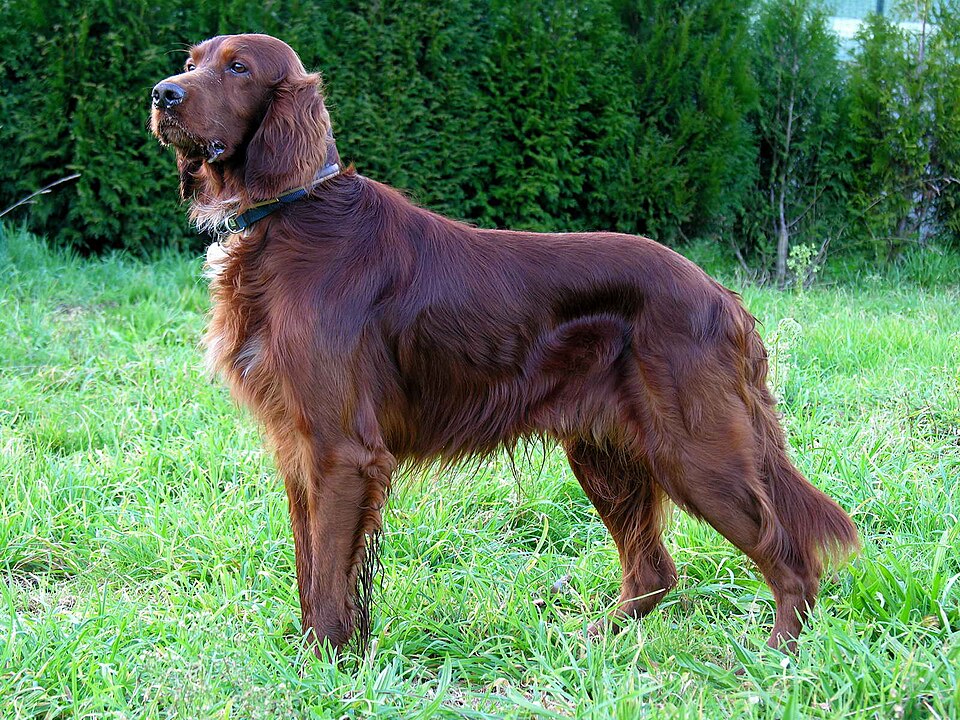
Reference photograph
Reference photograph of an Irish Setter. Examine this individual's color and form alongside the identification descriptions in the text.
Source: Luis Miguel Bugallo Sánchez ( Lmbuga Commons )( Lmbuga Galipedia ) Publicada por/ Publish by : Luis Miguel Bugallo Sánchez · Original material · CC BY-SA 3.0
1. Classification, origins and habitat
The Irish Setter developed in Ireland as a hunting dog that located birds and indicated their position. The word setter is connected with the historical lowered posture used on finding game. Distinguish origins associated with red-and-white setters from the registration scope of today's red Irish Setter. Alongside its beautiful-coated companion role, it has a history of activity in broad outdoor spaces.
2. Appearance and identification
A soft long coat of deep reddish brown, hanging ears, long neck and legs, and a slender body are characteristic. Feathering occurs on the ears, chest, legs and tail. Wet fur or a trimmed coat can alter the impression. When linking a streamlined body to healthy build, check actual body condition and growth stage instead of relying on photographs alone.
Feathering on the long ears, legs and tail can make body lines appear even longer in running or windblown photographs. The depth of reddish brown varies in appearance with lighting and coat condition, so one color name cannot determine an individual's line or abilities. The Irish Red and White Setter shares related history but is now treated as a separate breed. Do not mix red-and-white appearances into this page's typical solid-colored description; check precise breed information.
3. Behavior and way of life
Many individuals eagerly explore movement and scents in wide spaces. The word cheerful does not guarantee following people without training or constant safety around children. Use rewards to teach recall, waiting and calm encounters, and use a secure lead and fencing. Understand both hunting interests and the rules of companion life.
4. Observation, conservation and care
After grassy or wooded outings, check ears, paws and long feathering for tangles and foreign material. Divide exercise into walking, exploration and play appropriate to age and health instead of filling life with repeated sprinting alone. Manage safe rest, feeding routines and body condition together. Finding game does not mean getting along with every small animal, so introduce encounters carefully.
Evidence and references
- American Kennel Club — Irish Setter
Breed origins, form, behavioral tendencies and grooming
- Defra — Living environment and welfare of companion dogs
General principles of living space, food, normal behavior, social relationships and responsible care