
Mammals (Horses)
Suffolk Punch
Suffolk Punch
Classification and scientific name: Equus caballus
Sources checked:
A chestnut coat, deep body and powerful shoulders are characteristic
The Suffolk Punch is an agricultural draft horse from Suffolk, England. It is one of the traditional livestock breeds managed by conservation organizations. A chestnut coat, deep body and powerful shoulders are characteristic. Its appearance can be compared with other draft horses that have extensive feathering around the lower legs.
Origins and distribution
Suffolk, England
- Suffolk Punch
- Suffolk, England
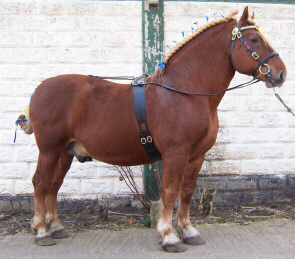
Reference photograph
Reference photograph of a Suffolk Punch horse. Compare the photographed individual's color and form with the identification information in the text.
Source: Suffolkp at English Wikipedia · Original material · Public domain
1. Classification, origins and habitat
The Suffolk Punch is an agricultural draft horse from Suffolk, England. It is one of the traditional livestock breeds managed by conservation organizations.
The breed has a history of selection for powerful work in eastern England's farming areas. Conserving a traditional breed involves not only the number of living animals but also the diversity of breeding lines. Descriptions of rarity need to identify the country and date of the underlying survey.
2. Appearance and identification
A chestnut coat, deep body and powerful shoulders are characteristic. Its appearance can be compared with other draft horses that have extensive feathering around the lower legs.
The chestnut coat, deep body and strong shoulders are characteristic, while shades vary between individuals. Feathering may appear less extensive than in other draft breeds. Punch relates to the compact body type; it does not mean every individual has identical height and weight.
Chestnut includes a range of light and dark shades. Observing the deep body, shoulders and proportions of the head and legs together reveals draft-horse structure better than treating the breed as a uniform color sample.
3. Behavior and way of life
The breed was selected for agricultural work and also attracts conservation interest. Apparent rarity varies with the country and date of the data.
Distinguish its earlier role pulling heavy farm equipment from modern exhibition and conservation uses. A reputation as a regional working horse does not mean it can withstand unlimited heavy loads and long work. An individual's age and training, the ground and equipment determine working conditions.
4. Observation, conservation and care
Descriptions of a rare breed need to be read alongside registration criteria and survey dates. Breeding should consider genetic diversity together with individual health.
Breeding should consider pedigree records and health together, rather than simply reproducing a chestnut appearance. During quieter periods, check that feeding matches activity and body condition. A large horse also needs room to move and lie down comfortably, hoof care and opportunities for companionship.
Evidence and references
- Oklahoma State University — Suffolk Punch
Classification, origins, appearance, ecology or breed uses
- Defra — Welfare code for horses and ponies
Suitable surroundings, feed, companionship, training and long-term care responsibilities