
Mammals (Horses)
Camargue Horse
Camargue Horse
Classification and scientific name: Equus caballus
Sources checked:
Adults are commonly gray, while foals are born dark.
The Camargue horse is associated with the wetlands of the Rhône delta in southern France. It was used locally for riding while handling livestock. Adults are commonly gray, while foals are born dark. A compact body and conformation adapted to the regional environment are characteristic.
Origins and distribution
Camargue, France
- Camargue
- Camargue, France
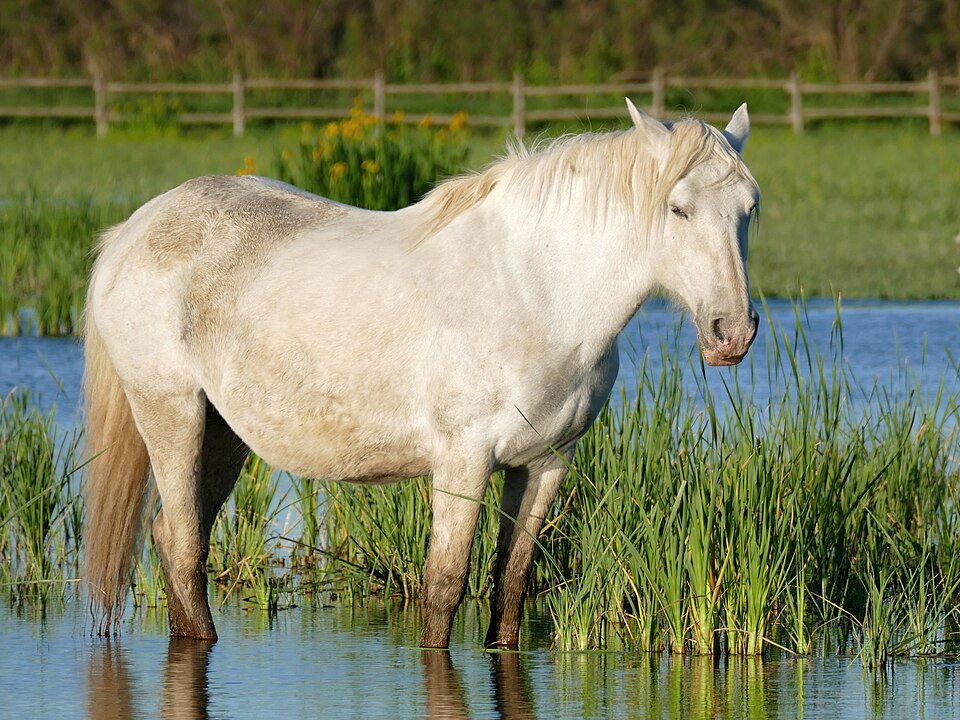
Reference photograph
Reference photograph of Camargue Horse. Compare the color and form of the individual shown with the identification notes in the text.
Source: Bernard DUPONT from FRANCE · Original material · CC BY-SA 2.0
1. Classification, origins and habitat
The Camargue horse is associated with the wetlands of the Rhône delta in southern France. It was used locally for riding while handling livestock.
This is a managed domestic horse population developed in the delta wetlands and local livestock culture. Photographs of horses running through water are famous, but the animals should not be described as a primitive wild species remaining apart from people. Wetland landscapes and traditional riding can be considered together.
2. Appearance and identification
Adults are commonly gray, while foals are born dark. A compact body and conformation adapted to the regional environment are characteristic.
Dark-coated foals often become light gray as they grow. A light adult coat does not indicate albinism with white skin. In a full-body photograph, observing the compact body, relatively short legs and full mane together reveals the structure of the small build.
3. Behavior and way of life
They live in groups in wetland grazing environments and form a managed domestic horse population. Outdoor-life photographs are not evidence of a completely wild species unrelated to people.
Used locally in riding work with cattle, their lives connect with group living on grazing land. Crossing water does not mean that they live permanently in it like aquatic animals. Distinguish a group made to run for photography from ordinary feeding and resting.
4. Observation, conservation and care
In photographs, observe seasonal water levels, ground conditions and coat-color changes together. It is useful to distinguish regional ecology from traditional livestock use.
Water levels, mud, hooves and leg condition influence life in wetlands. Do not chase horses or block their movement to take photographs. Even a breed adapted to its local environment needs water, food, dry resting space and protection when necessary as part of basic care.
Evidence and references
- Oklahoma State University — Camargue
Classification, origins, appearance, ecology or uses of the breed
- Defra — Welfare guidance for horses and ponies
Suitable environment, food, companionship, training and long-term responsibility for care