
Mammals (Horses)
Tennessee Walking Horse
Tennessee Walker
Classification and scientific name: Equus caballus
Sources checked:
Coat colors vary; the running walk is a more important distinguishing feature than body shape
The Tennessee Walking Horse is an American riding breed developed around gait characteristics. Its name relates to a particular walking gait. Coat colors vary; the running walk is a more important distinguishing feature than body shape.
Origins and distribution
Tennessee, United States
- Tennessee Walking Horse
- Tennessee, United States
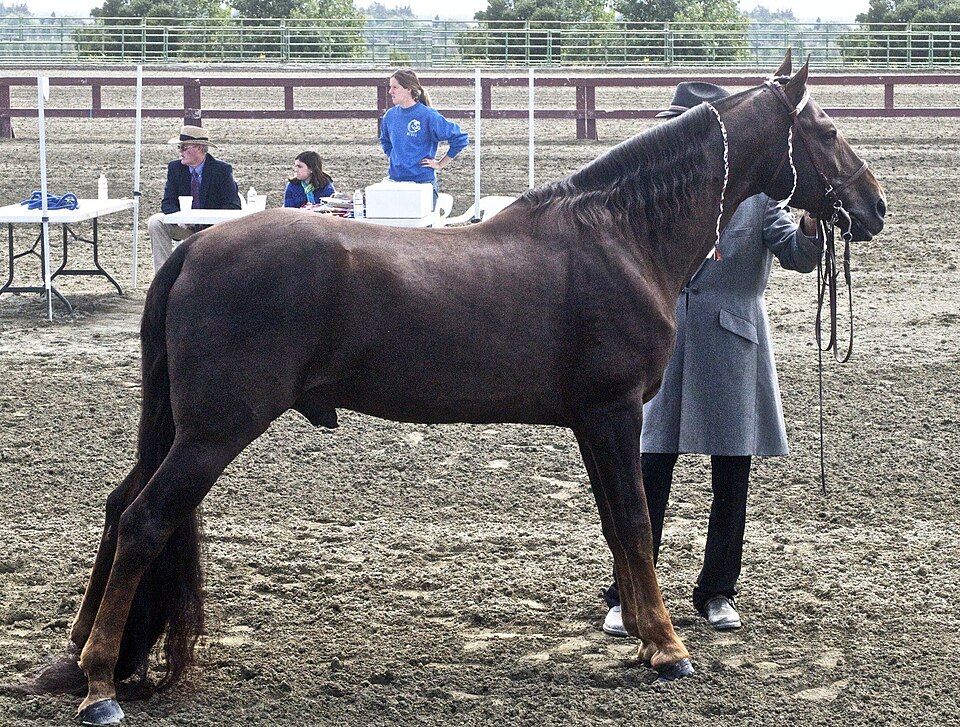
Reference photograph
Reference photograph of a Tennessee Walking Horse. Compare the photographed individual's color and form with the identification information in the text.
Source: Just chaos · Original material · CC BY 2.0
1. Classification, origins and habitat
The Tennessee Walking Horse is an American riding breed developed around gait characteristics. Its name relates to a particular walking gait.
It developed from several North American horse lines through selection for a gait suited to comfortable, long-distance riding. Walking in the name does not simply mean a horse that walks slowly; it belongs to the context of the gait that distinguishes the breed. Understand it using criteria different from speed records in flat racing.
2. Appearance and identification
Coat colors vary; the running walk is a more important distinguishing feature than body shape.
A still photograph can show the long neck and balanced body, but a sequence of movements or video is needed to assess the rhythm of the running walk. Coat colors vary, so color is not the breed's central identification criterion. A single photographed moment with a lifted foot cannot establish a trot, pace or distinctive gait.
3. Behavior and way of life
The running walk is a gait in which the feet move in a four-beat sequence. Do not describe this gait as the same movement as an ordinary trot.
Observing the four-beat footfall sequence together with head movement reveals differences from an ordinary trot. Even where inherited gait tendencies exist, experience and physical condition influence an individual's actual movement. Descriptions of a comfortable ride must not be treated as an automatic safety guarantee for every rider.
4. Observation, conservation and care
Distinguish natural gait from artificially exaggerated movement. Check hoof and leg condition, training methods and actual riding experience together.
Distinguishing exaggerated high leg action from natural gait is important. Do not confuse painful methods used to produce a movement with the breed's normal gait. Management should consider hoof and leg condition alongside humane training practices.
Evidence and references
- Oklahoma State University — Tennessee Walking Horse
Classification, origins, appearance, ecology or breed uses
- Defra — Welfare code for horses and ponies
Suitable surroundings, feed, companionship, training and long-term care responsibilities