
Reptiles
Green anaconda
Green Anaconda
Classification and scientific name: Eunectes murinus
Sources checked:
A waterside boa: distinguish large females from general size records
Green anacondas are adapted to life near water; recent species-delimitation research involves debate, so check scientific names and studied populations.
Origins and distribution
South America
- Eunectes murinus
- South America
- Observing species-specific ecology
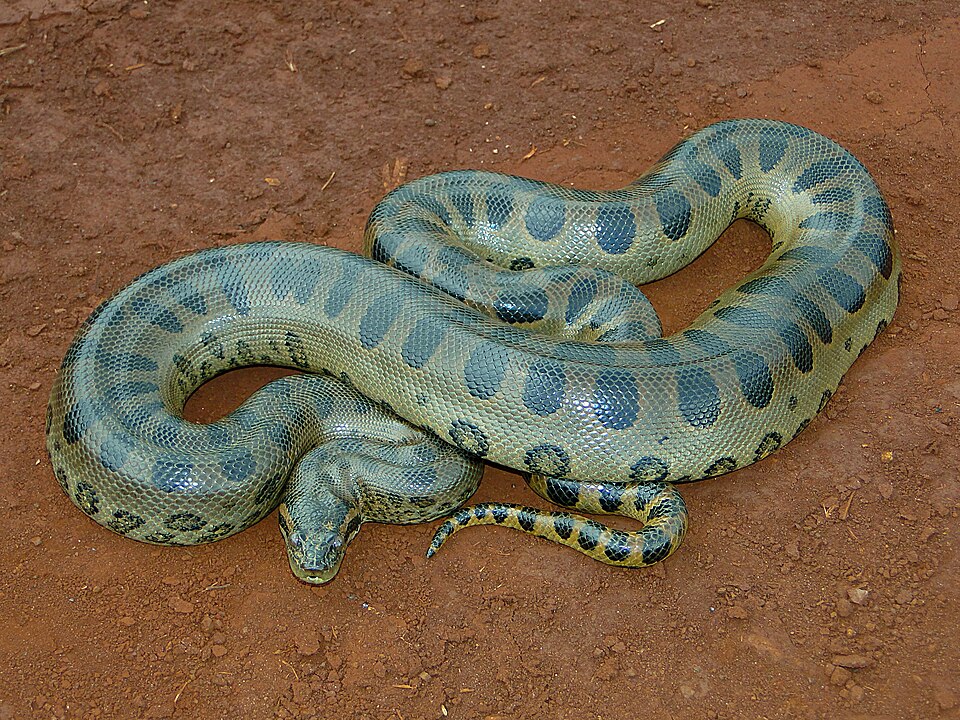
Reference photograph
Reference photograph of a green anaconda. Compare its colours and form with the identification details in the text.
Source: MKAMPIS · Original material: Sucuri_verde.jpg · CC BY-SA 4.0
1. Classification, origins and habitat
The green anaconda is a boa-family snake adapted to waterside life. Recent species-delimitation research involves debate, so check the scientific names and populations studied.
Anacondas are South American boas, and species boundaries within green anaconda populations remain a subject of discussion. This page uses material identified as Eunectes murinus. Broad older distribution maps cannot simply be allocated across all currently discussed species; consider study location, scientific name and publication date together.
2. Appearance and identification
A thick body, dark spots on a greenish-brown background, and eyes and nostrils near the top of the head are characteristic. Females tend to be larger than males.
High-set eyes and nostrils relate to exploring surroundings with most of the body in water. The large size difference between sexes means that estimating ordinary size only from extremely large females is misleading. Compare the spotted greenish-brown body, thickness and head markings together with other anacondas.
3. Behavior and way of life
Green anacondas are predators that subdue prey by constriction. Do not describe them as using the same feeding method as fanged cobras.
They use various vertebrates in and beside water, subduing them by wrapping and constricting. A large snake does not therefore seek people as its staple food. Chemical exploration with the tongue, underwater movement and resting positions are different observation points. Breeding aggregations should not become a claim of year-round life in the same group.
4. Observation, conservation and care
Green anacondas use rivers, swamps and other water-containing environments. Records of very large females should not become average length and mass for every individual.
Connections among rivers, swamps and waterside vegetation relate to concealment, movement and food acquisition. Being underwater does not imply fish-like gill breathing; this reptile breathes air. Distinguish wild observation from catching or stretching large animals to measure them. Photographic angles can exaggerate size, so avoid adding maximum records without verified specimen information.
Evidence and references
- Animal Diversity Web — University of Michigan — Eunectes murinus
Classification, origin, appearance and ecology
- The Reptile Database — Eunectes murinus
Scientific names, synonyms, distribution and related taxonomic research