
1. A green curtain photographed from space
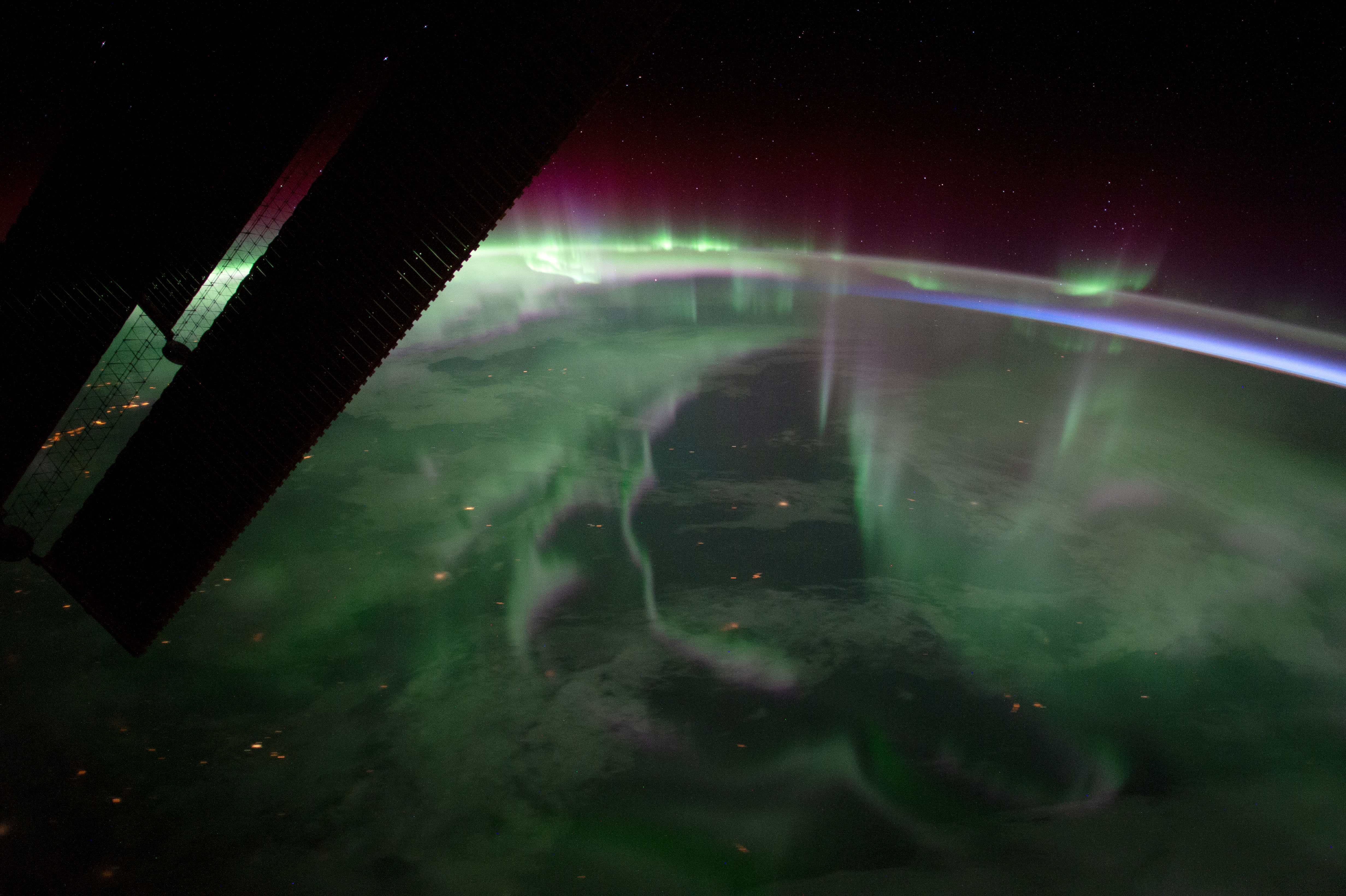
A green curtain spreads beyond dark structures, with purple and red light above Earth's curved edge. This photograph shows the northern lights captured by NASA astronaut Randy Bresnik from the International Space Station on September 15, 2017. The station was passing over Ontario, Canada. NASA identifies the image as ISS053-E-23965; it was taken with a Nikon D4 camera and a 24-millimeter lens. Start by recognizing that this is an orbital view of atmospheric light, rather than a view looking up from the ground.
First separate the vertical strands of green light, the scattered small lights below them, and the bright band on the right-hand horizon. Being recorded together does not mean they all shine for the same reason. This frame includes aurora, city lights, airglow and the light of an approaching sunrise. It is also not an experiment placing a ground observer's naked-eye view beside photographic colors. Explaining the colors in an image differs from judging how a person would have seen the scene.
2. Light emitted by the atmosphere, rather than reflected sunlight
Auroral light is emitted by atoms and molecules in the upper atmosphere after they receive energy. When fast electrons collide with atmospheric particles such as oxygen and nitrogen, those particles can enter excited energy states. Their subsequent release of energy as light produces the aurora we see. This emission differs from clouds reflecting moonlight or rainbows refracting sunlight. Reading the green as a reflection of forests on the surface, or as green clouds, misses its cause.
The energy connection involves the solar wind and Earth's magnetosphere. Interactions between the solar wind and its magnetic field and Earth's magnetic environment transfer energy into the magnetosphere. Electrons there can be accelerated toward the upper atmosphere along magnetic field lines. It is therefore more accurate to consider energy transfer and electron acceleration than to assume every particle arriving from the Sun directly strikes the atmosphere. Auroras occur in both hemispheres and are commonly associated with oval regions around the magnetic poles. Northern and southern lights are not flames made of different materials.
3. The same oxygen can emit green and red
Both the characteristic green and red are associated with emissions from oxygen atoms. Even the same element emits different light depending on the energy state involved. Nitrogen emissions are important in explaining blue, pink and purple auroras. The visible color depends jointly on the gas, its energy states, its atmospheric distribution and collision conditions. It is wrong to call only green auroras real and other colors fake, and it is also wrong to attribute every red light to nitrogen.
Air density and particle distribution change with altitude, affecting which emissions are prominent. Excited particles can also lose energy through collisions before emitting light. You need not memorize color altitudes as fixed, nonoverlapping layers: multiple emissions overlap along the line of sight, and the camera adds its own color rendition. Considering these physical conditions and photographic limits, this article does not determine an exact altitude or gas proportion from color alone. Such measurements require observations beyond an ordinary color photograph.
4. Why an aurora can look vivid in a photograph but faint to the eye
In dim light, human eyes can notice brightness differences while struggling to distinguish colors. A weak aurora may therefore be described as gray or whitish bands. Bright auroras can show color to the naked eye too, so it is also wrong to say that auroral colors appear only in cameras. Consider both light intensity and the eye's state of adaptation; one person's difficulty seeing color should not be generalized to all auroras.
A camera records incoming light during an exposure, then forms an image through its sensor and image processing. NASA explains that modern digital cameras can record auroras too faint for the naked eye. A vivid photograph and an observer's description of faint light can therefore both be valid. That does not mean a camera always shows more accurate colors. Check the settings and processing used for the released image. This photograph cannot establish that its brightness or color intensity exactly reproduces what the astronaut saw.
5. Not every light on the horizon is an aurora
NASA identifies the small scattered lights near the bottom as city lights on the ground. It also describes airglow along Earth's limb separately from the aurora. Airglow is upper-atmospheric emission; the description accompanying this image connects it to chemical reactions triggered by sunlight. The bright bluish-white light on the right-hand horizon is the approaching sunrise. Distinguishing these sources, rather than stopping at the green curtain's shape, lets you read both the space environment and Earth's day-night boundary in the same photograph.
The released image also has a documented processing history. NASA Earth Observatory states that this version was cropped, contrast-enhanced and cleaned of lens artifacts. This site uses that distributed JPEG without additional cropping or color changes. The institution's earlier processing and this site's use of the file are separate stages. Processing does not make the observation itself fake, but the result should not be presented as unprocessed sensor data or an exact reproduction of human vision.
6. Four things to check in your next aurora photograph
For a new image, check the shooting location and date, image identifier or equipment, disclosed processing, and other visible light sources, in that order. Ground photographs and station photographs face different directions. Even images from the same day may not be comparisons of the same scene if location and time differ. Instead of turning one frame's colors into altitude measurements or a forecast for a particular area, distinguish the source's actual observations from interpretations added by the reader.
A single photograph also cannot guarantee a sighting when you wait for an aurora yourself. Alongside current space-weather information, consider clouds, surrounding lighting and your view of the horizon, and observe from a safe place. To compare photographs with naked-eye impressions, record location, time and photographic conditions together. Different records do not immediately prove manipulation or a failed observation. The green light here offers a clue to atmospheric emission; reading that clue accurately requires examining both the cause of the light and how it was recorded.