# Astrophysics of Black Hole Event Horizons and Thermodynamics: Hawking Radiation, Bekenstein Entropy, Information Paradox, and Quantum Holography
An exhaustive theoretical astrophysics masterclass on rotating Kerr black holes, the thermodynamics of event horizons, and quantum gravity holography.
Key physical principles and relativistic breakthroughs covered in this deep dive:
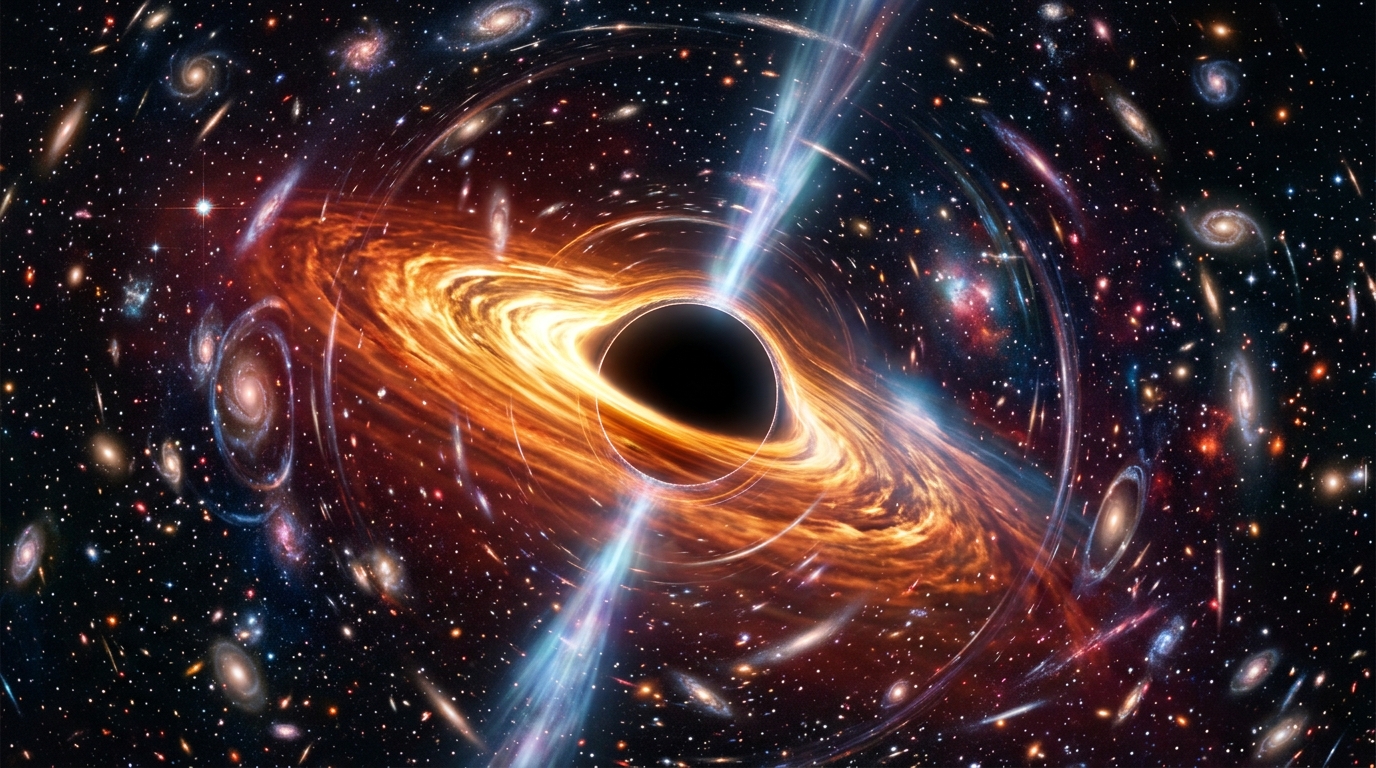
The Anatomy of Extreme Gravity: Relativistic accretion disk Doppler beaming creating asymmetric luminous intensity, the 2.6x event horizon shadow, the unstable photon sphere (r_ph = 3GM/c^2), and Blandford-Znajek relativistic plasma jets propelled by twisted magnetic fields.
Geometry of Rotating Kerr Black Holes: Frame-dragging (Lense-Thirring effect) within the ergosphere, the static limit surface vs the outer event horizon (r_+), and Penrose process energy extraction capturing up to 29% of the hole's rotational mass-energy.
Accretion Disk Thermodynamics: Converting gravitational potential energy to radiation with an unprecedented 42.3% efficiency for maximally spinning holes—over 60 times more efficient than hydrogen nuclear fusion.
Four Laws of Black Hole Mechanics: Complete mathematical isomorphism with classical thermodynamics; Bekenstein-Hawking entropy formula (S_BH = k_B c^3 A / 4 G ħ) establishing that information capacity scales strictly with 2D boundary surface area, birthing 't Hooft and Susskind's Holographic Principle.
Hawking Radiation & Quantum Vacuum Fluctuations: Particle-antiparticle pair production at the horizon boundary, negative energy tunneling into the interior, and the Hawking temperature (T_H = ħ c^3 / 8π G M k_B) with negative heat capacity leading to eventual explosive evaporation.
The Black Hole Information Paradox: Unitary quantum evolution vs thermal blackbody radiation, Don Page's entanglement entropy Page curve, the AMPS firewall paradox, and the AdS/CFT holographic resolution (ER = EPR quantum wormholes).