
1. A blue evening on the Red Planet
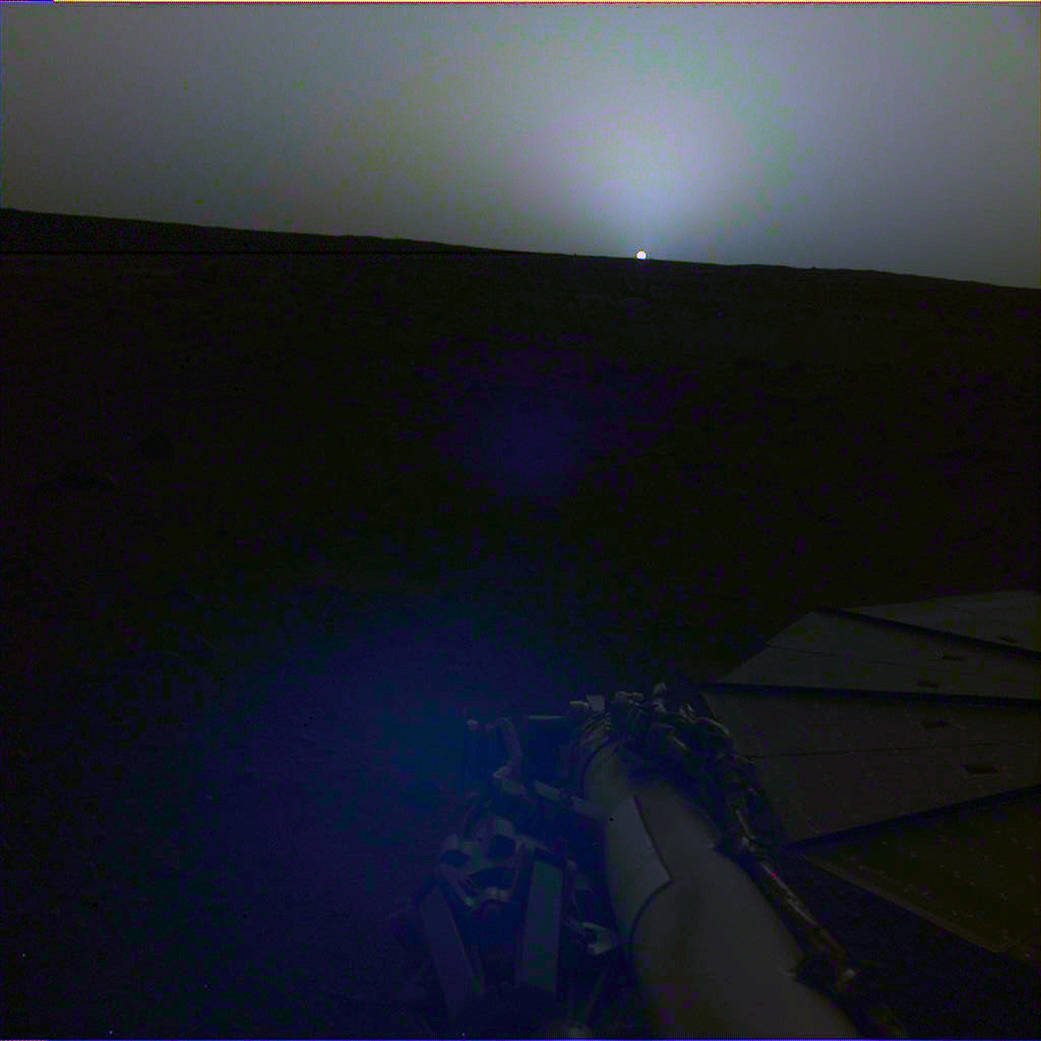
Mars is called the Red Planet, but scenes photographed there are not entirely red. In this article's photograph, pale blue-gray light spreads around a low Sun above dark ground. NASA's InSight lander recorded this sunset on April 25, 2019, using the Instrument Deployment Camera (IDC) at the end of its robotic arm. It was released as a record from about 6:30 p.m. local Mars time on the mission's 145th sol. A sol is a Martian day used to count mission dates; it is not the same notation as an Earth calendar date or the reader's local time. The first step is to distinguish this scene from famous sunset images taken by other spacecraft.
The featured photograph is the color-corrected version of PIA23202 released by JPL. It is neither an invented image made by putting a blue filter over an Earth sunset nor an artist's impression of a future mission. However, its screen colors do not perfectly reproduce what every person standing there would see. JPL provides both raw and color-corrected versions, explaining that the latter more closely represents human vision. Reading the photograph means considering together the real subject, the camera's recording of data, and the color processing used to display it.
2. Start with Earth's red sunsets
Sunlight contains a mixture of visible wavelengths. A major reason Earth's clear daytime sky looks blue is that air molecules scatter shorter wavelengths more strongly. Scattering changes light's direction as it interacts with matter. Our eyes receive not only light arriving directly from the Sun's direction but also light scattered toward us from other parts of the sky. To discuss sky color, therefore, we must first distinguish looking at the solar disk from looking at nearby or overhead sky. The Sun itself does not become a blue star during the day and a red star in the evening.
Near sunset, sunlight travels along a long, slanting path through the atmosphere before reaching an observer. As shorter wavelengths are scattered out of that path in different directions, red and orange can make up a greater proportion of the light continuing toward the observer. Clouds and aerosols also affect the actual colors, so sunsets do not have identical colors or brightness every day. The key is to consider atmospheric composition and particles, the path light has traveled, and the viewing direction together. Simply applying Earth's familiar sequence of colors to another planet overlooks what that planet's atmosphere does.
3. Fine Martian dust changes the directional pattern
NASA identifies fine dust suspended in Mars's thin atmosphere as central to understanding its blue sunsets. Martian dust differs in size and properties from Earth's air molecules and consequently distributes light differently. Among the light arriving from the Sun, blue light remains relatively concentrated around lines of sight close to the Sun, while yellow and red spread across broader directions in the sky. Blue hues around the Sun can therefore become prominent when it is low. This does not mean dust grains glow like blue paint or that the atmosphere produces only blue light.
The important point is not that blue light undergoes no scattering, but that the distribution of directions in which light arrives differs by color. JPL's account of Curiosity observations likewise emphasizes how dust-scattered blue light stays closer to the Sun's direction than other colors. It would therefore be misleading to summarize the effect as the whole Martian sky turning blue like Earth's clear midday sky. A yellowish or reddish daytime sky and blue light around the setting Sun can both occur. Avoiding the generalization of one direction's color into a fixed color for the entire planet connects the photograph more accurately with its explanation.
4. Even on Mars, sunsets vary
As the Sun gets lower, light travels farther through the atmosphere, which can make dust-related color differences more apparent. But the vividness of the blue in a photograph cannot be explained by dust quantity alone, nor does a bluer image necessarily mean more dust. Real observations require consideration of dust conditions and distribution, solar elevation, viewing direction, and camera characteristics together. NASA describes Perseverance's November 9, 2021 sunset as a case in which little atmospheric dust made the colors less pronounced than usual. This comparison is neither a color chart applicable to every photograph nor a simple formula for measuring dust.
A single sunset image must also be distinguished from a record of the twilight that follows. Even after the solar disk disappears below the horizon, dust high in the atmosphere can scatter sunlight and leave a faint glow in the sky. Researchers use brightness, color, and observing conditions at multiple times together to investigate how high dust extends through the atmosphere. This article's single still photograph cannot directly reveal the duration of twilight or the altitude of the dust. A beautiful scene becomes scientific data through knowledge of when, where, with which instrument, and how it was recorded, as well as through its visual colors.
5. Color correction and false color mean different things
Camera sensors do not respond to light in exactly the same way as human eyes. In JPL's release of this scene, some details are easier to see in the raw version, while the color-corrected version is intended to more closely resemble human vision. The label “raw image” used for that public version should not be expanded into a claim that it is completely unprocessed sensor data. Nor does correction make a real observation fake. It is more accurate to check the purpose of the version being viewed and interpret its colors within the limits stated in the original description.
A false-color image that assigns different colors to temperatures in thermal-infrared data serves a different purpose. The value represented by blue in such data is not the same information as blue light in a visible-light sunset photograph. This article's image does not map Martian surface temperatures in blue, and a blue-looking sky does not establish a temperature or the presence of water. Display brightness and color settings can also change the impression, so a color value sampled from a web photograph should not be treated as a precise spectroscopic field measurement. Checking the image version and the instrument's observing range first helps prevent confusion between different kinds of blue Mars images.
6. What this photograph shows, and which questions remain
Look again at the photograph: first the bright region around the low Sun, then the spreading blue-gray sky, and finally the boundary of the dark-looking ground. The source lets you check that the spacecraft was InSight, the date was April 25, 2019, the camera was IDC, and the selected version was color-corrected. For this article, the supplied JPEG was downloaded and used without cropping or color changes. Correction at the source and additional editing on this site are separate stages. To find the same photograph again, use the identifier PIA23202 together with the version name to avoid confusing it with the raw version.
When moving beyond observation, keep track of information absent from the photograph. One image cannot establish that day's air temperature, the exact size or concentration of dust, the color of the entire sky, or the length of the subsequent twilight. The blue is not evidence of an Earth-like atmosphere or an ocean, either. The scene shows that the same sunlight can reach us in different colors after encountering particles in a different atmosphere and different observing conditions. A useful starting point for understanding Martian sunsets is to go beyond naming a mysterious color and read both the path taken by the light and the process that produced the photograph.