
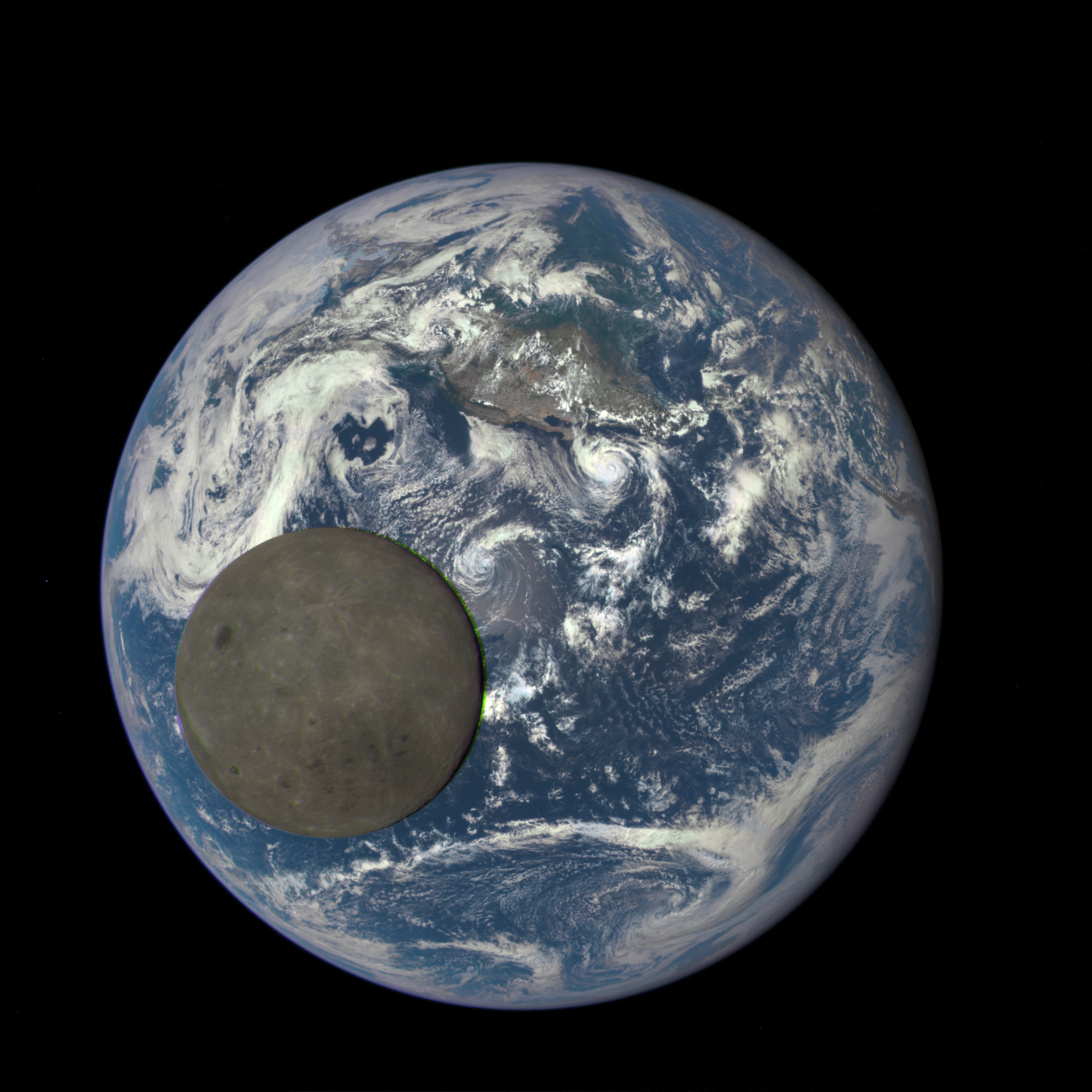
1. Darker than Earth, yet lit by the Sun
A gray-brown Moon overlaps blue Earth. Against Earth’s white clouds, it looks dark and unfamiliar, but light and dark surface markings are clearly visible. This scene was not photographed through a telescope on Earth. On July 16, 2015, NASA’s EPIC camera aboard DSCOVR observed the Moon crossing in front of Earth. The Moon covers part of Earth at the lower left, showing its far side instead of the familiar near side. The first question is not how dark the Moon looks, but where the camera is and which way it is looking.
DSCOVR observes Earth from near L1, the first Lagrange point between the Sun and Earth. At about 1.5 million kilometers from Earth, it can look toward Earth’s sunlit side. When the Moon crosses this field of view, the side we cannot see from Earth also faces the camera while illuminated. This is a publicly released color composite of actual observations, not an imagined scene made by arbitrarily pasting a separate Moon photograph onto Earth. Assuming the camera was on Earth’s surface can make a possible scene seem impossible.
2. Far side refers to Earth, not the Sun
The near side is the lunar hemisphere facing Earth; the far side is the opposite hemisphere. Day and night, meanwhile, depend on whether a surface receives direct sunlight. These are different reference systems. As the Moon orbits Earth, sunlight moves across its surface, so the far side also has days and nights. A crescent or full Moon mainly reflects a change in how much of the illuminated part of the same near side we can see. The Moon is not turning a new face toward us every day, and Earth’s shadow does not produce its ordinary phases.
This photograph corrects the idea that the whole far side is eternally night. Most of the lunar disk is illuminated, with a thin dark sliver remaining along its right edge. Around new Moon, when the Moon is barely visible from Earth, a camera elsewhere can see its bright far side. Separately, some crater floors near the lunar poles are permanently shadowed and receive no direct sunlight. Those particular terrain shadows do not define the entire far side. Nor can this single photograph reveal polar ice or the temperature of a crater floor.
3. The Moon does rotate, even while showing the same face
The Moon shows nearly the same face to Earth because it rotates synchronously, not because it does not rotate. It turns once on its axis in the time it takes to orbit Earth once: a state called tidal locking. Place a chair in the middle of a room and walk around it while facing it. To keep looking at the chair, your body must successively face different walls. If you keep facing one wall while walking around the chair, someone at the chair will also see your back. This analogy explains rotation and revolution; it does not reproduce celestial distances or speeds.
Earth’s gravity slightly deforms the Moon. In the past, the interaction between that deformation and rotation dissipated energy as heat, slowing the Moon’s spin until rotation and revolution became synchronized. Yet the visible boundary is not perfectly fixed at every instant. Libration, associated with the Moon’s elliptical orbit and inclination, lets us see a little beyond the usual edges. “Nearly the same face” therefore better describes actual observations. This small change in our view differs from a spacecraft looking directly at the central far side. Simply increasing a ground telescope’s magnification cannot reveal the whole far side.
4. Read brightness and terrain markings separately
The Moon looks darker than Earth here, but that does not make it night. Its surface reflects only some of the sunlight falling on it, and the difference stands out beside bright objects such as Earth’s clouds. Reflectivity describes how much of the received light a body sends back. A full Moon looks bright against our dark night sky; here it is compared with bright Earth. Background and exposure can change our impression of the same object, so screen brightness alone is an unreliable test of whether sunlight is present.
Terrain differences also make the far side unfamiliar. The Earth-facing side has extensive dark plains called lunar maria, or seas. These are not water seas, but landforms filled by ancient lava that later solidified. Such broad plains are much less extensive on the far side, so its pattern differs from the familiar near side. This does not mean there are no dark plains at all on the far side. Rock reflectance and illumination both influence the markings. This whole-disk image cannot establish the type of a small rock or the age of an individual crater.
5. What is the green along the lunar edge?
Magnify the Moon’s right outline and a thin green fringe appears. It is not evidence of forests or a green atmosphere. EPIC’s natural-color images combine separate monochrome observations through red, green and blue filters. These observations were not made at exactly the same instant. NASA explains that exposures about thirty seconds apart allow the Moon to move relative to Earth, slightly misaligning the color components. The right-side green and subtle other-color offsets on the left must be understood through both the exposure sequence and that motion.
Combining colors does not mean inventing the observed bodies. Information recorded by the sensor through different filters is expressed as a color image people can see. Nor does “natural color” guarantee an exact match to every person’s vision on location or to colors on every screen. Here, NASA’s supplied PNG is used without cropping, color changes or additional compositing. The provider’s image production and this site’s handling of the file are separate stages. To interpret unusual edge colors, first consult the instrument and released-version descriptions.
6. Finding spatial relationships in one photograph
Return to Earth’s white clouds, the Moon covering them, and the lunar surface markings, in that order. The overlap shows that the Moon is in front, but the actual separation between the two bodies is not directly marked in this photograph. Their disk-size ratio is not a ruler showing their physical diameter ratio either, because the camera is at different distances from each body. Measuring only the disks to calculate the Moon’s size or orbit without knowing the viewpoint and distances can lead to an incorrect conclusion.
Finally, distinguish the observation date, publication date and mission name to avoid confusing similar pictures. This is a DSCOVR–EPIC observation from July 2015, different from the Earthrise photograph taken by Apollo astronauts. The central distinction is that far side describes a relationship to Earth, while day and night describe a relationship to the Sun. The dark-looking surface, thin unlit region and color-compositing fringe in the same image each have different causes. Separating them turns an unfamiliar lunar photograph into a way to understand rotation, revolution, reflected light and observing instruments together.