
1. Guessing a missing picture is different from recovering data
When a phone reads an address from a poster’s QR code despite a small scratch, it is easy to imagine that the camera redraws the covered image. A QR code, however, contains information for error correction in addition to the information being sent. It is designed so that, under specified conditions, the original data can be calculated and recovered even if some values are read incorrectly. That differs from guessing an address from context. This article covers ordinary square QR codes; it does not apply the same figures to every differently shaped two-dimensional code.
Reading is not a single operation either. The reader first finds the symbol’s position and shape in the captured image, distinguishes the light and dark states of its small squares, and then interprets the data according to defined rules. Error correction addresses data errors arising in that process. If the symbol is captured too small or blurred even to locate, choosing a high error correction level does not guarantee a successful read. The starting point is to distinguish the conditions needed to recognize a symbol from the ability to recover recognized data.
2. Modules, codewords and error correction information
The small square cells of a QR code are called modules. Treating one module as one character would misrepresent its structure. A QR code represents information as bits and arranges it through several stages of rules, depending on the input and character type. In DENSO WAVE’s explanation, one codeword is a unit of eight bits, and codewords are also the unit used to explain the restoration percentages. The number of visible squares, the number of input characters and the data units used in recovery are different quantities.
Error correction uses Reed–Solomon coding. The essential idea is to add information mathematically related to the original data, allowing the original values to be found within limits even if some are read incorrectly. It is not simply a second copy of the complete original, nor a way to recreate unlimited missing parts. Actual recovery can be affected by the number and location of errors and the structure of the code. This article explains the principle; it does not calculate or present an experiment showing how much of an arbitrarily erased QR code can be recovered.
3. About 30% at level H is not a guarantee about image area
Ordinary QR codes have four error correction levels: L, M, Q and H. DENSO WAVE’s overview describes their approximate restoration rates as 7%, 15%, 25% and 30% of codewords respectively. These figures are expressed relative to the total number of codewords. They do not mean that a code remains readable if that percentage is cut out of any part of its image. In particular, the area of small squares and the rate of codeword errors should not be converted directly into the same percentage. If parts needed to locate the symbol are damaged, reading can fail before data recovery begins.
A code with a logo in the middle that scans once does not establish that a logo of the same size is safe on every code. Results can change with the encoded content, symbol version and layout, and printing and camera conditions. The location covered also matters, so no rule based on area alone determines success. Error correction provides a margin for damage; it is not permission to cover the original symbol however one likes. A design intended for distribution needs to be checked using its finished file and printed output.
4. A higher correction level also changes symbol size conditions
When encoding the same content, adding more error correction information changes the relationship between usable capacity and the required symbol size. At a fixed version, the amount of input that fits can decrease; keeping the same content may require a version with more modules. DENSO WAVE explains that ordinary QR codes range from version 1 to 40, from 21 to 177 modules per side, with four modules added to each side at every version. Version selection depends on character type and error correction level as well as input length. Addresses with the same character count do not all necessarily produce the same shape and size.
If the overall printed width stays fixed while the number of modules increases, each square becomes smaller. It then matters whether the printer can produce clear squares and whether the camera can resolve each one in sufficient detail. Even with the benefit of a higher correction level, an overly small print combined with a blurred image can make reading harder. Instead of choosing the highest level alone, consider content length, available space, module size and the environment together. No particular size in millimetres is presented as a guarantee for every print and every phone.
5. Outer margins and print condition are separate reading requirements
A QR code needs an empty margin around it without other markings. DENSO WAVE’s guidance for ordinary QR codes describes a margin four modules wide on each of the four sides. Here four means a width based on that code’s module size, not four pixels or four millimetres. A border, text or decoration placed close to the code can encroach on this clear space. Even if the data within the symbol is intact, difficulty distinguishing it from its surroundings is not solved by the correction level alone.
The same file can read differently depending on paper, printing and capture conditions. If small squares bleed together or their boundaries blur during reduction, distinguishing light from dark becomes harder. Glare and poor focus are also input problems distinct from damage to the data. Keep the print file clear, preserve the necessary margin and check at the actual output size and reading distance. A successful scan of a large image on one screen cannot stand in for the result on a small business card or a sign viewed from farther away.
6. Distinguish recovery, connection and validity of information
Recovering an address from a QR code does not mean its web page also opened successfully. Reading obtains the data in the symbol; connecting to a page is a later operation involving a network and server. Even if an old printed code yields the same address, its destination may have moved or disappeared, preventing the intended information from being reached. Reprinting at a higher correction level does not restore a missing page. When diagnosing a problem, first distinguish failure to read the symbol from failure to connect after reading.
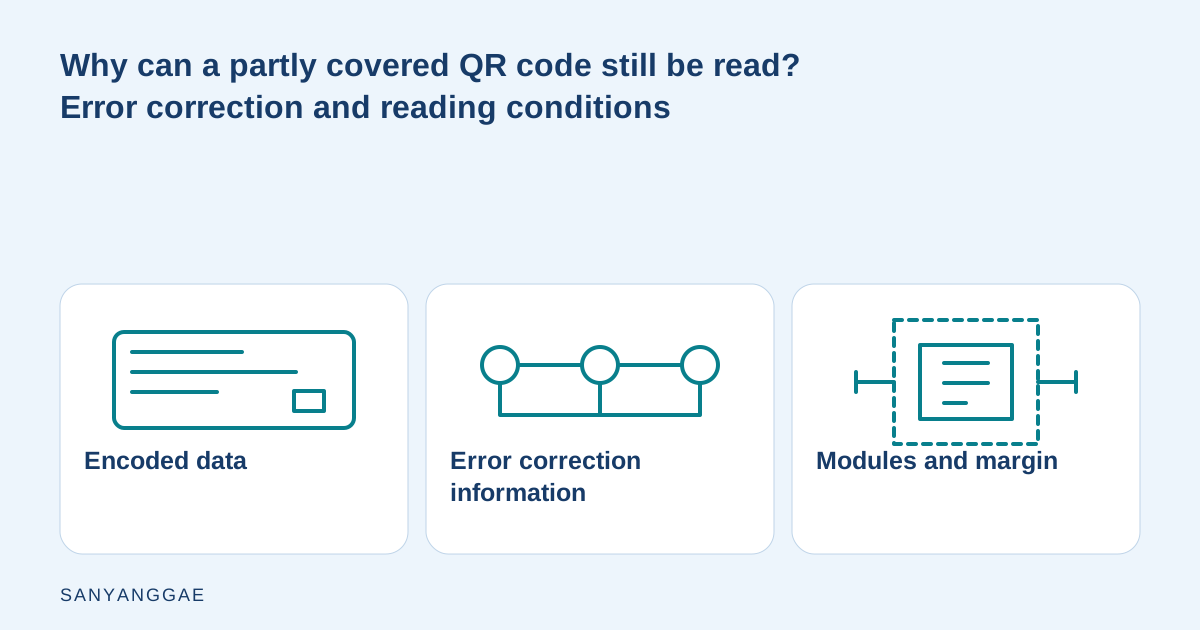
Before distribution, check the finished design for the required margin and interference from text or decoration, and verify that an actual print reads as the intended content. Consider use at different sizes and distances too. This describes a checking procedure; it does not mean this article tested the success rate or durability of a particular design. The representative image is an original explanatory diagram separating data, error correction and reading conditions. It is neither a scannable QR code nor a screen from an actual recovery experiment, and its small grid does not guarantee reading performance.