
1. A new message does not require a new page
When a friend's message appears immediately in a chat room, the browser may not have downloaded the entire page again. A program runs in the page initially received and updates part of the conversation using data arriving from the server. WebSocket is one communication method it can use. Once the browser and server establish a connection, either side can send messages when needed. This differs from a design in which the server must wait for a new query from the browser whenever it has something to send. An immediately changing screen, however, does not prove that a site uses WebSockets.
Periodically asking for new content or having the server send events in one direction can produce a similar screen. The appropriate method depends on how frequently user input and server notifications travel in both directions, and how connections and server resources will be managed. WebSocket does not mean a feature for rendering pages quickly or a database for storing conversations. Separating screen updates, data delivery, and record storage makes it easier to ask where delays or omissions occur. This article concerns the connection that carries messages between the browser and server.
2. What opening and maintaining a connection means
WebSocket communication begins with a negotiation to open a connection. In the traditional HTTP/1.1 approach, the client requests an upgrade and the server sends an acceptance response before WebSocket frames are exchanged. This should not be generalized into a claim that every environment opens connections using the same HTTP/1.1 procedure. A separate standard also defines how to start WebSockets within an HTTP/2 connection's stream. The common idea is that both sides exchange data over an established communication path instead of requiring a new page request for every exchange. Opening a connection is separate from granting a logged-in user access to every chat room.
The browser's basic WebSocket object has connecting, open, closing, and closed states. Constructing an object does not complete the connection immediately, so the program must wait for the open event before sending data. A maintained connection can still break when the network changes, the device sleeps, or the server restarts. A persistent connection is no guarantee that it lasts forever or never fails. Displaying its state helps users distinguish whether their text is still waiting on their device or a new connection is needed. Actual delay also depends on the network, server processing, and device conditions.
3. Distinguish messages, frames, and conversation meaning
WebSockets deliver text and binary data as messages. A chat program might package the sender, room identifier, and message body into a single text structure. The service defines what those fields mean; the WebSocket standard does not prescribe every chat application's data format. During transmission, a message may be divided into several frames, and the browser program generally receives the reassembled message as an event. A frame observed on the network should therefore not automatically be treated as one sentence sent by a user. A design can also bundle several conversation entries into one message.
Carrying data in order over the same live connection is separate from confirmation that the server stored a conversation or the recipient read it. Calling the send method is not proof that display on the other screen or permanent storage has finished. A service can define additional rules for message identifiers, server acceptance acknowledgments, and read status. To avoid displaying a retransmitted entry twice after reconnection, it must decide how to handle the same identifier. Conversation order after connections change or several servers participate depends on application policy. WebSocket alone does not automatically make the entire history consistent.
4. Queues grow when input outpaces transmission
For rapidly changing cursor positions or large numbers of chat messages, checking that the connection is open is not enough. The basic WebSocket API's bufferedAmount indicates the number of bytes of application data queued by send requests but not yet transmitted to the network. It is not a count of messages the recipient has not read, nor the server's storage backlog. If it keeps increasing, that is a clue to investigate whether data is being produced faster than it can be sent. Even a value of zero cannot confirm that the remote application has processed the content.
The receiving side can also have problems if messages arrive faster than the screen can process them. The basic WebSocket API does not automatically apply backpressure in this situation, so the service must manage memory use and processing load. Intermediate updates may be combined for information such as a fleeting cursor position when only the latest value matters. The same rule should not simply be applied to chat text that must not be omitted. Message size and rate limits, server flow control, and history retrieval should be designed for the purpose. Using WebSockets does not make it safe to receive unlimited data on a slow device.
5. Reconnecting and recovering missed history are separate tasks
When Wi-Fi returns after an interruption, a closed browser WebSocket object does not automatically revive its previous connection. The program must implement creation of a new connection. If many users repeatedly retry without pausing just after losing service together, they can make server recovery harder. RFC 6455 recommends a random initial delay when retrying after an abnormal closure, followed by increasing waits if failures continue. This is not a numerical interval imposed identically on every service. Depending on the closure reason, login state, and server guidance, an application may stop retrying or wait for the user's action.
Opening a new connection does not automatically deliver the conversations that occurred while it was absent. A recovery procedure must request missing history using the identifier or sequence of the last confirmed message, or obtain the current state again. The recoverable range also depends on whether records have exceeded their retention period. Protocol Ping and Pong frames can check connection status, but the browser's basic JavaScript API does not expose them directly. Even if the program exchanges separate application-level check messages, they do not mean that a conversation was stored. Separating connection checks, delivery acknowledgments, and history recovery allows the screen's behavior after an interruption to be explained accurately.
6. Encrypted channels still need permission checks
Production services use wss, the encrypted WebSocket scheme, to protect the communication path. This protects content in transit; it does not mean that the service is honest or every user should have access to every conversation. The server must authenticate users and check permissions for each room and action. Checking a browser connection's Origin helps restrict use from web pages that are not allowed. Non-browser clients, however, can forge this value, so Origin alone cannot prove a user's identity. The server must also continue to validate received message formats, sizes, and permitted actions.
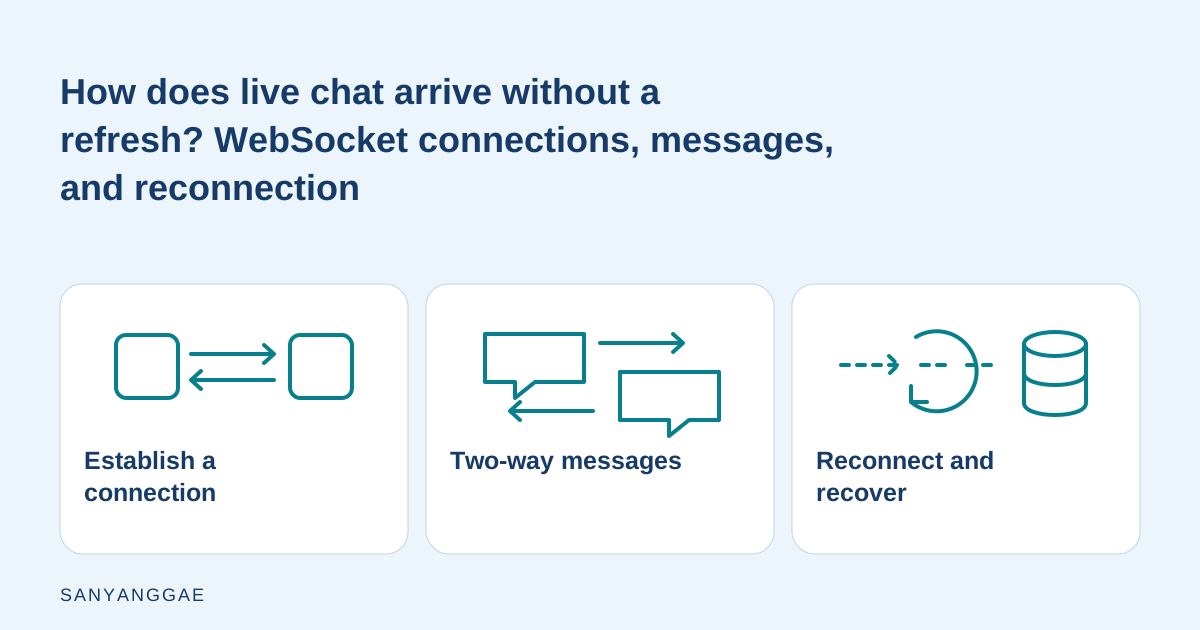
When chat stops, useful questions include whether the connection opened, whether outgoing data is accumulating, whether the server acknowledged acceptance, and whether history was recovered after reconnection. These questions separate different causes; this article alone cannot diagnose a particular service's outage. The illustration is an original explanatory diagram separating connection establishment, two-way messages, and reconnection with history recovery. It is not an actual server trace or speed measurement graph. A conversation that continues without a page refresh depends on screen handling, storage, permissions, and recovery procedures working together alongside the communication protocol.