
1. Rain stopping is not enough to produce a rainbow
When a colored band appears after rain, it can look like a painted bridge suspended somewhere in the clouds. A rainbow, however, is an optical phenomenon produced by the right arrangement of sunlight, airborne water droplets, and the observer, rather than a fixed object. You can usually look for it with the Sun behind you and raindrops ahead. Conditions may be suitable even if rain has stopped where you are, provided sunlit droplets remain in front of you. Conversely, rain does not ensure a visible rainbow if sunlight is blocked or you are looking in the wrong direction.
What matters here is the path of light entering your eyes, rather than simply the location of the entire rain cloud. Two people far apart may look at the same sky, yet receive rainbow light from different sets of droplets. We can call it a rainbow in the same landscape, but this differs from viewing the same painted object from different sides. This also explains why you cannot reach a rainbow’s apparent end by walking toward it. As the observer moves, the droplets and viewing conditions producing the rainbow change too.
2. Refraction and reflection both occur inside a droplet
Refraction is the change in direction of an oblique light ray as it passes from air into water. Some light entering a droplet reflects from its far boundary back toward the front, and refracts again when leaving water for air. The representative path explaining a primary rainbow involves refraction on entry, one reflection inside the droplet, and refraction on exit. Treating a droplet simply as a flat mirror or a prism makes it difficult to explain both this path and the viewing direction.
Not all light striking a droplet follows that path. Some reflects in other directions or passes through the droplet. Nor does the internal reflection mentioned here have to be called total internal reflection. Along the light paths explaining a rainbow, some light can reflect at the boundary while some is transmitted. Actual raindrops also vary in shape and size, but imagining small spherical droplets is useful when learning the principle. This simplification helps explain basic relationships between color and angle; it is not a claim that every raindrop is a perfect sphere.
3. Droplets do not create the colors from nothing
Sunlight contains light of many wavelengths. Water’s refractive index depends on wavelength, so the change in direction differs slightly for the light associated with each color. This is called dispersion. A droplet does not add pigments absent from white light; light originally arriving together is separated into different directions. Visible light toward the violet end generally refracts more strongly in water than light toward the red end. However, identifying the outer color of a rainbow requires the entire path, including internal reflection and refraction on exit, rather than just refraction at entry.
In a primary rainbow, red lies outside and violet inside. Although we often learn about seven colors, the actual band is a continuous spectrum rather than a paint sample divided into seven compartments. How we name colors can differ from how distinctly eyes or photographs resolve the bands. A photograph without exactly seven visible stripes should therefore not be rejected as a rainbow. Droplet size and observing conditions also influence color definition and additional bands, so a simple basic diagram cannot predict every fine pattern.
4. Roughly 42 degrees is not a fixed height in the sky
Think of the direction directly opposite the Sun: the direction toward which your head’s shadow points. The outer red band of a primary rainbow appears roughly 42 degrees from this antisolar direction. This angle is measured at the observer’s eye; it is neither the distance to the droplets nor a fixed height above the ground. A bright band forms because light leaving spherical droplets is relatively concentrated near a particular angle. The 42-degree value is an approximation explaining the basic principle, rather than one exact value applying to every color and actual droplet.
All sightlines maintaining the same angle form a cone, and their trace on the sky forms a circle. From the ground, we usually see an arc, part of that circle, because the ground and the area below the horizon hide the rest. When the Sun is low, the antisolar direction is near the horizon and a higher arc can be visible. When the Sun is high, more of the same circle lies below the horizon. This explains rainbows commonly seen from level ground; it must not be extended into an absolute claim of invisibility that also includes elevated observers looking at droplets below them.
5. The outer band of a double rainbow has one more reflection
Sometimes a fainter colored band appears outside the primary rainbow. The representative light forming this secondary rainbow leaves a droplet after two internal reflections. Its different path places it outside the primary bow and reverses the color order. The secondary rainbow has red inside and violet outside. It is not a second image of the same rainbow’s shadow in the sky, nor simply light from the identical single-reflection path arriving from farther away. Distinguishing the different paths is the starting point for understanding the color order.
The secondary bow is usually fainter because less light reaches the eye along the path involving the additional reflection. The region between the primary and secondary rainbows that can appear darker than its surroundings is called Alexander’s dark band. This does not necessarily mean that black clouds or a separate black material occupy that region. It is related to the distribution of directions in which representative rays forming the two bows emerge. Background clouds and other light also influence actual sky brightness, so one scene with a dark gap cannot determine the rain cloud’s thickness or the amount of rain.
6. Understanding circular rainbows and photographs
From an aircraft or a high viewpoint, sunlit droplets below the observer can reveal more of the rainbow’s circle, sometimes all of it. The arc seen from the ground has not turned into an entirely different phenomenon; the conditions limiting the view have changed. Similar geometry can be observed in fountains and spray, though not every spray guarantees a clear rainbow. Looking toward droplets with the Sun behind you helps explain the viewing direction. There is no need to look directly at the Sun or move into a dangerous position to find a rainbow.
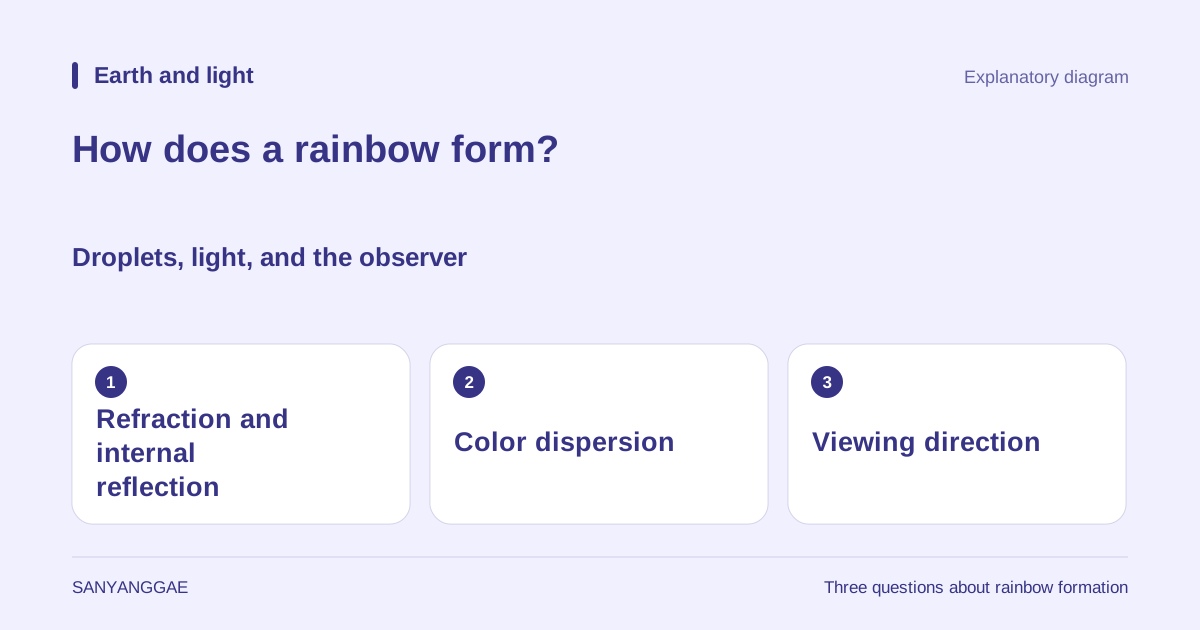
When looking at photographs, consider the inner and outer color order of the primary and secondary bows, the relationship between the horizon and arc, and the camera’s position. Wide-angle lenses and cropping can change the impression, so one photograph cannot locate a fixed rainbow endpoint or determine the distance to the droplets. This article’s diagram was created by Sanyanggae to organize three questions: refraction and internal reflection, color dispersion, and viewing direction. It is neither an actual observation photograph nor a scale drawing from precise ray calculations, and does not reproduce the actual definition of the colored bands.