
Creeping woodsorrel
Creeping woodsorrel is a small herb with three heart-shaped leaflets, yellow flowers and elongated capsules. Spreading stems and scattered seeds make it a common sight in fields, beside paths and around pots.
- Scientific name
- Oxalis corniculata L.
- Family
- Wood-sorrel family · Oxalidaceae
- Other names
- Oxalis corniculata
- Reviewed
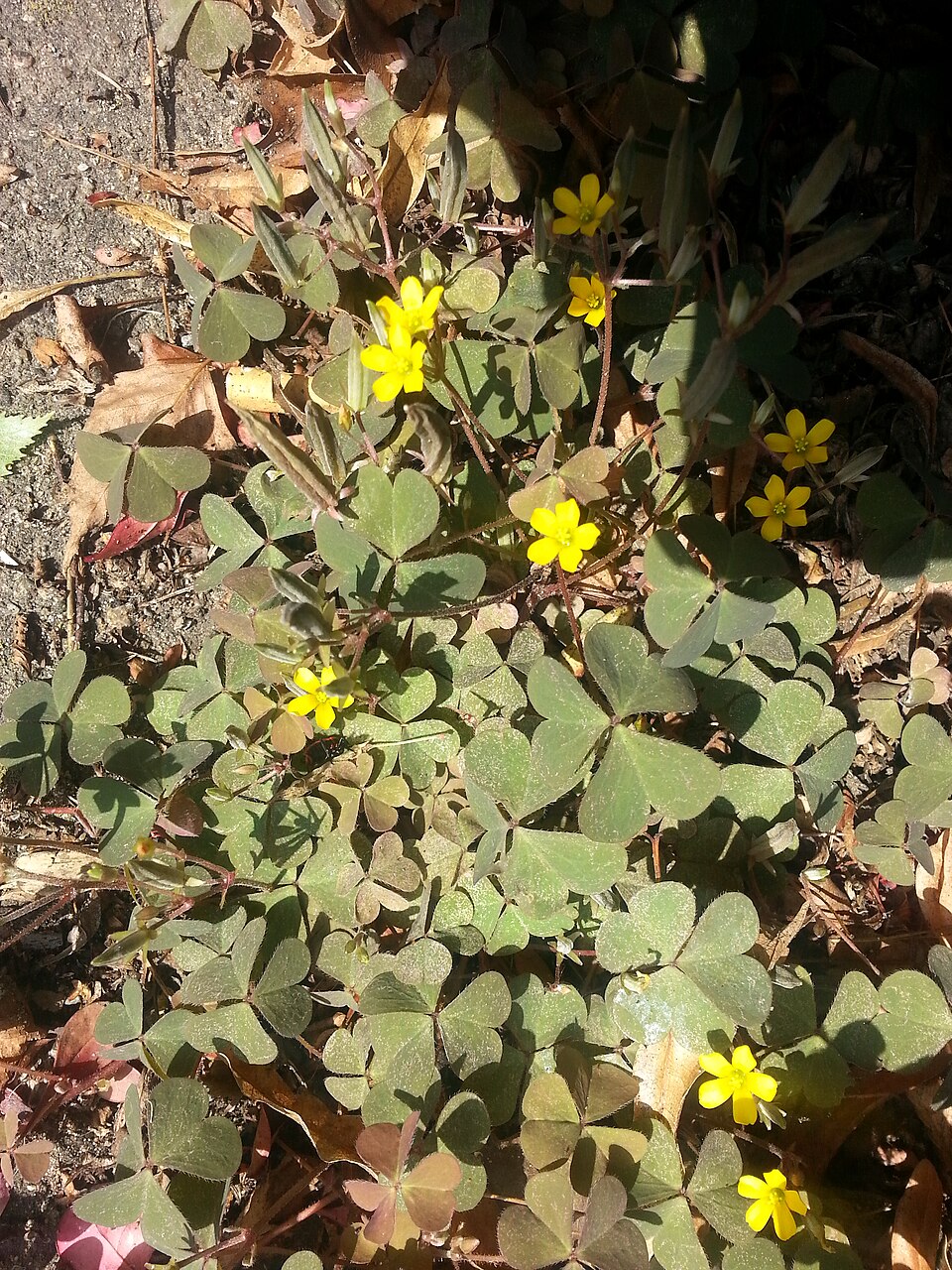
Three leaflets, yellow five-petaled flowers and elongated capsules of creeping woodsorrel are visible together. Compare several plant organs rather than identifying a plant from a single leaf shape.
Oxalis corniculata in Germany.jpg
Photo credit: AlternativesLebensglück
License: CC BY-SA 4.0
A reduced-size JPEG supplied by Wikimedia is used, with no additional cropping or color changes.
Names and classification
Oxalis corniculata belongs to Oxalidaceae; three leaflets do not make it the same plant as clover in the pea family. Its long history of spread around the world means sources may interpret its native range and regional native or alien status differently.
Observable features
Three heart-shaped leaflets, each notched at the tip, sit at the end of a long stalk, and small yellow flowers appear. Looking at the stems spreading near the ground and the slender, elongated capsules also helps when comparing similar Oxalis species.
Distribution and habitat
In Korea it grows in frequently disturbed ground such as fields and roadsides, and appears among lawns and potted plants. Depending on climate it can persist as an annual or a perennial, so winter behavior in one region does not establish its entire life history.
Ecology and life cycle
Spreading stems and reproduction by seed both contribute to its growth, and ripe capsules eject their seeds. Observing surrounding seedlings and fruits as well as the place where flowers were first found reveals how this small herb spreads.
Cultivation and care
Where it is unwanted, manage it before fruits ripen and inspect the soil and seedlings in newly introduced pots. After removing stem fragments, also check whether remaining stems and roots grow back.
Observation and use precautions
Do not eat it on the strength of descriptions of a sour taste or the edibility of another plant. It contains oxalates, so avoid large consumption or mixing it into pet food, and do not judge medicinal effects or safe amounts from a photograph.