
Japanese maple
Japanese maple is a deciduous tree with hand-shaped leaves and paired winged fruits. This entry covers Acer palmatum rather than the entire maple genus.
- Scientific name
- Acer palmatum Thunb.
- Family
- Soapberry family · Sapindaceae
- Other names
- Acer palmatum
- Reviewed
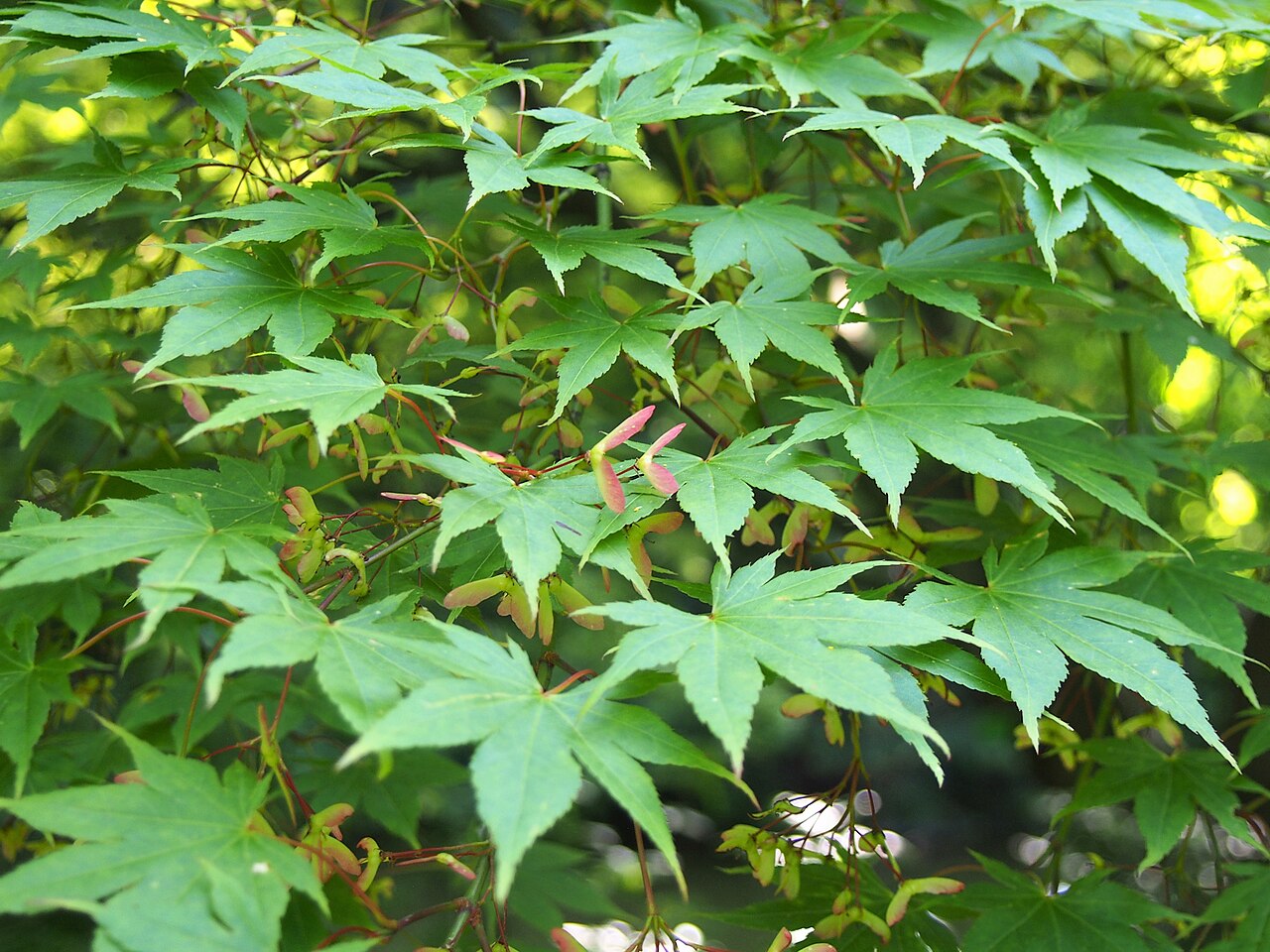
Japanese maple leaves and paired winged fruits on a tree cultivated in Wrocław University Botanical Garden, Poland. The photograph does not show the whole tree or its flowers.
Acer palmatum Klon palmowy 2019-05-26 05.jpg
Photo credit: Agnieszka Kwiecień, Nova
License: CC BY-SA 4.0
JPEG proportionally reduced by Wikimedia’s server. No local cropping, recoloring or compositing was performed.
Names and classification
Japanese maple is Acer palmatum, currently placed in the soapberry family, Sapindaceae. Not every red-leaved landscape tree belongs to this species, and cultivars must be distinguished from species.
Observable features
Leaves grow opposite one another and usually have five to nine toothed lobes. The fruit has two paired, winged parts, while leaf color and the depth of lobing vary among cultivars.
Distribution and habitat
Its native range includes southwestern Korea and central and southern Japan, and it is cultivated in gardens elsewhere. Being planted in a region does not establish that it is native there.
Ecology and life cycle
Small flowers appear in spring, followed by developing winged fruits. Recording autumn color and leaf fall on the same tree reveals its seasonal life cycle.
Cultivation and care
Consider a position in dappled light and evenly moist, well-drained soil. Shelter it from drying winds and adjust watering to soil conditions and the weather.
Observation and use precautions
Young leaves can be damaged by late frost, and foliage may scorch in strong sun, drying wind or drought. Leaf color and lobing alone do not establish a cultivar or distinguish every similar maple species.