
Oriental cattail
Oriental cattail is a perennial herb with rhizomes in waterside mud and leaves and flower spikes rising above the water. The brown cylinder is a cluster of many female flowers; observe the leaves and upper male portion as well.
- Scientific name
- Typha orientalis C.Presl
- Family
- Cattail family · Typhaceae
- Other names
- Typha orientalis
- Reviewed
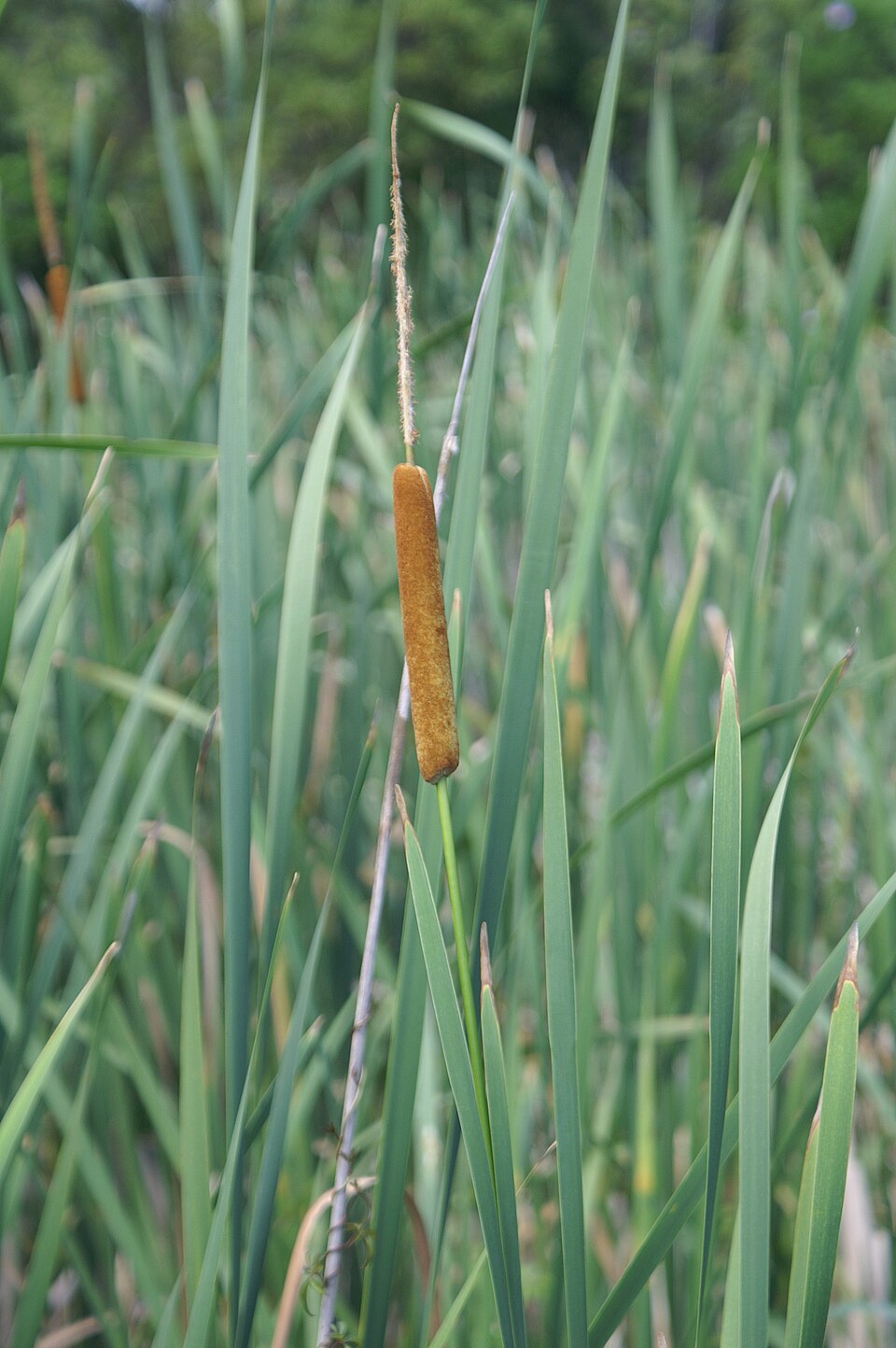
Strap-shaped leaves, the brown female spike and the slender remains of the male portion above it. The photograph shows the leaves and overall arrangement as well as part of the flower spike.
Typha orientalis flowerhead13 SWR NC - Flickr - Macleay Grass Man.jpg
Photo credit: Harry Rose from Dungog, Australia
References: https://www.flickr.com/photos/macleaygrassman/19361138574/
License: CC BY 2.0
A reduced-size JPEG supplied by Wikimedia is used, with no additional cropping or color changes.
Names and classification
Typha orientalis belongs to Typhaceae and is distinct from Typha angustifolia and Typha latifolia. Its range extends from Mongolia through East Asia and the Philippines to Australia and New Zealand, and includes Korea.
Observable features
Long strap-shaped leaves stand upright, with the slender male portion above the thicker female portion that becomes brown. The two portions may touch or be separated, so their gap should not be used as an invariably fixed species marker.
Distribution and habitat
It is a rooted emergent aquatic plant of wetlands, lake and stream margins, and water channels. Its leaves rising above the water distinguish its way of life from submerged or free-floating aquatic plants.
Ecology and life cycle
Underground rhizomes spread sideways and can form large stands. Stand size depends on moisture and site conditions, so the presence of cattails alone does not prove good water quality or complete removal of pollutants.
Cultivation and care
Before adding it to a small pond, check for a wet substrate and room for spreading rhizomes, and watch that it does not overrun other plants. Do not plant or move it into natural wetlands without authorization; check local management objectives.
Observation and use precautions
Do not mix photographs or uses of different Typha species, or collect it for food based only on a brown flower spike. Consider water depth, slippery ground and surrounding vegetation while observing, and do not force a path through stands for a photograph.