
Tomato
Tomato is a fruit crop in the nightshade family, producing fruits of varying colors and shapes after yellow flowers. Looking at stems, flowers and developing fruits, as well as ripe red tomatoes, reveals the crop's growth cycle.
- Scientific name
- Solanum lycopersicum L.
- Family
- Nightshade family · Solanaceae
- Other names
- Solanum lycopersicum · Lycopersicon esculentum
- Reviewed
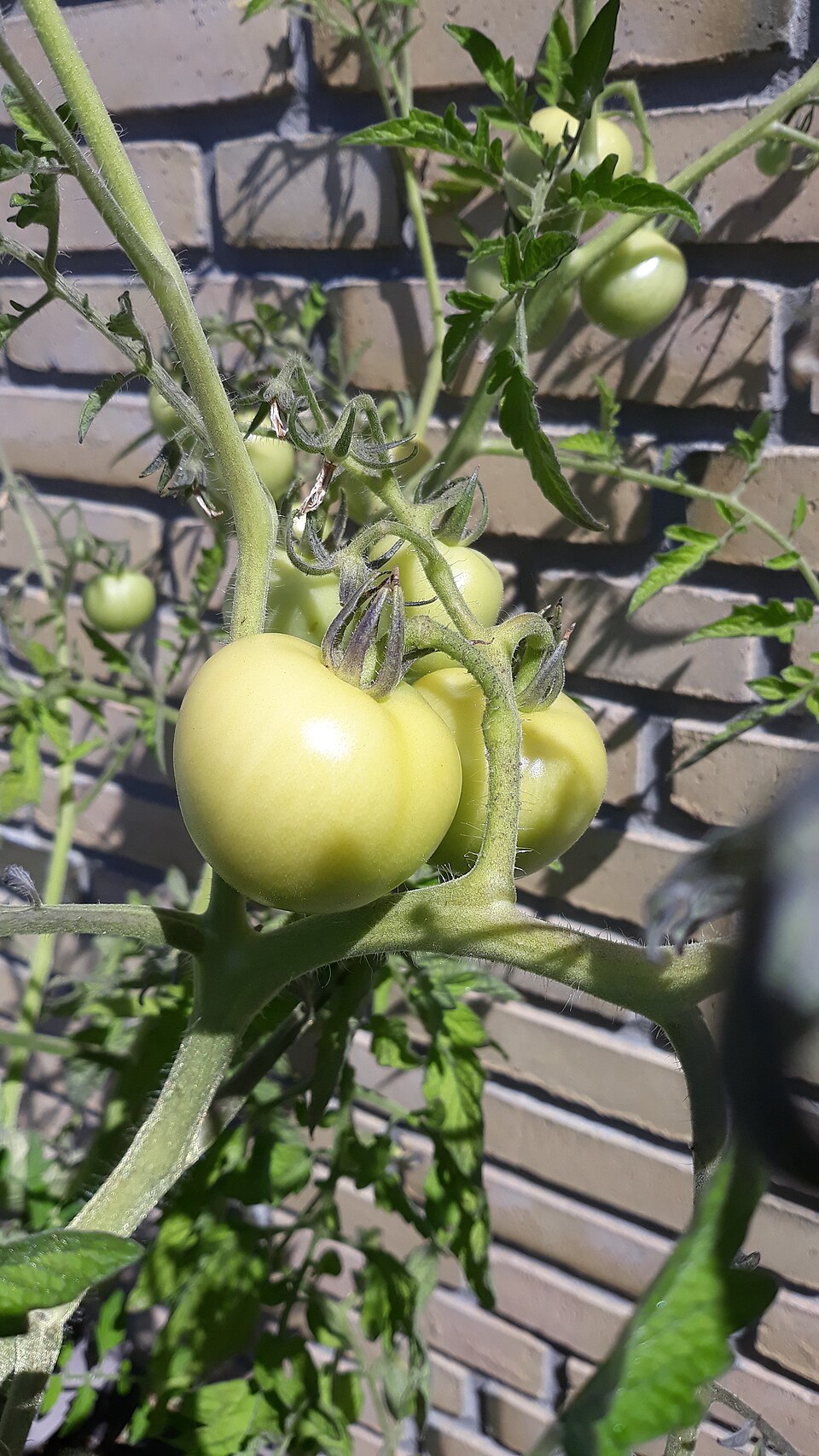
Developing green tomatoes on a balcony-grown plant. The photograph does not show a harvest of ripe red fruits.
Photo credit: MyFreeMedia
License: CC BY-SA 4.0
A reduced-size JPEG supplied by Wikimedia is used, with no additional cropping or color changes.
Names and classification
The current scientific name is Solanum lycopersicum; older literature also uses Lycopersicon esculentum. It is a crop of South American origin shaped by long cultivation and selection, so modern cultivars should not simply be equated with a single wild tomato.
Observable features
Look for hairy stems, divided leaves and yellow, star-shaped flowers; the calyx remains on the fruit. Botanically the fruit is a berry, and ripe fruits may be yellow or other colors as well as red, so check color and size against the cultivar description.
Distribution and habitat
Tomatoes are widely grown in sunny fields and containers during warm seasons. They can survive for several years in frost-free climates, but in many regions they are grown as annual crops to avoid cold weather.
Ecology and life cycle
Flowering, fruit development and ripening are affected by light, temperature and moisture. Flowers do not always persist as fruits: heat-related blossom drop and the growth characteristics of the cultivar also need consideration.
Cultivation and care
Use well-drained soil, avoid large fluctuations in moisture and provide supports so fruit weight does not bend or break the stems. Excess nitrogen can encourage abundant leaves and stems, so adjust fertilizer according to the plant's growth.
Observation and use precautions
Do not treat the leaves and stems as the same food ingredient as the edible fruit, or imply that every part is edible because it is a crop. Assess ripeness using the cultivar's mature color and condition, and follow the labels and harvest instructions for products used at the growing site.