
Weyrich’s azalea
On Mount Halla on Jeju, this azalea opens red flowers at the tips of its shoots as the new leaves unfold. After flowering, clusters of broad leaves help you pick it out.
- Scientific name
- Rhododendron weyrichii Maxim.
- Family
- Heath family · Ericaceae
- Other names
- Azalea weyrichii
- Reviewed
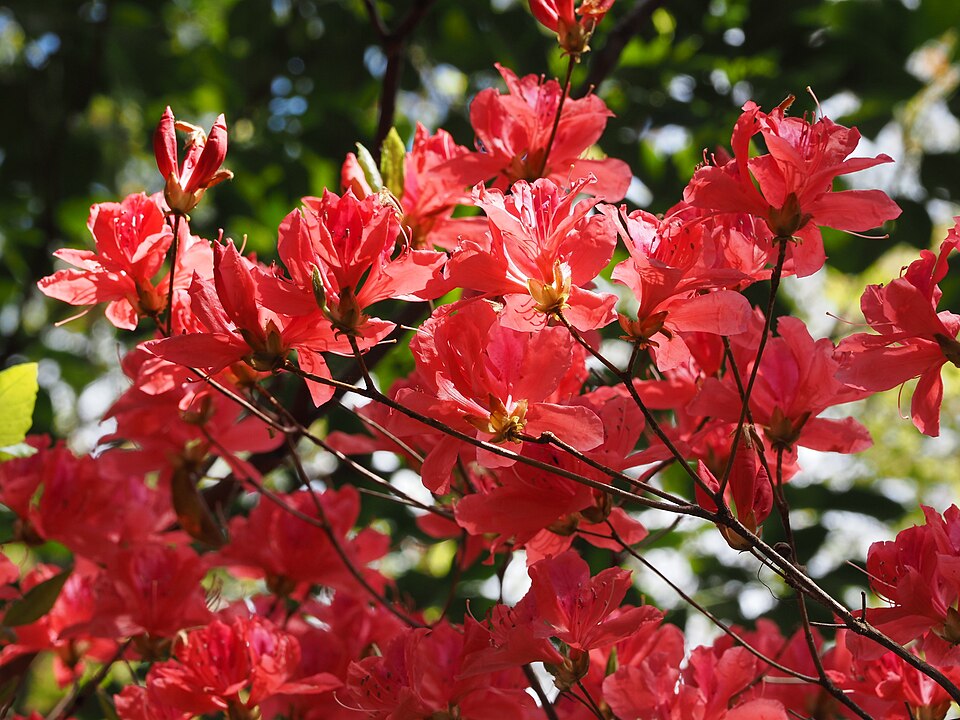
Closed buds sit among the open flowers. Slender stamens are visible inside the open blooms.
Photo credit: 笹谷康之 · © Sasatani Yasuyuki
License: CC BY-SA 4.0
This 960-pixel-wide JPEG thumbnail was supplied by Wikimedia and used without further editing.
Names and classification
Rhododendron weyrichii is a deciduous woody plant in the heath family. It belongs to the same genus as the Korean rosebay (Rhododendron mucronulatum), but they are distinct species.
Observable features
Look for groups of three leaves at the ends of short shoots. The leaves range from broadly oval to nearly diamond-shaped, and the red flowers open out like funnels.
Distribution and habitat
In Korea it grows on forest edges and mountain slopes on Mount Halla, Jeju. Its native range extends into south-central and southern Japan.
Ecology and life cycle
Korean observations place flowers and emerging leaves together around May. A dry capsule covered with brown hairs forms where each flower stood and ripens around September.
Cultivation and care
Choose a nursery-grown plant labelled with its scientific name and allow room for the spreading branches. Photograph the same shoot in spring and autumn to find the fruit where the flowers were.
Observation and use precautions
Leave wild branches intact and photograph the point where flowers and leaves meet. Flower colour alone cannot distinguish similar rhododendrons or establish that a flower is edible.