
Cats
Birman
Birman
Classification and scientific name: Felis catus
Sources checked:
Blue eyes and white gloves distinguish this semi-long-haired breed from the Burmese
The Birman is famous for traditions linked to temples in Myanmar, but legends cannot prove every aspect of the modern breed’s origins. Breeding in France and subsequent registration records form an important part of its modern history.
Origins and distribution
Traditions linked to Myanmar; modern breed development in France and elsewhere
- Birman
- Domestic cat
- Assess each individual’s temperament
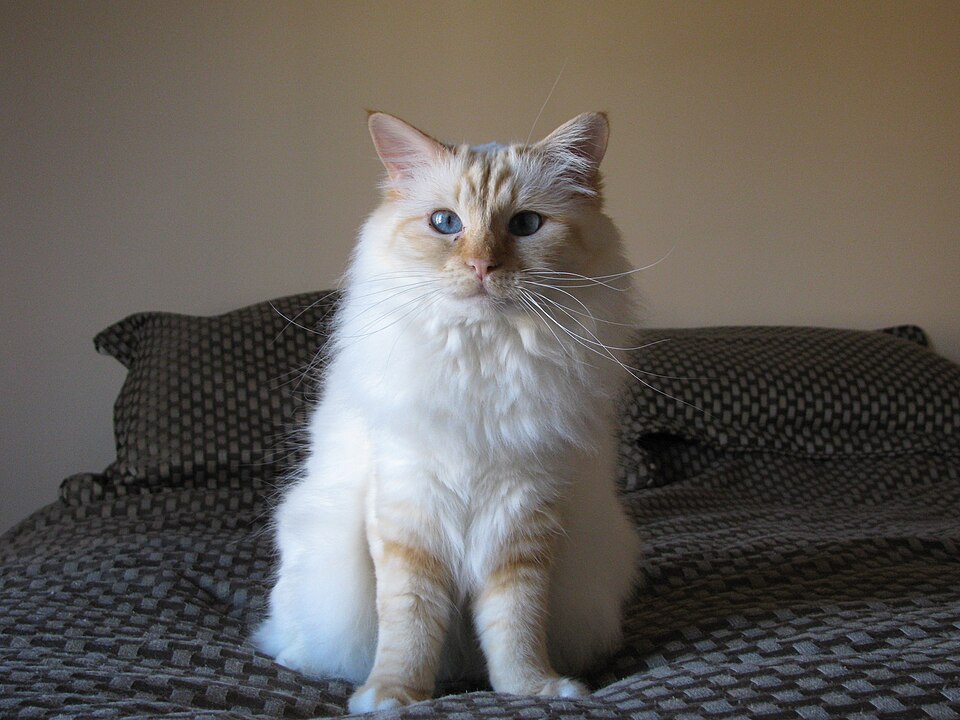
Reference photograph
Reference photograph of a Birman. Examine this individual’s color and form alongside the identification descriptions in the text.
Source: Donovan Tremblay · Original material · CC BY-SA 4.0
1. Classification, origins and habitat
The Birman is famous for traditions linked to temples in Myanmar, but legends cannot prove every aspect of the modern breed’s origins. Breeding in France and subsequent registration records form an important part of its modern history. The similarly named Burmese is a separate breed with short hair and different standards. The nickname sacred cat is a cultural story, not a special ability relating to temperament or health. Breed descriptions should be linked to photographs of individuals with verified sources.
2. Appearance and identification
Blue eyes, a pointed pattern, markings resembling white gloves on all four feet and a semi-long coat are characteristic. Body and point colors vary and can become more distinct as the cat grows. White feet alone do not make every Ragdoll or other pointed cat a Birman. Glove symmetry relates to show standards, but does not measure an individual cat’s happiness or health. Consider the proportions of the face, body and tail as well.
3. Behavior and way of life
A tendency toward close relationships with people and calm interaction is described. A quiet disposition does not guarantee that the cat can always be held. Respect both the pace at which it approaches and its withdrawal when seeking rest. Play and exploring high places are also part of daily needs, while the time needed to become familiar with other animals in the home varies by individual. The temple-cat legend cannot replace behavioral evidence about the absence of aggression.
4. Observation, conservation and care
Check the semi-long coat for tangles around the armpits and belly, and assess body condition and skin beneath the fur. Divide brushing into short, comfortable experiences suited to the individual’s reactions. Provide high places, hiding spots and easy access to water and litter facilities. Use photographs that show white gloves, points and head shape together, and do not mix in the Burmese’s brown short coat as the same breed. Neither lineage nor pattern guarantees a life free of disease.
Evidence and references
- Cat Fanciers’ Association — Birman
Breed background, appearance standards and temperament descriptions
- The International Cat Association — Birman
Breed characteristics, coat, activity and daily care