
Cats
Abyssinian
Abyssinian
Classification and scientific name: Felis catus
Sources checked:
A ticked coat and a sleek body; the name alone does not establish an ancient pedigree
A ticked coat and a sleek body are characteristic; the name alone does not establish an ancient pedigree. Although “Abyssinian” is connected with the former name Abyssinia, the precise early origins of the modern breed cannot be settled by a single country name. Breed standards developed through modern British exhibition and breeding records.
Origins and distribution
Established as a breed in modern Britain; its exact early origins need a separate explanation
- Abyssinian
- Domestic cat
- Check the individual’s behavioral tendencies
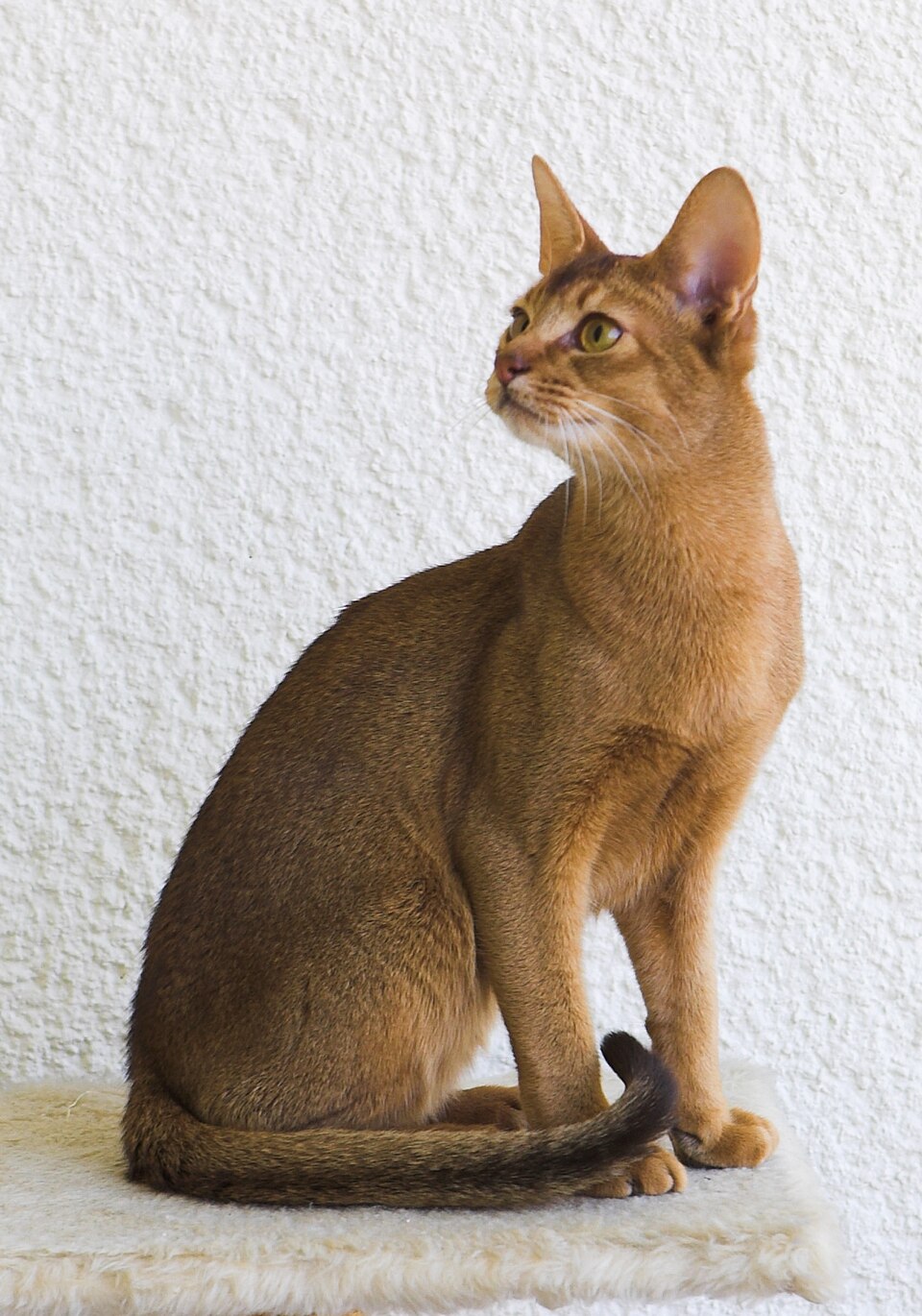
Reference photograph
Reference photograph of an Abyssinian. Examine the individual’s color and shape alongside the identification notes in the text.
Source: Karin Langner-Bahmann · Original material · CC BY-SA 3.0
1. Classification, origins and habitat
Although “Abyssinian” is connected with the former name Abyssinia, the precise early origins of the modern breed cannot be settled by a single country name. Breed standards developed through modern British exhibition and breeding records. An impression of resemblance to cats in ancient Egyptian wall paintings is different from evidence that a particular lineage continued unchanged for thousands of years. The Somali is a closely related breed associated with the long-haired trait, but the two names are not interchangeable.
2. Appearance and identification
Ticking, in which individual hairs have light and dark bands, produces fine shading across the body. Several colors occur, and the coat has a tabby-related color structure even without dark stripes or large spots. Look at the large ears and eyes together with the balanced, sleek body. Lighting can change the warm tones of the coat, so do not make the brown in a single photograph the standard for every individual. The short coat is also a feature to observe when comparing it with a Somali.
3. Behavior and way of life
The breed is described as tending to show interest in exploration, high places and active play. “Active” does not mean always needing to be held, or, conversely, disliking contact. Consider both the time a cat spends chasing a toy and the time it chooses to rest. Rather than turning descriptions of intelligence into a human-style ranking, explain them by observing the problems the cat explores. Relationships with other individuals are not determined by the breed name alone.
4. Observation, conservation and care
Climbing places, stable footholds, food-search games and hiding spaces offer choices for exploration. Being good at climbing does not remove the need to check the safety of windows and railings. Even a short coat needs care that takes skin condition and shedding into account. Do not judge every individual as underweight simply because the body looks slender; consider actual body condition and movement together. In photographs and text, do not confuse a ticked coat with large spots.
Evidence and references
- Cat Fanciers’ Association — Abyssinian
Breed background, appearance standards and an introduction to behavioral tendencies
- The International Cat Association — Abyssinian
Breed characteristics, coat, activity and everyday care