
Mammals (Cattle)
Santa Gertrudis
Santa Gertrudis
Classification and scientific name: Bos taurus × Bos indicus
Sources checked:
Usually red-coated, with some Brahman-derived skin and body-form features
The Santa Gertrudis is a beef cattle breed developed at King Ranch in Texas using Shorthorn and Brahman lines. Usually red-coated, with some Brahman-derived skin and body-form features.
Origins and distribution
Texas, United States
- Santa Gertrudis
- Texas, United States
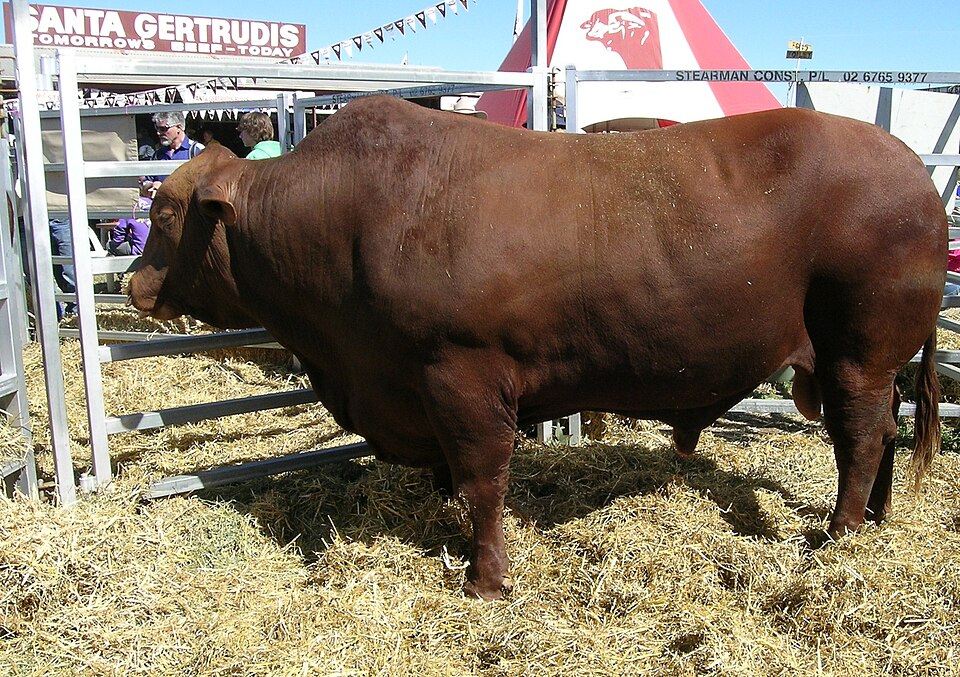
Reference photograph
Reference photograph of Santa Gertrudis. Examine this individual’s color and form alongside the identification descriptions in the text.
Source: Cgoodwin · Original material · CC BY-SA 3.0
1. Classification, origins and habitat
The Santa Gertrudis is a beef cattle breed developed at King Ranch in Texas using Shorthorn and Brahman lines.
It illustrates combining traits of different lineages to raise beef cattle in the hot southern United States. Rather than merely listing Shorthorn and Brahman as foundation breeds, consider the subsequent pedigree management that developed a separate breed.
2. Appearance and identification
Usually red-coated, with some Brahman-derived skin and body-form features.
Observe the red coat, loose skin and shape of neck and shoulders together. Sharing some ancestors with Brahman does not mean every animal has a conspicuous large hump or long ears. Exact ancestry proportions cannot be calculated from one photograph.
In comparisons with red-coated Salers or Red Poll, consider hump, ears, skin below the neck and overall build together. Red color is shared by several beef breeds. Texas formation history and the source’s registered name complement appearance observations.
3. Behavior and way of life
The breed was improved for beef production in hot regions. Foundation breeds and present registration standards are separate information.
Beef improvement considers several goals together, including growth, reproduction and local adaptation. Descriptions of heat adaptation do not remove every effect of humidity, poor nutrition or pathogens. Comparing production records under matching husbandry conditions helps explain differences.
4. Observation, conservation and care
Consider husbandry purpose and regional climate together, and establish breed from registration records. Heat tolerance and productive ability vary by individual and management conditions.
Check registration and individual records to avoid confusing other red beef cattle with this breed. On pasture, consider whether drinking places and resting spaces, as well as grazing, suffice for the whole herd; provide room to turn during handling.
Evidence and references
- Oklahoma State University — Santa Gertrudis
Classification, origins, appearance, ecology or uses of the breed
- Defra — Cattle welfare guidance on behavior, feeding and environment
General principles of feed, water, rest and handling. A United Kingdom source, not guidance on Korean legislation.