
Mammals (Cattle)
Texas Longhorn
Texas Longhorn
Classification and scientific name: Bos taurus
Sources checked:
Long horns extending to the sides stand out, but length and direction of curvature vary greatly with individual and age
The Texas Longhorn is a domestic cattle breed formed as various cattle populations brought to North America mixed and were selected in regional grazing environments. Long horns extending to the sides stand out, but length and direction of curvature vary greatly with individual and age.
Origins and distribution
Texas, United States, and southwestern North America
- Texas Longhorn
- Texas, United States, and southwestern North America
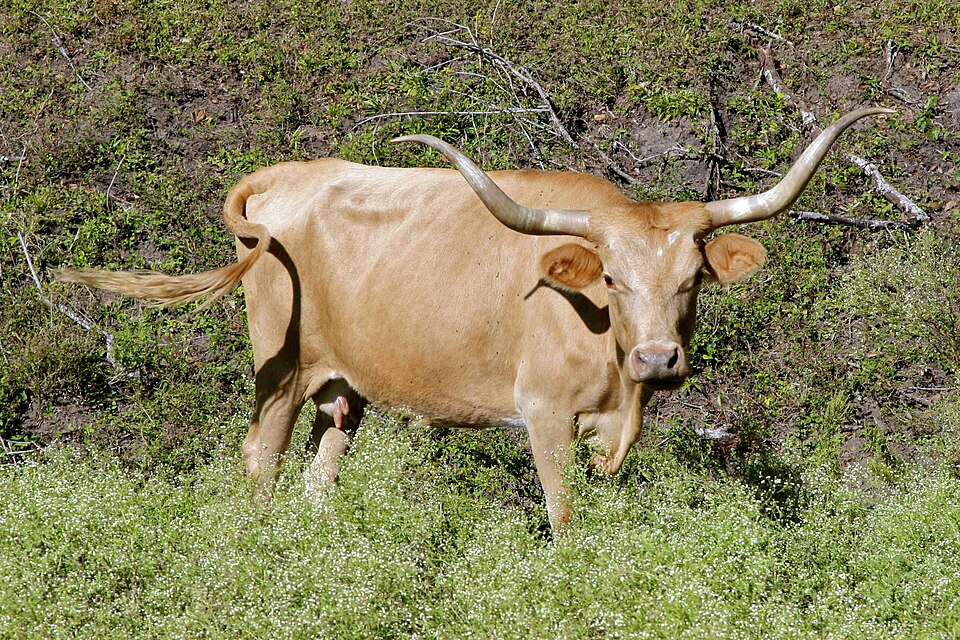
Reference photograph
Reference photograph of Texas Longhorn. Examine this individual’s color and form alongside the identification descriptions in the text.
Source: Ed Schipul from Houston, TX, US · Original material · CC BY-SA 2.0
1. Classification, origins and habitat
The Texas Longhorn is a domestic cattle breed formed as various cattle populations brought to North America mixed and were selected in regional grazing environments. Its long horns and history of livestock movement became symbols of American ranching culture. It is separate from Britain’s Longhorn cattle despite sharing longhorn in the name, so check the registered English name as well.
Distinguishing the introduction of Spanish-derived livestock, regional grazing and later pedigree conservation avoids reducing origins to a simple story about one country. Do not infer history from long horns alone.
2. Appearance and identification
Long horns extending to the sides stand out, but length and direction of curvature vary greatly with individual and age. Coat colors also vary, including red, black, white and spotted patterns. Do not describe a record horn-tip span as the average for the breed. It also matters not to compare a young animal’s short horns and an adult’s horns by the same standard.
Horn tips may turn upward or spread widely sideways, among other forms. Camera angle changes apparent length, so do not estimate precise numeric dimensions without a scale in the photograph.
3. Behavior and way of life
The breed is used for extensive pasture grazing and beef production, and traditional bloodlines are also conserved. A history of life in harsh environments does not mean that little food or water is sufficient. Spacing within a herd and reactions toward people are influenced by husbandry experience. A symbolic appearance and actual production records need to be considered separately.
Moving in search of grass while grazing is natural food exploration. Being photographed outdoors does not make it a wild species unrelated to human management; distinguish farmed cattle from historical free-ranging populations.
4. Observation, conservation and care
Provide watering points, gateways, transport and handling space that accommodate long horns. When multiple animals crowd into a narrow area, horns can catch on one another as well as bodies colliding, making facility shape important. Visitors should not touch horns even across a fence. In ranch photographs, horn curves, color patterns and the surrounding grazing environment can be observed together.
Passageways or feeders that ignore the widest span of the horns can obstruct passage and herd movement. Consider the space an actual body needs before a decorative appearance.
Evidence and references
- Oklahoma State University — Texas Longhorn
Species-specific information on origins, appearance, uses or ecology
- Defra — Cattle welfare guidance on behavior, feeding and environment
General principles of feed, water, rest and handling. A United Kingdom source, not guidance on Korean legislation.