
Mammals (Cattle)
Normande
Normande
Classification and scientific name: Bos taurus
Sources checked:
Red or brown markings on white and frequently dark patches around the eyes are typical
The Normande is a dual-purpose cattle breed developed in Normandy, France. Improvement has considered both dairy and meat production. Red or brown markings on white and frequently dark patches around the eyes are typical.
Origins and distribution
Normandy, France
- Normande
- Normandy, France
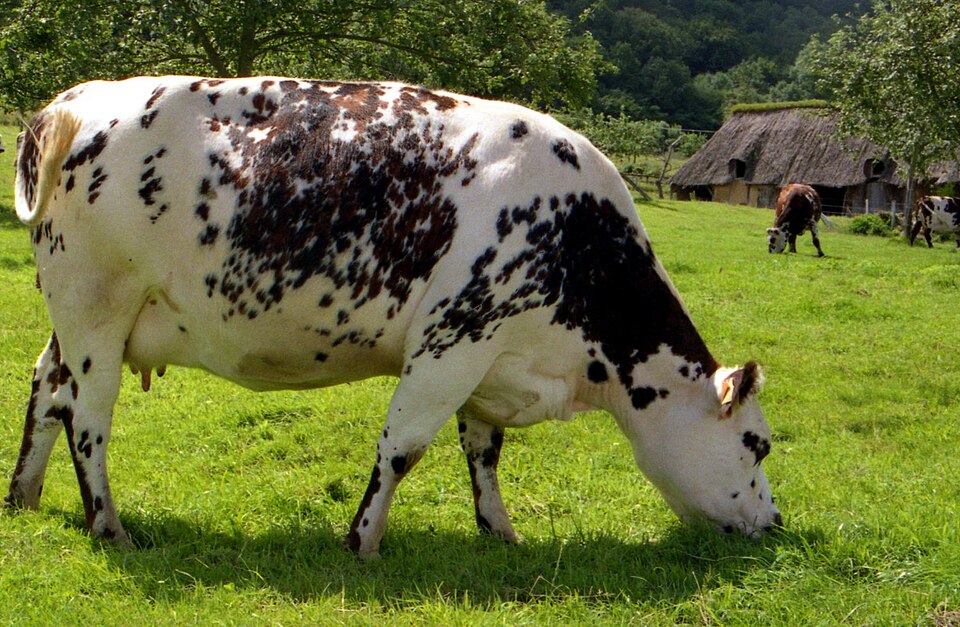
Reference photograph
Reference photograph of Normande. Examine this individual’s color and form alongside the identification descriptions in the text.
Source: ²°¹°° · Original material · Public domain
1. Classification, origins and habitat
The Normande is a dual-purpose cattle breed developed in Normandy, France. Improvement has considered both dairy and meat production.
As dual-purpose livestock connected to Normandy’s dairy culture, it illustrates improvement for milk and meat together. Regional cheese names and cattle breed registration are separate information; not every cow photographed in Normandy is a Normande.
2. Appearance and identification
Red or brown markings on white and frequently dark patches around the eyes are typical.
Observe dark, spectacle-like eye markings together with brown and red markings on white. Patches are irregular and individual, so markings around the eyes do not look identical in every photograph. Consider body and leg proportions as well.
Spectacle-like eye patches help recall the name, but not every individual has symmetrical circular markings. White, brown and red areas vary in extent, and a face photograph alone cannot establish registration or use.
3. Behavior and way of life
The breed relates to both milk used in cheesemaking and beef production. Do not use historical milk-yield or population figures as fixed present-day values.
It is a breed in which milk composition and beef traits are considered together. Cheesemaking use does not mean every animal is raised under identical farming practices. Lactation stage and feeding conditions help comparisons of yield and composition.
4. Observation, conservation and care
For appearance comparisons, observe eye markings and body patch arrangements. When explaining productivity, check feed conditions and when records were made as well.
Manage animals according to dual-purpose build and actual production stage. White and brown photographic areas provide identification clues, but do not replace evidence for assessing body condition and gait. Descriptions of regional identity and tradition should connect to management prioritizing present access to rest, water and feed.
Evidence and references
- Oklahoma State University — Normande
Classification, origins, appearance, ecology or uses of the breed
- Defra — Cattle welfare guidance on behavior, feeding and environment
General principles of feed, water, rest and handling. A United Kingdom source, not guidance on Korean legislation.