
Mammals (Cattle)
Holstein
Holstein Friesian
Classification and scientific name: Bos taurus
Sources checked:
Large black-and-white patches are typical, but red-and-white Holsteins also occur
The Holstein is a prominent dairy breed developed from cattle in the Netherlands and northern Germany. Large black-and-white patches are typical, but red-and-white Holsteins also occur.
Origins and distribution
Dairy regions of the Netherlands and northern Germany
- Holstein Friesian
- Dairy regions of the Netherlands and northern Germany
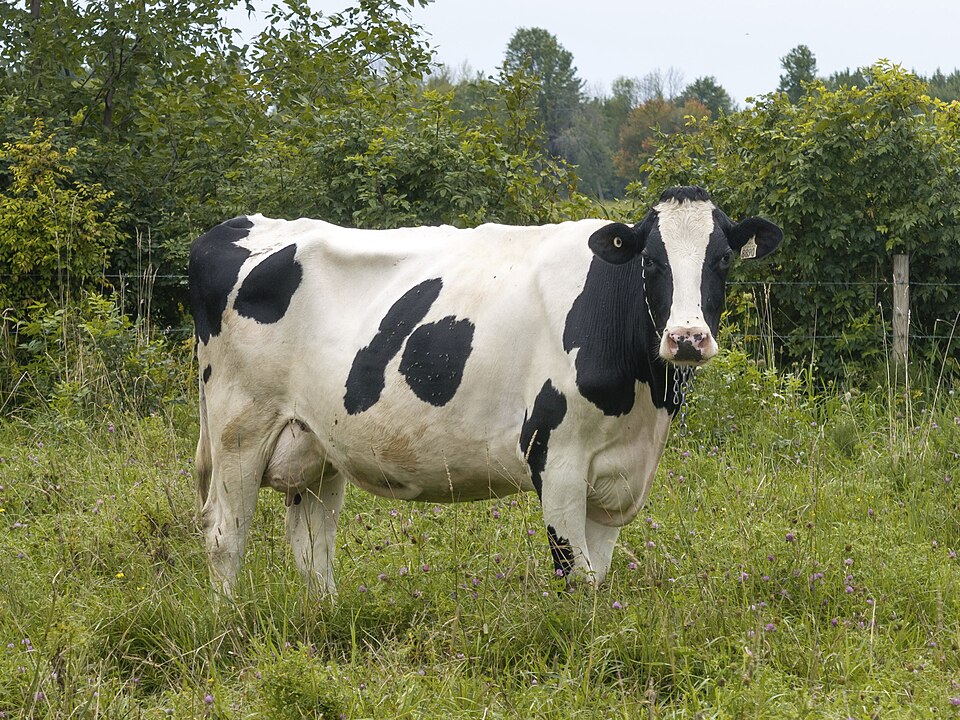
Reference photograph
Reference photograph of Holstein. Examine this individual’s color and form alongside the identification descriptions in the text.
Source: Hayden Soloviev · Original material · CC BY 4.0
1. Classification, origins and habitat
The Holstein is a prominent dairy breed developed from cattle in the Netherlands and northern Germany. Registration and improvement centered on milk production in many countries spread it widely through dairying. It is a breed within domestic cattle, not an exact synonym for the use category dairy cow. Other dairy breeds include Jersey and Guernsey.
Its spread involved exchanges of pedigrees and production records as well as movements of cattle. Do not apply a particular country’s historical milk-yield record as the current average for every Holstein.
2. Appearance and identification
Large black-and-white patches are typical, but red-and-white Holsteins also occur. The positions of markings differ by individual, allowing comparisons of facial and flank patterns. Adult cows have a dairy-type build different from the proportions of bulls and calves. Black-and-white patches alone cannot determine whether an animal is crossbred with another breed.
Photographs of cows showing their udders give a different impression from bull photographs, even within one breed. Checking facial patches and white areas on the legs can also make individual differences in markings interesting to observe.
3. Behavior and way of life
The breed has been selected primarily for milk production. High milk-producing ability in a breed description does not mean that every individual produces the same amount. Records vary with lactation status, stage after calving and feeding conditions. Rest and rumination are parts of life, so do not label a stationary pose in a photograph as a lazy personality.
Milking is only part of daily life. Also observing drinking, selecting feed and lying comfortably to ruminate helps readers understand an animal with behavioral needs rather than a production machine.
4. Observation, conservation and care
Observe body condition, gait, feed intake and rest alongside milk yield. A lactating cow’s water and nutritional requirements differ from a growing calf’s or a non-lactating animal’s, so do not apply a uniform feeding quantity. Keep barn flooring and resting areas clean and provide ventilation and shade to escape heat.
Calves and dams, lactating cows and bulls should not be managed using one feeding chart. Dairy comparisons should consider hoof and udder condition and opportunities for recovery and rest alongside milk quantity and composition.
Evidence and references
- Oklahoma State University — Holstein Friesian
Species-specific information on origins, appearance, uses or ecology
- Defra — Cattle welfare guidance on behavior, feeding and environment
General principles of feed, water, rest and handling. A United Kingdom source, not guidance on Korean legislation.