
Mammals (Horses)
Norwegian Fjord
Fjord Horse
Classification and scientific name: Equus caballus
Sources checked:
Dun coat colors and a dark stripe along the back are characteristic
The Fjord horse developed in Norway. It has been used for farm work, riding and driving. Dun coat colors and a dark stripe along the back are characteristic. A dark band down the center of the mane stands out when the mane is cut short.
Origins and distribution
Norway
- Norwegian Fjord
- Norway
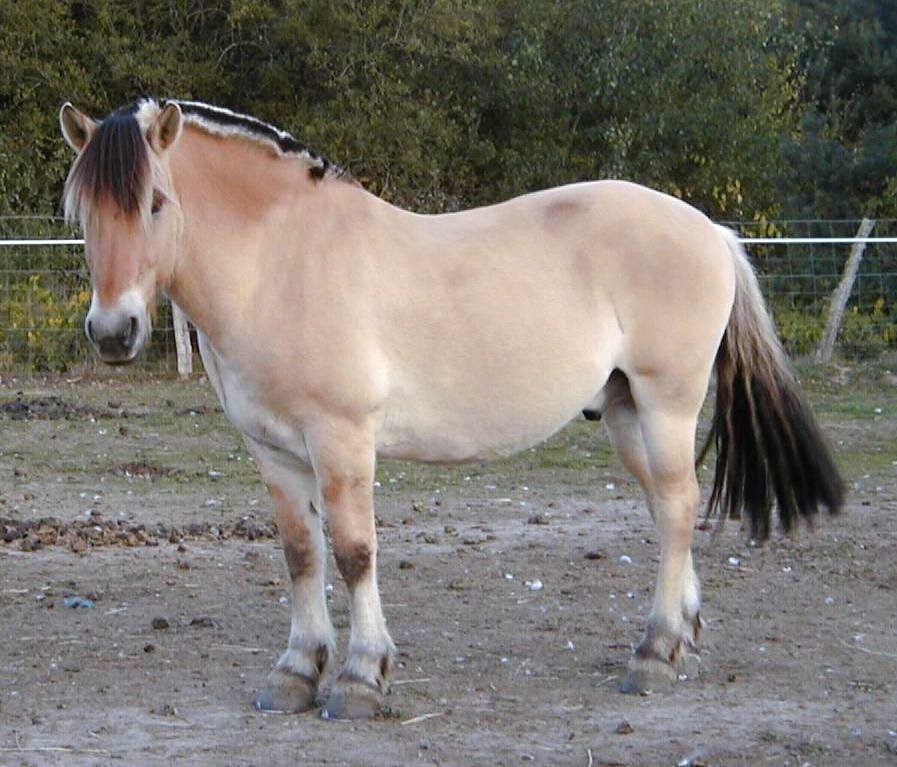
Reference photograph
Reference photograph of a Norwegian Fjord horse. Compare the photographed individual's color and form with the identification information in the text.
Source: Plasma at French Wikipedia · Original material · Public domain
1. Classification, origins and habitat
The Fjord horse developed in Norway. It has been used for farm work, riding and driving.
The breed developed within Norwegian farming, transport and riding traditions. Although it is a domestic animal retaining primitive-looking markings, it is not a wild species separate from other domestic horses. Considering its history alongside modern tourism and riding scenes helps retain the context of its earlier work pulling loads.
2. Appearance and identification
Dun coat colors and a dark stripe along the back are characteristic. A dark band down the center of the mane stands out when the mane is cut short.
The dorsal stripe, dark central mane band and division between light and dark mane hairs are characteristic. The short, upright mane is cut and maintained by people. There are several dun colors, so avoid describing every Fjord as having exactly the same beige coat.
A mane cut short to display its dark central band is a managed appearance. The same band may be less visible in photographs of a naturally long mane, so distinguish grooming from inherited color patterns.
3. Behavior and way of life
The Fjord is a versatile horse used for pulling and riding. Its clipped mane reflects human management and must be distinguished from the natural mane length.
This solidly built horse is used in farming, driving and riding. A pony-like size and a calm-looking photograph do not guarantee the safety of every individual. Linking dorsal or leg markings to wildness or stubbornness is not a scientific explanation.
4. Observation, conservation and care
Primitive-looking markings do not make it a wild horse. When comparing breeds, consider coat color, the dorsal stripe and pedigree records together.
Distinctive mane grooming and basic horse care are different matters. Check body condition, hooves and saddle fit first, and match feed and movement to current activity. When comparing photographs, remember that both naturally long manes and manes clipped for exhibition may appear.
Evidence and references
- Oklahoma State University — Norwegian Fjord
Classification, origins, appearance, ecology or breed uses
- Defra — Welfare code for horses and ponies
Suitable surroundings, feed, companionship, training and long-term care responsibilities