
Mammals (Horses)
Jeju horse
Jeju Horse
Classification and scientific name: Equus caballus
Sources checked:
Compared with large racehorses, the body is smaller and compact and the legs look relatively short
Jeju horses are native equine genetic resources long used for agriculture and transport on Jeju. Compared with large racehorses, the body is smaller and compact and the legs look relatively short.
Origins and distribution
Jeju, Republic of Korea
- Jeju horse
- Jeju, Republic of Korea
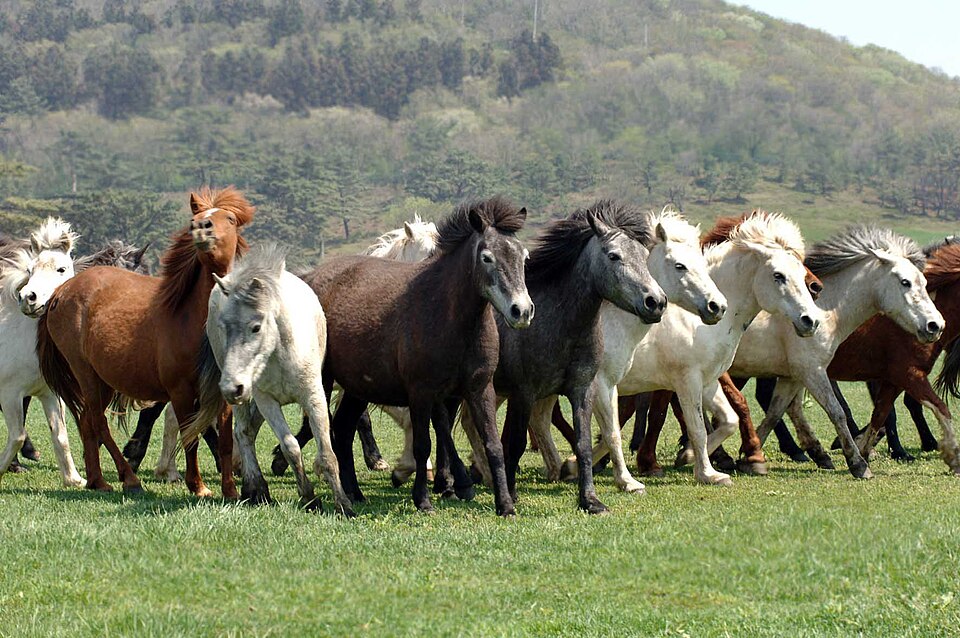
Reference photograph
Reference photograph of Jeju horse. Examine this individual’s color and form alongside the identification descriptions in the text.
Source: 제주마육성팀 · Original material · CC BY-SA 4.0
1. Classification, origins and habitat
Jeju horses are native equine genetic resources long used for agriculture and transport on Jeju. Related to the island’s livestock history, their pedigrees are managed for conservation and improvement. Birth on Jeju alone does not establish a native Jeju horse. Crosses with other breeds and ordinary riding horses are distinguished through separate pedigree information.
Management records should clarify the boundaries of conservation populations and horses used for racing or riding. Distinguishing Jeju as a place name, small build and native ancestry makes introductory descriptions clearer.
2. Appearance and identification
Compared with large racehorses, the body is smaller and compact and the legs look relatively short. Colors include bay, chestnut, black and gray, so Jeju horses should not be defined by one color. Rather than thinking of calves or foals simply because of small size, observe adult head, body and leg proportions together.
Small adults and young animals of large horse breeds differ in head and body proportions. Knowing the photographed horse’s growth stage reduces misunderstanding about size.
3. Behavior and way of life
Purposes such as historical labor and transport and current racing and riding vary with period and managed population. A history of difficult environments does not mean restricting water and food is compatible with health. A breed name does not guarantee safe riding for children; check actual training and individual reactions.
Use in tourist riding is not the purpose of every Jeju horse. It is more accurate to distinguish agricultural, cultural and conservation history from the training learned by the current individual.
4. Observation, conservation and care
Conserving Jeju horses means recording pedigrees and genetic diversity, not merely preserving a small, cute appearance. In husbandry, provide feed, hoof care and resting space suited to adult size. At tourist sites, follow staff guidance and avoid sudden approaches from behind or unauthorized feeding.
Even a small horse has strength as an adult to push people or move suddenly when startled. Size alone does not justify unsupervised contact with children; follow on-site management.
Evidence and references
- National Institute of Animal Science — Jeju horse
Species-specific information on origins, appearance, uses or ecology
- Defra — Welfare guidance for horses and ponies
Suitable environment, food, companions, training and responsibility for long-term care