
Other Mammals
Dromedary camel
Camel
Classification and scientific name: Camelus dromedarius
Sources checked:
A dromedary storing fat in one hump
Camels include one-humped dromedaries and two-humped Bactrian lineages.
Origins and distribution
Livestock-raising regions of North Africa and Southwest Asia
- Dromedary
- Fat storage
- Livestock
- Drylands
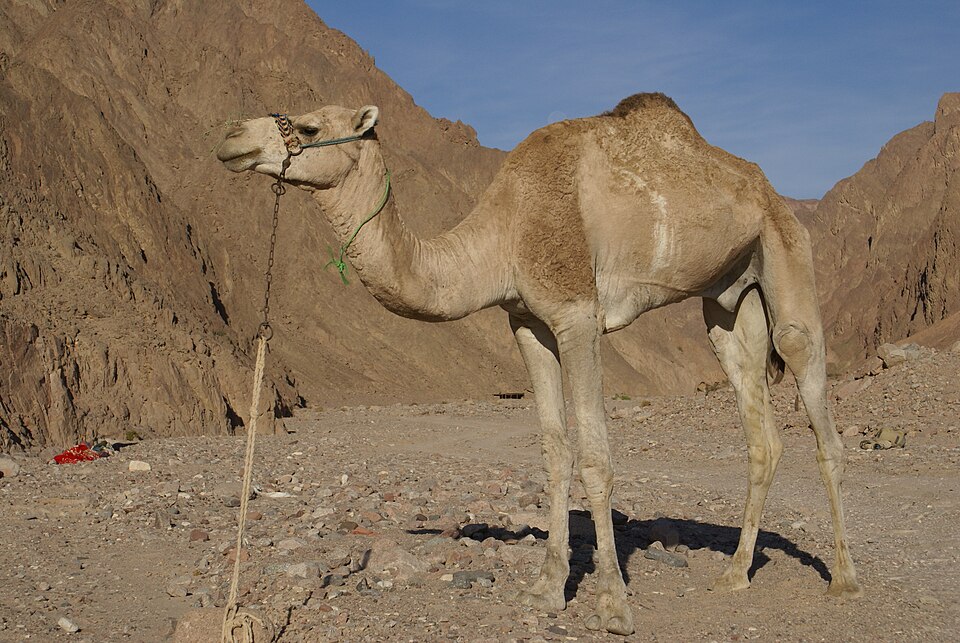
Reference photograph
Reference photograph of a dromedary camel. Compare the photographed individual's color and form with the identification information in the text.
Source: Florian Prischl · Original material · CC BY-SA 3.0
1. Classification, origins and habitat
Camels include one-humped dromedaries and two-humped Bactrian lineages. This entry centers on Camelus dromedarius, distinguishing it from Central Asian Bactrian and wild camels. Dromedaries have long been connected with domestic life in North Africa, Southwest Asia and other regions. Most individuals today belong to domestic lines; feral populations in some regions differ from original wild-species distributions. Desert photographs are representative, but life also requires food plants, water supplies and movement routes. The animal does not live on bare sand without resources.
2. Appearance and identification
The single hump is fat-storing tissue, not a water tank. Its condition can change, but photographs alone cannot establish health. Long legs, broad spreading foot pads, conspicuous long eyelashes and closable nostrils are features observable in dry environments. Lips select plants, while coat length and body color vary with region, lineage and season. Substituting a Bactrian image into a dromedary account would mismatch even hump number. Where desert equipment or loads conceal the body, also examine scenes showing humps and feet.
3. Behavior and way of life
Dromedaries use various plant resources, including grasses and shrub leaves, and domestic group movements also involve human management. Adaptations reducing water loss and allowing body-temperature changes do not mean no water is needed. Drinking amounts and frequency vary with condition and surroundings and cannot be fixed to one number. Sitting and rising reveal the sequence of folding legs and balancing the body. Spitting and vocalizing need interpretation alongside circumstances and relationships. A photograph of a camel carrying people does not show that every camel is suitable for the same work.
4. Observation, conservation and care
Dryland livestock management still requires adequate water, feed, rest and health checks. Working use needs assessment of loads, saddles, distance and heat effects together. Tourist encounters offer opportunities to assess how operators manage condition and rest. Feral populations may affect regional ecosystems and water use and should not share the same description as protected native wild camels. Match hump count with species names, and explain the separate functions of fat storage and water conservation rather than the misconception of water storage to clarify actual adaptations.
Evidence and references
- Animal Diversity Web — Camelus dromedarius
Classification, distribution, appearance, diet and reproductive behavior
- San Diego Zoo — Camel
Camel humps, feet, dryland adaptations and diet