
Other Mammals
Common Raccoon Dog
Common Raccoon Dog
Classification and scientific name: Nyctereutes procyonoides
Sources checked:
An omnivorous canid with dark markings around the eyes
The common raccoon dog is a member of the dog family, distinct from the raccoon. Explore its facial markings, body shape, varied foods and shelters, and principles for observing it near people.
Origins and distribution
East Asia, including the Korean Peninsula, China and eastern Russia. Introduced European populations are distinguished separately.
- Dog family
- Dark facial markings
- Omnivore
- Shelter in vegetation
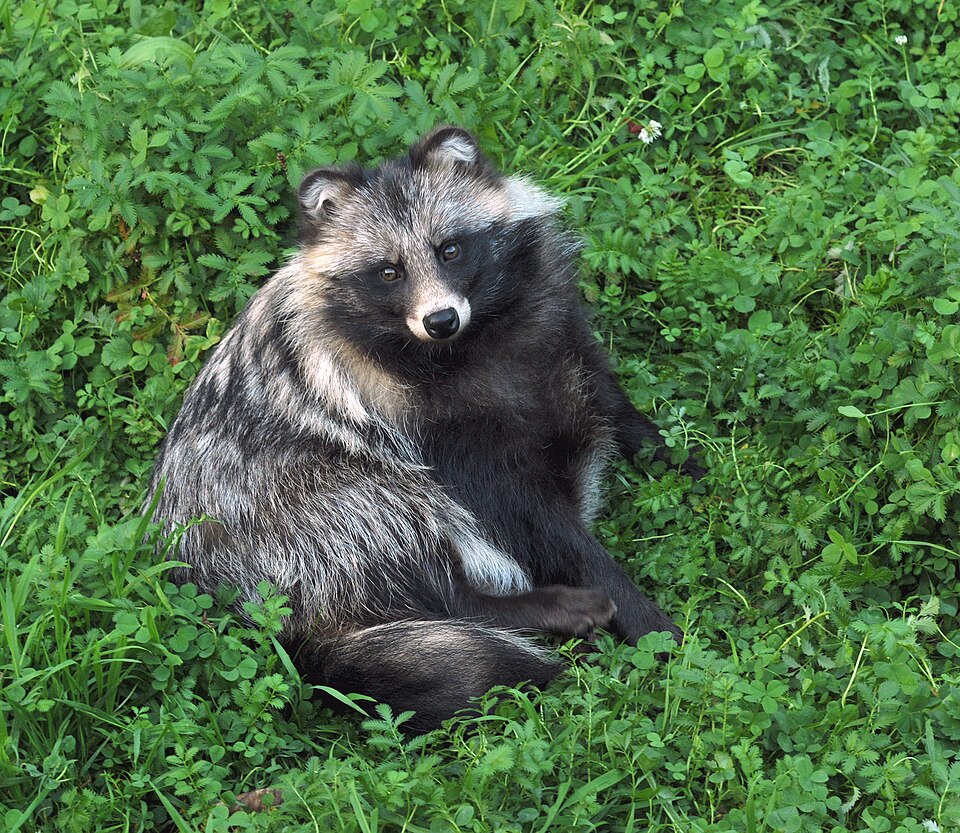
Reference photograph
A captive raccoon dog photographed at a facility in Springe, Germany. Reduced in size while preserving the original proportions.
Source: Michael Gäbler — Marderhund (Nyctereutes procyonoides).jpg · Original material · CC BY 3.0
1. Classification, origins and habitat
The common raccoon dog has the scientific name Nyctereutes procyonoides and belongs to the dog family, alongside dogs and foxes. Despite similar dark markings around the eyes, it belongs to a different lineage from the American animal called the raccoon. This profile covers the continental raccoon dog native to the Korean Peninsula, China and eastern Russia, among other areas. The American Society of Mammalogists recognizes the Japanese raccoon dog as a separate species, Nyctereutes viverrinus, so descriptions of Japan's tanuki are not all transferred to this species. It uses sheltering places such as forest edges and dense waterside vegetation and is also observed close to human living spaces.
2. Appearance and identification
Dark markings extending from the eyes to the cheeks, short rounded ears, low legs and a stocky body are noticeable features. The body ranges from grayish brown to dark brown, and the fullness of the coat varies with season and individual condition. Distinguish it from the conspicuous series of rings on a raccoon's tail. A badger's dark facial stripes run lengthwise from the muzzle past the eyes toward the back of the head, unlike the eye-and-cheek markings of a raccoon dog. In dark footage, however, markings can become indistinct; also examine the ears, tail and proportions of the entire body. Do not identify a young animal solely by its facial markings.
3. Behavior and way of life
Raccoon dogs are omnivores that use varied foods, including small animals, insects, fruit and carrion. Their diet changes with what is available locally, and accepting food from people must not be interpreted as normal care. They may use burrows dug by badgers as shelter, and communal latrine sites where family members repeatedly leave droppings are sometimes observed. They can greatly reduce activity during winter in cold regions, but this does not mean that animals everywhere sleep in the same way throughout the winter. A discovered burrow or latrine is evidence of an animal's life, not a visitor attraction that requires entering or approaching closely.
4. Observation, conservation and care
If you meet a raccoon dog while walking, do not approach or block its way; leave space for it to retreat. Do not feed or touch it, and keep pets under control so they do not chase it. Remaining still nearby does not establish that it is tame or safe to touch. Removing food and rubbish is also important to avoid encouraging it to seek food from people. Do not touch droppings or burrows directly; if documentation is needed, take photographs from a distance. If an animal appears injured or is trapped inside a facility, report the location and situation to the local wildlife authority rather than trying to capture it or keep it yourself.
Evidence and references
- National Institute of Biological Resources — Mammal Field Survey Guide: Raccoon Dog
Canid classification; identification of face, ears and tail; food, burrows, communal latrines and winter activity.
- American Society of Mammalogists — Mammal Diversity Database: Raccoon Dog
Species limits and native distribution of Nyctereutes procyonoides, including separation of the Japanese raccoon dog. Distinguished from the broader species concept used in older references.
- U.S. National Park Service — Wildlife Watching Guidelines
Keeping a distance, avoiding feeding, touching and luring, and observing from trails. U.S. park regulations and numerical guidance are not applied directly to Korea.