
Mammals (Pigs)
British Saddleback
British Saddleback
Classification and scientific name: Sus scrofa domesticus
Sources checked:
A white belt crosses the shoulders and forelegs of the black body, and the ears droop
The British Saddleback developed through combining Britain's Essex and Wessex Saddleback lines. A white belt crosses the shoulders and forelegs of the black body, and the ears droop.
Origins and distribution
Britain
- British Saddleback
- Britain
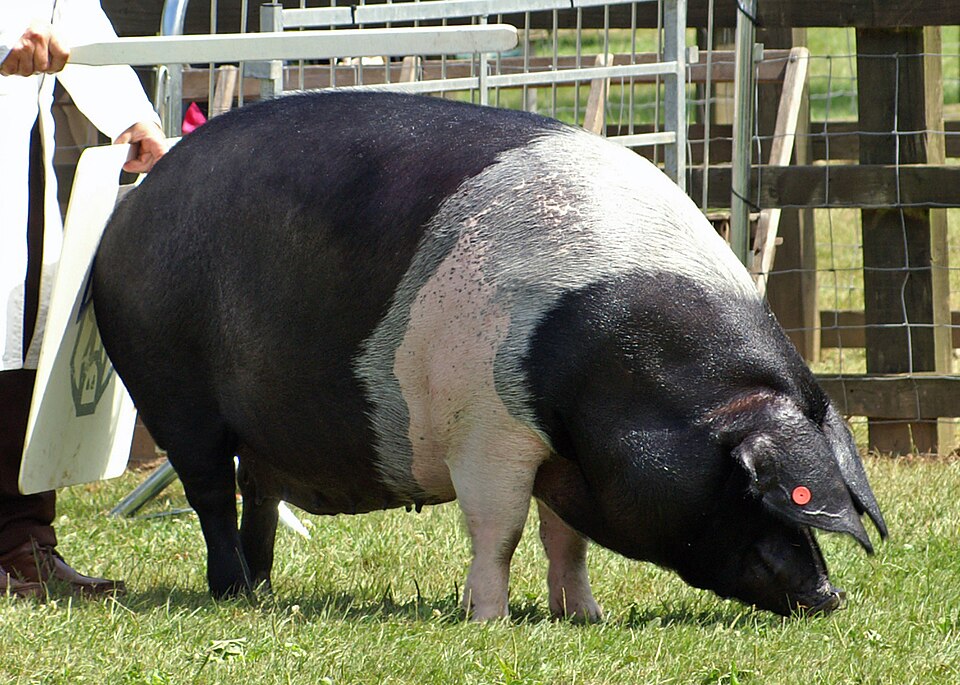
Reference photograph
Reference photograph of a British Saddleback pig. Compare the photographed individual's color and form with the identification information in the text.
Source: David Merrett from Daventry, England · Original material · CC BY 2.0
1. Classification, origins and habitat
The British Saddleback developed through combining Britain's Essex and Wessex Saddleback lines.
Its history concerns a modern registered population formed by combining Essex and Wessex Saddlebacks. Similarly patterned pigs in several countries do not all belong to the same registered breed. Distinguish saddleback as a general appearance description from the specific British Saddleback population.
2. Appearance and identification
A white belt crosses the shoulders and forelegs of the black body, and the ears droop.
Considering the white belt across the shoulders and forelegs alongside drooping ears allows comparison with the upright-eared Hampshire. Belt width varies individually, and photographic angle and body rotation change its appearance. A belt alone cannot establish pedigree or production methods.
Although the belt's position over the shoulders and forelegs resembles the Hampshire, drooping ears provide a comparison clue. Belt width and angle vary with individual and posture, so pattern alone cannot establish ancestry.
3. Behavior and way of life
The breed was used in traditional pig farming and pasture-based systems. Ear shape and pedigree can be compared with the similarly white-belted Hampshire.
This domestic pig was used in traditional outdoor husbandry. A pasture photograph differs from the actual feeding and management system, so a grassy background does not establish unmanaged husbandry. Color contrast is not a basis for predicting individual temperament or responses to people.
4. Observation, conservation and care
The name saddleback does not make every region's white-belted pigs the same breed. Check the registration organization and breed name in the source.
Provide fencing, shade, water and dry resting areas outdoors. Inspect both black areas and white skin, and check whether less competitive individuals are pushed away at feeders. A traditional breed name does not replace responsible modern welfare management.
Evidence and references
- Oklahoma State University — British Saddleback
Classification, origins, appearance, ecology or breed uses
- Defra — Pig behavior and environmental welfare guidance
Domestic pigs' exploratory behavior, feed, shade and resting space. This is UK material, not guidance on Korean legislation.